

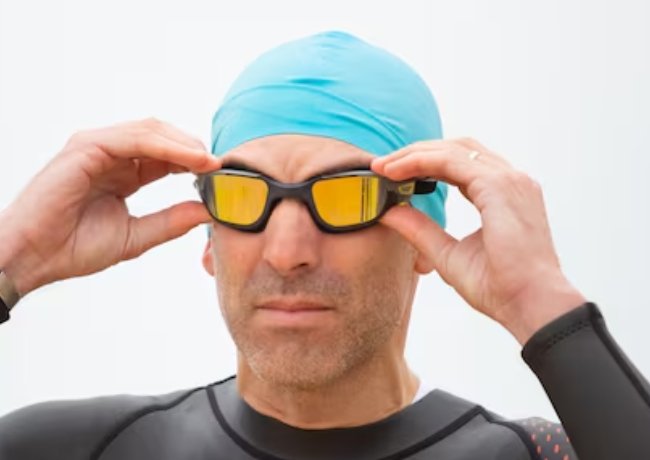
When you walk onto any pool deck on a Tuesday morning, you’ll witness the same scene repeatedly: swimmers pulling at silicone caps and twisting them in different directions in an attempt to create a seal that doesn’t pinch. From the outside, it appears almost comical, like witnessing someone wrestle a balloon onto their own head. But they continue to do it season after season, lap after lap, for a reason. Despite its unglamorous appearance, the swim cap serves more purposes than most people are aware.
It’s important to make some clarifications first. It was never intended for a swim cap to keep your hair completely dry. That’s arguably the most prevalent misconception that people have when they first arrive, and it leaves them disappointed when they towel off and discover wet strands underneath. In reality, the cap lowers drag, shields hair from chlorine, and keeps heat in colder water. If dryness occurs at all, it is a byproduct of a good seal rather than the purpose of the cap.
| Category | Details |
|---|---|
| Topic | Swim cap types and their functional benefits |
| Primary materials | Silicone, latex, Lycra/polyester, neoprene |
| Best for hair protection | Silicone caps |
| Best for cold water | Neoprene/thermal caps |
| Best for comfort | Lycra or polyester caps |
| Best for long hair | Bubble caps or extended-capacity silicone caps |
| Key safety benefit | Reduced risk of otitis externa (swimmer’s ear) |
When you watch swimmers shop for silicone, you can see why it has become almost the default option. The material, which is smooth and wrinkle-free and practically designed for speed, adheres firmly to the scalp. Because a molded silicone cap acts like a second skin in the water and reduces resistance in ways that add up over a 1500-meter race, competitive swimmers prefer it. On its own, it’s not dramatic, but if you remove enough strokes by fractions of a second, the difference becomes noticeable.
The open-water crowd, on the other hand, is a completely different type of swimmer. Neoprene caps have come out of niche obscurity and into the mainstream thanks to the growth of triathlon over the past ten years. Neoprene functions in an almost paradoxical way by allowing a thin layer of water to enter and then trapping it against the scalp, where it is warmed by body heat. Simplified to the size of a head, this is the same principle that scuba divers have been using for decades. In October, useful in a cold lake. Mostly useless in an indoor heated pool, where it merely retains heat that no one requested.
Swimmers who prioritize comfort are more likely to choose Lycra or polyester caps because they don’t pull at the hairline as silicone occasionally does. Because these caps are porous, hair seeps through almost instantly. It’s a trade-off between comfort and drag reduction, and it probably makes sense for someone who does easy laps three times a week instead of aiming for a personal best.
Bubble caps, which are vintage-looking items made of latex rubber and appear to be experiencing a quiet renaissance, occupy an odd corner of the market. They fit long hair well because they are roomier, and the trapped air inside provides an unanticipated layer of warmth. For precisely that reason, open-water swimmers appear to enjoy them. Additionally, the way they cover the ears muffles pool noise in a way that swimmers who train for extended periods of time sometimes describe as strangely calming, which is almost charming.
Correctly putting one on is a small skill in and of itself, particularly when dealing with long hair. If you pull too slowly, it will never sit perfectly; if you pull too quickly, it will bunch awkwardly at the crown. A stress point that allows water to seep in at the seal is frequently created by swimmers who tie their hair up in buns. It’s a small detail, but it’s the kind of thing that distinguishes someone who has been swimming competitively for years from someone who is attempting a cap for the first time.
It seems like a mistake that the speed argument is given more weight than the protective case for swim caps. A cap, especially one made of silicone or latex, functions as a sort of barrier because chlorine is actually harsh on hair over time, making it brittle and dull with repeated exposure. And there’s the ear problem. People who spend hours in chlorinated water are more likely to develop swimmer’s ear, or otitis externa, and ear canal caps significantly, if imperfectly, reduce this exposure.
Additionally, visibility is more important than most people realize. Sometimes the only thing keeping a swimmer visible to a boat or a lifeguard scanning the surface in open water is a brightly colored cap. It’s not glamorous, but it’s the kind of practical detail that becomes crucial just once, usually at the worst possible time.
This does not imply that all swimmers require the same cap. A parent swimming laps for fun on a Sunday afternoon is not the same as a masters swimmer preparing for a meet. The same silent reasoning applies to all of it: minimize drag, shield the hair, control temperature, and maintain visibility. Simple objectives, strangely specific equipment. It’s difficult to ignore the amount of engineering that goes into something that most swimmers wear mindlessly.
i) https://www.swimexpert.co.uk/about-us/news/swim-cap-savvy-different-types-and-their-benefits/
ii) https://www.independent.co.uk/extras/indybest/outdoor-activity/swimming/best-swimming-caps-a8143536.html
iii) https://www.traindaly.com/train-daly/blog/why-do-swimmers-wear-swim-caps
iv) https://pmc.ncbi.nlm.nih.gov/articles/PMC3737839/
v) https://www.simplyswim.com/pages/choosing-swimming-caps