

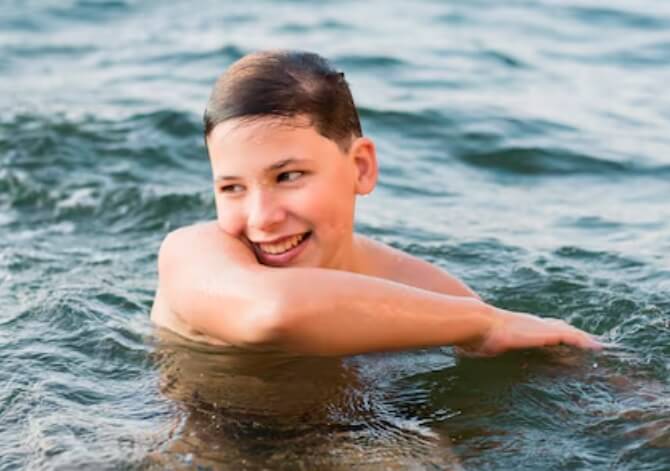
About four seconds after stepping into cold water for the first time, a beginner has a certain expression on their face that ranges from disbelief to betrayal, as if the water had personally wronged them. Anyone who has been near a lake or beach in October is aware of this. For a brief moment, it appears as though the entire plan was a mistake as the breath becomes labored and the shoulders lock up close to the ears. Usually, it isn’t. The question that comes up almost immediately is the right one: how long should I stay in?
The most honest thing that can be said about it is that there isn’t a single number that works for everyone. The temperature of water varies greatly depending on the season and location; inland lakes in the UK can be close to freezing in January and reach the mid-20s by August, while the sea remains colder, remaining in the low double digits even during the summer. Even though both might describe it, breathlessly, as “cold water swimming“, a beginner entering a 12-degree lake and someone wading into an 18-degree cove have quite different experiences.
| Category | Detail |
|---|---|
| Topic | Cold water swimming for beginners |
| Recommended starting time | 30 seconds to 2 minutes for first-time swimmers in cold conditions |
| General safety guideline | Roughly one minute per degree Celsius of water temperature, used as a rough ceiling, not a target |
| Main risk in first 90 seconds | Cold water shock, involving gasping, rapid breathing, and blood pressure spikes |
| Secondary risk with prolonged exposure | Swim failure from restricted blood flow to limbs |
| Long-exposure risk | Hypothermia, affected by water temperature, body composition, and experience |
| Post-swim concern | Afterdrop, the continued cooling that happens once a swimmer exits the water |
| Recommended frequency for adaptation | Weekly swims, maintained consistently through autumn into winter |
As a general guideline, the majority of coaches and experienced open water swimmers seem to concur that it takes about one minute for every degree Celsius. Ten minutes, give or take, in ten degrees of water. It’s more of a ceiling to be respected than a goal to pursue. Many skilled swimmers stop well short of it. The actual time for someone who is unfamiliar with this is more like thirty seconds or a minute, possibly two if the body adjusts more quickly than anticipated. There’s something almost paradoxical about being shorter than most people think much shorter than the nearby wetsuited triathletes might imply is typical.
The majority of the risky work is done in the first ninety seconds, and it’s important to know why. Almost immediately, cold water shock causes a sharp gasp, rapid breathing before the brain can process the situation, and a mostly involuntary increase in blood pressure. It has nothing to do with fitness level and is the body’s oldest trick, intended more for survival than for comfort.
When they first come into contact, a person who hasn’t worked out in ten years and a marathon runner will both gasp. This is also where the majority of cold water deaths happen not from hypothermia, which takes time, but from that first underwater gasp. More important than almost anything a beginner can do is to gradually ease in and keep the face above the water until breathing stabilizes.
A more subdued danger then emerges, one that sneaks up on you instead of making an announcement. Blood moves defensively from the limbs toward the body’s core, protecting important organs but rendering the arms and legs more and more useless. Swimmers sometimes describe it as a sort of heaviness, where strokes that were once effortless now require effort, and a distance that was simple yesterday turns into a minor struggle today. This is the time to leave, not to persevere. There is a temptation to treat that heaviness as something to overcome, especially for those who exercise frequently and equate discomfort with advancement. That instinct is not rewarded by cold water.
Although it deserves respect, hypothermia is further down the timeline and is not as serious of an issue for a two-minute beginner dip as people frequently believe. Body size, fat distribution, mental preparedness, and the length of time a person has actually been swimming regularly are all important factors. The symptoms, which include shivering, slurred coordination, and a slowing stroke rate, are obvious once they manifest.
Afterdrop, the unwanted sequel that shows up after they’ve already climbed out, towel in hand, feeling victorious, is what usually surprises newcomers the most. After emerging from the water, the core temperature actually decreases more than it did during the swim, and cool blood that had accumulated in the extremities begins to circulate once more.
For this reason, experienced swimmers don’t stand around talking about how it went; instead, they dress the top half first, put on a hat right away, and grab a warm drink. Seeing people discover this the hard way makes it seem like the swim itself receives all the attention while the ten minutes that follow receive virtually none, even though they are equally important.
For cold tolerance, consistency appears to be more effective than a single daring plunge. Weekly swimmers report that the shock gradually lessens it doesn’t completely go away, but it becomes something the body recognizes rather than freaks out over. People who expect tolerance to be permanent once earned are frustrated by the fact that skipping a few weeks can make the next swim feel like a fresh start. Not quite, it isn’t.
This is not intended to dissuade anyone. The rush that follows, the peculiar clarity that people talk about, and the way a two-minute dip can impact someone’s entire day are all genuinely appealing. Simply put, the appeal works better when the time spent in the water corresponds with what the body is truly prepared for rather than what the mind, engrossed in the moment, decides it wants to prove.
i) https://www.outdoorswimmingsociety.com/cold-water-feels-temperature-guide/
ii) https://outdoorswimmer.com/featured/swimming-in-cold-water-a-guide-to-temperature/
iii) https://www.diverscove.co.uk/blog/a-beginners-guide-to-acclimatisation-for-winter-swimming
iv) https://www.renutherapy.com/blogs/renu-therapy-blog/how-long-should-you-sit-in-a-cold-plunge-if-you-re-a-beginner