

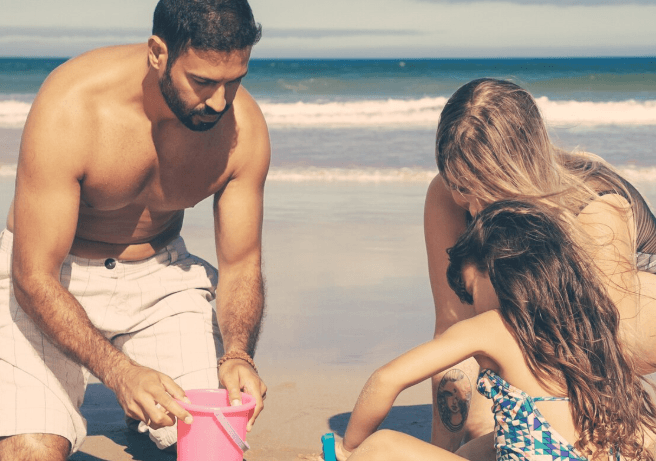
The moment you look up from your towel and realize the child who was standing right there, digging that intricate sandcastle, is just gone is a unique kind of dread that is exclusive to busy beach days. Not far away. Most likely not very far. It’s gone not far can still mean invisible on a crowded August beach. Family beach vacation safety has risen to the top of parent search trends this week due to this particular anxiety, and anyone who has managed young children on a busy summer shoreline won’t be surprised by the numbers.
According to the UK Maritime and Coastguard Agency, there has been an alarming increase in incidents involving missing children at beaches. This pattern started to intensify last summer and doesn’t seem to be abating. The Coastguard, an organization that usually speaks in measured, bureaucratic terms, felt compelled enough to give parents direct guidance.
| Field | Details |
|---|---|
| Organisation | UK Maritime and Coastguard Agency (MCA) |
| Founded | 1998 |
| Headquarters | Southampton, England |
| Role | Government executive agency responsible for maritime safety, search and rescue coordination |
| Jurisdiction | UK coastline and surrounding waters |
| Key Initiative | Beach safety awareness campaigns, including child wristband scheme |
| Parent Department | Department for Transport |
| Official Website | www.gov.uk/government/organisations/maritime-and-coastguard-agency |
The instructions themselves are remarkably straightforward. Purchase a plastic wristband. Put your mobile number on it. Make sure your kids wear it whenever they go to the beach. That’s pretty much it. Speaking to the parenting website Netmums, a spokesperson was straightforward about the cause: the wristband enables Coast Guard officers to get in touch with parents right away when a child is discovered separated from their family, reducing what can be a confusing and terrifying wait to just a few minutes.
“We can easily contact parents and guardians to let them know their children have been found”, the agency said. The advice’s elegance lies in the fact that it works exactly in situations where all other systems fall short, such as when a child is too young to recall a phone number, too upset to speak clearly, or just surrounded by strangers who are unsure of where to begin.
The fact that parents are already aware of the issue is what makes this specific advice so popular. The math is clear to anyone who has seen a three-year-old run toward the water while being asked to find the sunscreen, control a sobbing sibling, and remember who owns which towel. In summer, a crowded beach is a truly chaotic place. Paradoxically, children wearing brightly colored swimwear are more difficult to identify in a crowd of other kids wearing the same color. Nothing actually prevents separation, but the wristband lessens the ensuing crisis.
The timing of this advice’s significant impact on search trends also speaks to a larger trend in British families’ summertime travel arrangements this year. According to AttractionTickets.com’s analysis of UK Google search trends from 2019 to 2025, safety concerns produced one of the biggest search spikes of any travel-related topic during that time. Additionally, it goes beyond beach safety.
The number of searches pertaining to medical coverage overseas, travel insurance, and what activities are truly covered by standard policies has steadily increased every year. Parents seem to be approaching the holiday planning stage with a kind of forensic attention to the fine print that wasn’t quite as common before, especially those managing post-pandemic travel with small children. The search results seem to support the feeling of genuine anxiety.
According to the same study, packing anxiety is one of the main pre-holiday stressors, and holiday packing lists are associated with some of the dataset’s biggest spikes. Travel expert Chris Bradshaw, who was mentioned in the study, advised beginning with things like prescription glasses, travel documents, and medications that are actually expensive or difficult to replace overseas. In Majorca, you can purchase an additional bottle of shampoo. A child’s asthma inhaler or the appropriate electrical adaptor are difficult to replace. It’s sensible advice that seems obvious until you realize you left the inhaler on the bathroom shelf while you’re standing in airport security.
Parents’ reactions to the Coast Guard’s wristband tip back on the beach have been instructive. It was described by one parent as “a fantastic thing to offer especially when beaches are packed”. Another simply stated that it should be adhered to by all parents. A third mentioned the practice of writing a child’s phone number directly on their arm, which is a solution that many parents have come up with on their own, but they stated that they would be moving to the wristband. It’s a minor improvement with a significant practical difference: plastic doesn’t wash off in the sea, whereas ink does.
It’s difficult to ignore how much of today’s holiday anxiety stems from the conflict between the need for kids to have truly joyful, free, and physical experiences like building things in the sand, running into waves, and the overall beautiful chaos of it and the difficulty of perfectly supervising that freedom. The beach isn’t a controlled setting. It was never intended to be. The Coastguard’s advice does not ignore that reality; rather, it honestly recognizes it. It’s physics, not carelessness, to lose sight of a child on a crowded beach. The wristband is merely a backup plan in case physics prevails.
Family beach vacation safety will most likely continue to be at the top of parents’ priorities as summer searches are already more intense than in previous years and the school holiday season is still coming up. At the very least, the Coast Guard tip provides a unique solution that is both genuinely effective and reasonably priced.
i) https://rollercoaster.ie/family/coastguard-keep-kids-safe-beach/
ii) https://www.attractiontickets.com/en/latest-news/orlando/holiday-questions-brits-search-every-summer-according-five-years-travel-data
iii) https://www.rlss.org.uk/water-safety-at-the-beach
iv) https://www.parentfriendlystays.co.uk/tag/beach-nearby/
v) https://www.mumsnet.com/talk/holidays/5094971-sandy-beach-holiday-with-kids-where