

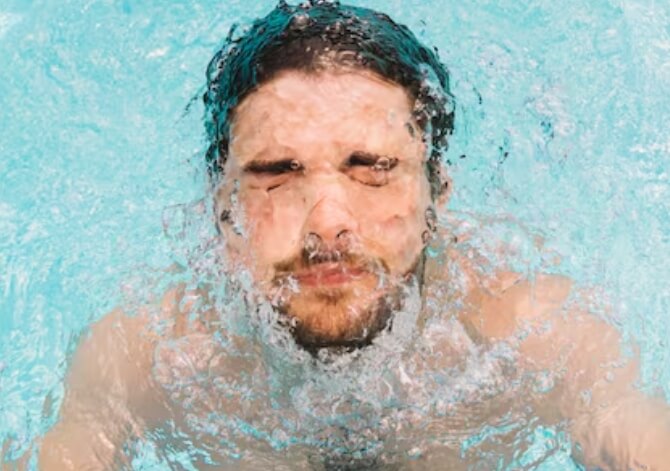
Vivien Solari no longer gives it a second thought. She spends most mornings sometimes twice a day carving through waves close to the Solent or sharing a loch with seals in Scotland in water that is between eight and ten degrees Celsius. This has given her a kind of steadiness that is difficult to fake after twenty-two years. “To be immersed in something powerful and wild is often a humbling experience”, she says, “but it’s nurturing too”. That kind of talk makes you want to roll your eyes, but then you realize how composed she seems.
Then there are the rest of us, standing in a garden somewhere, gazing at a grey plastic tub that has lost its air and wondering if the elastic in the swimsuit from last summer has made it through the winter. Open water swimming and cold plunging are frequently combined, and on TikTok, they are essentially the same trend. They are not truly interchangeable, and the distinctions are more significant than the wellness influencers usually acknowledge.
| Category | Details |
|---|---|
| Practice Name | Cold water therapy (umbrella term covering open water swimming and cold plunging) |
| Typical Temperature Range | Below 15°C / 59°F for therapeutic effect |
| Common Forms | Cold showers, lake or sea swimming, ice baths, portable plunge tubs |
| Notable Researchers | Dr. Susanna Søberg, University of Copenhagen (metabolism research); Dr. Andrew Huberman, Stanford School of Medicine |
| Historical Origins | Practiced by Romans, Vikings, and ancient Greek physicians including Galen |
| Estimated Market Value | Roughly £8 billion globally for cold plunge products and facilities |
Swimming in open water requires more physical exertion than swimming in a stationary tub. There’s an unpredictable quality to swimming that seems to have an effect on the nervous system that goes beyond the cold itself. You’re swimming, moving, navigating current, and controlling your own breathing. In contrast, plunging is static. You take a seat. Companies like Lumi have built a business on portable bathtubs that promise lake-level benefits without the lake because the cold works while your body remains motionless.
In just one month, Gavin Teague, who started Lumi after experimenting with wheelie bins and whisky barrels in his own garden, sold about a million pounds in preorders. That’s no longer a specialized pastime; it’s an industry that, according to him, is worth about £8 billion globally. Additionally, he is refreshingly direct about how much of the surrounding culture is noise. “I don’t listen to any of the wellness social media people”, he told me, “just the science ones”. Given how crowded this area has become with breathless claims, it’s a helpful filter.
It is important to acknowledge that science is still in its infancy. Brown fat activation and metabolic response have been studied by Dr. Susanna Søberg of Copenhagen, and Andrew Huberman of Stanford has contributed to the widespread belief that exposure to cold increases dopamine and noradrenaline. Both research avenues are truly fascinating. Neither is sufficient to declare cold plunging a proven cure for any particular condition. The majority of publicly available information is based on limited research, self-reported wellbeing, and extensive extrapolation.
Additionally, there is a sex-specific detail that is seldom included in marketing. Women have slightly more brown adipose tissue than men, which alters how the body reacts to cold, according to exercise physiologist Dr. Stacy Sims. Her advice goes against the macho ice-bath aesthetic: women typically don’t require water that is close to freezing; instead, water that is between 14 and 16 degrees is sufficient. The one-size-fits-all framing that most plunge brands rely on is complicated by this detail.
Additionally, not everyone believes that this is consistently good. Acupuncturist Sandra Lanshin Chiu is among the traditional Chinese medicine practitioners who advise caution when it comes to repeated cold exposure, especially for women who are menstruating or those who are managing chronic illness. She takes care to point out that while formal research hasn’t resolved the issue, skepticism has long existed in some parts of Asia and shouldn’t be disregarded simply because it goes against the current trend.
When you try it, the results are usually less dramatic than what the videos portray. Having swum in icy lakes since childhood, a friend’s Norwegian houseguest recently entered a 12-degree tub and climbed out in a matter of seconds, appearing almost bored. In contrast, the men in the group displayed a good deal of theatrical suffering. Beneath that gap lies a true lesson: tolerance is developed rather than innate, and much of the apparent struggle is more about ego than physiology.
Which is better, plunging or swimming? Depending on what a person is truly pursuing, yes. Although there are significant risks associated with cold water shock and unpredictable conditions, open water offers movement, scenery, and a connection to something bigger than a backyard tub. Plunging provides a measurable routine that fits into a typical workweek, control, and repeatability.
Based on the available data, neither is obviously better, and anyone who claims to be certain is probably exaggerating. Strangely, Solari’s advice is applicable to both. She says, “Leave your ego on the shore”. “You need to listen to your body and learn when you need to get out” . At least that part isn’t debatable.
i) https://www.mayoclinichealthsystem.org/hometown-health/speaking-of-health/cold-plunge-after-workouts
ii) https://pmc.ncbi.nlm.nih.gov/articles/PMC11872954/
iii) https://www.careysmanor.com/area-guides/cold-water-therapy-should-you-take-the-plunge/
iv) https://www.boots.com/healthhub/mental-health-support/cold-shower-benefits
v) https://blog.davidlloyd.co.uk/wellness/benefits-of-cold-water-therapy-and-plunge-pools-after-exercise/