

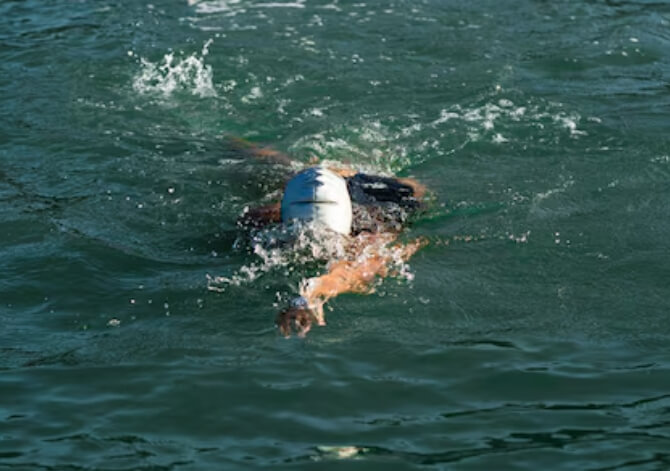
At seven in the morning in February, when the mist has not yet burned off and the only sound is the slap of water against the edge of the men’s pond, a certain silence descends upon Hampstead Heath. A few regulars are already in, breathing in short, deliberate bursts, neck-deep. Perhaps none of them could adequately explain why they act in this way. You’ll learn something about feeling alive, about clarity, and about the cold “resetting” something if you ask them. Seeing grown adults line up to submerge themselves in nearly freezing water before their commute is strange, but they do it every day, rain or shine.
Although it hasn’t happened overnight, city wild swimming has emerged as one of those phenomena. The Serpentine Swimming Club, located in Hyde Park, asserts that it is the oldest swimming club in Britain, and Hampstead’s ponds have been accessible to swimmers for well over a century. The scale of interest has changed. Wetsuits are sold out. Lidos has membership waiting lists that go on for months. People who would never have thought of going for a pond swim in 2018 seem to have found themselves desperate for something free, unstructured, and outdoors after the pandemic, and they never really let go of the habit once gyms reopened.
| Category | Details |
|---|---|
| Practice Name | City Wild Swimming |
| Primary Location | Hampstead Heath Ponds, London |
| Other Notable Spots | Serpentine Lido, Hyde Park |
| Newest Addition | River Thames at Ham and Kingston (proposed bathing site) |
| Governing Standard | Bathing Water Regulations, Environment Agency |
| Recommended Season | April–September, with year-round dippers in colder months |
And it’s no longer just Hampstead. The 750-meter-long marked open-water swim loops at East London’s Royal Victoria Dock now attract a crowd that resembles a triathlon club rather than the fabled bobble-hatted wild swimmers. Canary Wharf is working on plans for its own floating lido.
The River Thames, which was deemed biologically dead seventy years ago, is currently being considered for its first officially designated bathing site, somewhere in the southwest of the city close to Ham and Kingston. This is perhaps the most telling development of all. The water quality debate appears to be gradually shifting in favor of investors in river cleanup infrastructure. It remains to be seen if the Thames will ever feel as welcoming as a lake in the Cotswolds.
Choosing a city pond over a swimming pool seems almost rebellious, especially in a city as relentlessly paved over as London. You begin to realize that it’s not really about exercise when you pass the Heath on a winter’s morning and witness someone lower themselves into water that’s hardly warmer than four degrees. It’s about recovering a small amount of wilderness from a landscape that would otherwise provide you with very little. The fact that you work at a desk doesn’t matter to the ducks. Nor does the cold care. Neither do you for a few minutes.
The swimming community here is remarkably open about the risks involved in all of this. Even for strong, healthy swimmers, cold shock can occur within seconds of entering the water, causing an involuntary gasp reflex that is dangerous. This is not just a general warning; instructors at every London lido constantly remind newcomers who think they’ll just tough it out.
Regulars always give the same advice: swim slowly, regulate your breathing, never swim alone, and honor your body’s signals when it’s had enough. It’s the kind of advice that seems clear until you find yourself standing at the water’s edge on a chilly morning, feeling pressured by your peers to follow the swimmer in front of you.
Beneath all of this enthusiasm, there is still an unresolved tension regarding water quality. While 32 sites still did not meet minimum standards, 87% of England’s designated bathing sites were rated as excellent or good in 2025. There is still a gap between what people want from urban water and what it can currently provide, which puts that statistic awkwardly next to the idealized picture of swimming in cities.
Increasing the number of officially monitored locations, according to campaigners, will put more pressure on the government to genuinely clean up Britain’s waterways rather than merely labeling already-existing issues. Whether that pressure will be sufficient is still up for debate.
The current cultural shift is more difficult to argue against. Telling coworkers that you had swum in a London pond before work might have raised an eyebrow ten years ago. It hardly seems unusual anymore.
A new type of commute is marked by tow floats that bob along the Thames towpath like fluorescent buoys. Once a specialized purchase for coastal surfers, changing robes are now a common sight on the Northern line. London has not turned into a coastal city. It has, rather surprisingly, evolved into a location where people expect to find wild water, and they increasingly do.
i) https://www.brassmonkey.co/blogs/dip-spots/a-beginner-s-guide-to-wild-swimming
ii) https://www.cotswoldoutdoor.com/the-knowledge/wild-swimming-guide.html
iii) https://kateandtoms.com/blog/wild-swimming-in-the-uk-a-beginners-guide/
iv) https://www.outdoorswimmingsociety.com/10-ways-to-stay-well-swimming/
v) https://www.telegraph.co.uk/travel/advice/open-water-swimming-tips/