

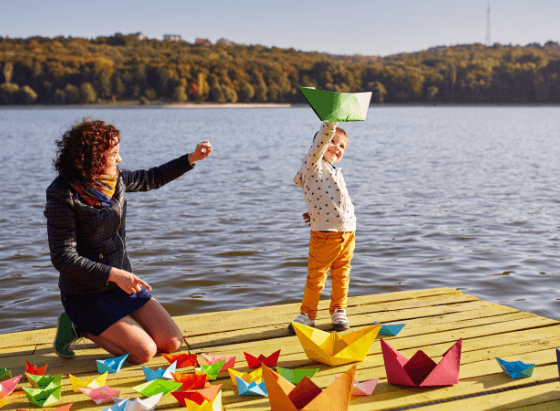
It’s common for adults to discuss creativity as though it requires teaching. worksheets, exercises, and enrichment activities. Water play is at the top of the list of nearly unstructured activities that provide some of the strongest evidence for creative development.
Water has long been recognized as an open-ended material by developmental specialists. It doesn’t demand a specific result. It can be poured, halted, rerouted, squandered, and recovered. Youngsters are only told what it can do, not what it should become.
| Key Context | Details |
|---|---|
| Core idea | Open-ended water play is linked to creativity, imagination, and problem-solving in early childhood |
| Age range | Most benefits observed in early years (toddlers to primary school age) |
| Expert consensus | Child development specialists widely support water play as a creative catalyst |
| Learning domains | Creativity, motor skills, language, emotional regulation, social interaction |
| Safety note | Constant adult supervision is essential, even with shallow water |
This distinction is important. Children’s play with fixed toys frequently has a predetermined plot. A toy vehicle advances. A doll is grasped. Water doesn’t like this type of scripting. It requires reaction and modification.
This means that in practice, creativity manifests itself in decision-making rather than art. At what speed should the water flow? If I tilt this cup, what will happen? Why did that leaf float while the stone instantly disappeared?
Teachers refer to these instances as “imaginative inquiry”, but if you’re not paying attention, it’s simple to overlook them. A youngster stops, then tries again. Another kid observes, then makes a small adjustment to the arrangement. Nothing noteworthy occurs, but something significant is developing.
The sensory component, which is frequently overlooked, is another. Movement, pressure, and temperature all affect how water feels. These variations don’t need an explanation, so they encourage experimentation.
One early learning center’s teacher explained how a child who didn’t talk much would line up containers, carefully refill them, and then empty them again while spending extended periods at the water table. As time went on, more kids joined not to converse but to take part. There wasn’t much inventiveness. It was meticulous.
In a controlled manner, water play also introduces risk. Accidents happen. Structures fall apart. Plans go awry. Because failure has little consequence and the reset is instantaneous, children adjust rapidly.
This is the point at which emotional development and creativity meet. When a well-constructed channel is overturned by water, annoyance momentarily arises and then disappears. The kid reconstructs. or fails to. They are both options.
Perhaps because there was nothing immediately wrong to correct, I recall how infrequently adults interrupted these moments.
This freedom, according to experts, is essential for creative development. When adults take a backseat, kids explain their own reasoning. They create logic, narratives, and structures.
Water play frequently turns into a cooperative activity without being labeled as such. A child pours, another blocks, and a third watches and proposes a modification. Roles arise naturally.
Imagination and language both grow. Naturally occurring words that are associated with action rather than instruction include “faster”, “empty”, “overflow” and “again”. Because of this foundation, the vocabulary is retained.
Water play’s creative aspects are frequently overlooked in favor of its physical aspects. balance, coordination, and fine motor skills. These can be measured and are comforting. Because creativity is more difficult to measure, it may be overlooked.
Persistence, however, is a sign of creativity. in the way a child engages in the same activity every day, making minor adjustments each time. In the quiet self-assurance that results from firsthand experience with cause and effect.
Water also encourages prop-free pretend play. Soup is made from a puddle. A stream turns into a road. A well is created from a bucket. For it to work, there is no need for consensus on the plot.
Crucially, water play can accommodate a variety of temperaments. Kids with lots of energy run and splash. Careful kids test boundaries by pouring slowly. Neither feels pressured to fit in, but both are involved.
Naturally, there are risks. Even in shallow water, care must be taken. Regarding this, the majority of educators are lucid. Risk does not diminish value; rather, it increases awareness.
Parents are frequently taken aback by how long kids can maintain concentration when there is water involved. Forty minutes is an extension of ten. Due to the fact that the activity reacts to effort, concentration increases.
This prolonged focus is among the more subdued markers of creativity. The youngster isn’t watching entertainment. They are producing it.
Water play, according to critics, is only recreational and a diversion from “real learning”. The way young children learn is misunderstood by this framing. Being creative is a must. It’s the system.
Children are not merely fantasizing when they work with water. They are simultaneously making assumptions, editing, and telling stories. Despite its apparent simplicity, the learning is layered.
Water frequently helps kids feel more connected to their surroundings when they are outside. Rain turns from being annoying to being fascinating. Mud turns from mess to material.
More lasting than any one lesson, these experiences mold attitudes. Curiosity is bolstered. It feels safe to try new things.
Patterns develop over time. Regular access to open ended play materials encourages children to approach problems creatively. They experiment with several answers. They put up with ambiguity.
Water is not a teaching tool for creativity. By permission, it permits it.
That might be the strongest argument of all. Children show us what they can create when we give them water, space, and time.