

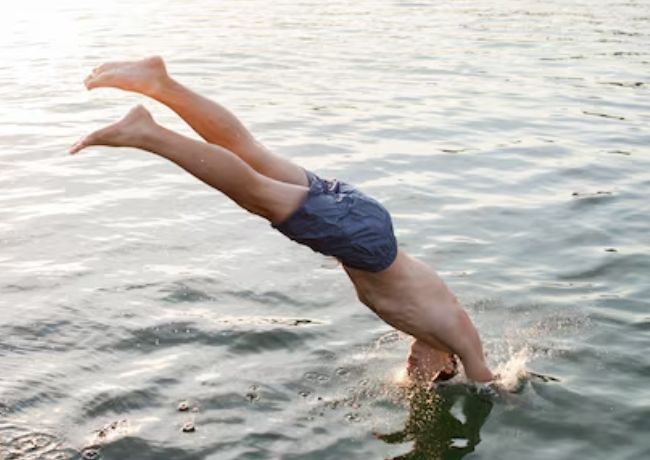
On the first truly hot day of the year, people experience a certain kind of confidence. The kind that, because the sun is out, the air feels like summer, and the water has undoubtedly caught up, sends them carelessly off the sand and into the sea. It hasn’t. Not at all. Not in Britain, nor in the majority of locations where lakes are shaded for the majority of the year and rivers flow from hills. Cold shock swimming becomes dangerous when there is a discrepancy between what the air promises and what the water delivers. People who would never consider themselves reckless can fall victim to this discrepancy.
Even among those who spend a lot of time near water, cold water shock and hypothermia are frequently confused. Hypothermia takes time. It is unsettling. Conversely, cold shock occurs in a matter of seconds when the skin beneath the neck comes into contact with water that is below 15°C. The body responds on its own terms, causing involuntary gasping, an increase in breathing rate, and a heart rate that is high enough to strain even a healthy heart, let alone one with an existing condition. It has nothing to do with swimming ability. In that first moment, a person who hasn’t swum since school and a triathlete are operating from the same nervous system.
| Category | Details |
|---|---|
| Condition | Cold water shock |
| Water temperature threshold | Below 15°C |
| Onset speed | Immediate to within 90 seconds |
| Key physiological response | Gasp reflex, hyperventilation, increased heart rate |
| Risk factors | Heart conditions, high blood pressure, asthma, pregnancy |
| Recommended survival technique | Float to Live |
| Time to regain breathing control | Approximately 60–90 seconds |
| Related but distinct danger | Cold incapacitation (swim failure) |
| Secondary risk | Secondary drowning, 1–24 hours post-incident |
This is especially unsettling because of how typical the scene is. Not a storm-tossed sea, not some far-off expedition, a lake on a Saturday, a riverbank where families are eating lunch, a beach that appears exactly the same as it did the previous week, but the season and tide have subtly changed the water’s temperature by a few degrees. The sea and inland waters around the UK frequently remain cold enough to catch swimmers off guard, even when air temperatures rise, according to Samantha Hughes of the RNLI’s water safety team. This discrepancy between what’s felt on skin and what’s happening beneath the surface is exactly the trap.
In addition to being the most crucial, the first ninety seconds are also the ones that people make the most mistakes in. Instinct tells you to fight the cold, swim hard, and get to safety. The issue is that instinct. An upright swimming position is the least stable and least buoyant option available during that window, and thrashing uses energy when the body is least able to recover it. The RNLI’s instructions to “float on your back”, “tilt your head”, “let the legs sink slightly”, and “breathe” sound almost too passive to be helpful in an emergency. It doesn’t attempt to resist the reaction, which is why it works. It’s holding out.
A second, more subdued threat usually manifests itself later sometimes even hours later. Even tiny amounts of water entering the lungs during that first gasp can cause secondary drowning, which can occur up to 24 hours after a person appears to recover from a dunking. Even if someone is pulled out of the water, they may still be in danger even if they walk away, speak normally, and insist they are okay. It’s important to keep in mind that “fine” right after an incident doesn’t always mean fine, and it’s a detail that doesn’t receive nearly enough attention outside of lifeguard training.
After a season or two of acclimatization, open-water swimmers who have developed tolerance over the years describe a sort of recalibration that occurs with repeated exposure to water that would feel harsh to a novice. Research on cold-water habituation has shown that this adaptation is real, which helps explain why seasoned swimmers occasionally underestimate how hazardous the same water is for a novice swimmer. For someone taking a vacation dip, what seems doable to someone who can swim through the winter is quite another.
All of this does not preclude outdoor swimming. It makes the case that the water should be treated according to its own conditions rather than those of the day. Wetsuits, staged entry, knowing the exit point before entering, and never swimming alone are examples of non-dramatic precautions that people typically overlook. Over the years, people’s habits around the water have changed, sometimes in a negative way, but the water itself hasn’t changed significantly. It’s difficult to predict whether that will change again as cold swimming gains popularity. Respect for the first ninety seconds in cold water appears to be the most significant difference.
i) https://www.rya.org.uk/water-safety/cold-water-shock-safety/cold-water-shock/
ii) https://www.rlss.org.uk/cold-water-shock-the-facts
iii) https://rnli.org/safety/know-the-risks/cold-water-shock
iv) https://www.metoffice.gov.uk/blog/2025/cold-water-shock-how-to-stay-safe
v) https://www.everyoneactive.com/content-hub/swimming/open-water-swimming/