

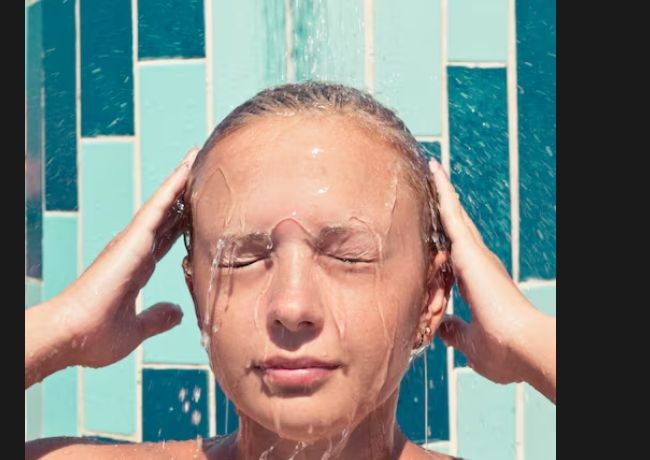
After a long swim, there’s a certain smell that sticks to hair a subtle, metallic tang that doesn’t quite go away with a single rinse. It’s familiar to anyone who has spent a summer at the neighborhood pool. Most people are unaware that the smell is frequently the first indication that chlorine has already begun to work on their hair and not in a good way.
There is a good reason why pools contain chlorine. It eliminates bacteria, prevents the water from becoming a biohazard, and enables widespread public swimming. When it comes into contact with hair, that same chemical reactivity which is so effective against pathogens becomes indiscriminate. It leaves behind something more akin to straw after removing the natural oils that keep the strands shiny and flexible. Dermatologists who treat swimmers frequently compare it to a gradual corrosion that is cumulative rather than sudden or dramatic.
| Category | Detail |
|---|---|
| Topic | Swimming Hair Damage |
| Primary Cause | Chlorine exposure in treated pool water |
| Common Effects | Dryness, brittleness, colour fade, breakage, green-tinted strands |
| At-Risk Hair Types | Bleached, dyed, chemically treated, porous, or naturally dry hair |
| Recommended Prevention | Pre-soaking hair, protective oils, swim caps, clarifying shampoo |
| Post-Swim Routine | Rinse immediately, clarifying wash, deep conditioning mask |
| Expert Referenced | Dr. Joe (dermatology-adjacent haircare commentary) |
The relationship between chlorine and hair color is less evident but perhaps more fascinating. Blonde or bleached hair appears to suffer the most from it, taking on the subtle green hue known as “swimmer’s hair”. Contrary to popular belief, chlorine does not actually cause hair to turn green. Chlorine binds to trace metals that are already dissolved in the water, most frequently copper. Lighter hair just makes the metal more noticeable as it adheres to the hair shaft. Brunettes don’t see the same cosmetic giveaway, but they are still susceptible to the harm.
Swim caps became standard equipment long before recreational swimmers gave them much thought because competitive swimmers have known this for decades. Olympic athletes treat their hair with a sort of clinical seriousness, rinsing right away, avoiding sun exposure with wet hair, and applying restorative treatments almost as a ritual, even if their caps fall off or slip in the middle of their laps. Even someone who swims twice a summer can learn something from that discipline.
In actuality, the chemistry is quite specific. Once chlorine enters the hair shaft instead of merely resting on the surface, it starts to degrade keratin proteins and break the disulfide bonds that give hair its strength and suppleness. Hair is more likely to break once those bonds weaken, particularly when brushing or heat styling. Many swimmers may underestimate it until the damage is already apparent because it’s a gradual deterioration process rather than an overnight transformation.
People don’t realize how important timing is. Most stylists advise against swimming for at least a week following any salon treatment because hair that has recently been colored, chemically treated, or extended is especially vulnerable. The reasoning is simple: adding chlorine too soon can cause unpredictable reactions, such as premature fading or unexpected texture changes, and chemical bonds from coloring or perming require time to stabilize.
It turns out that the damage itself is more difficult to prevent. Since hair acts somewhat like a sponge and can only hold so much liquid, soaking hair in clean tap water before swimming in a pool minimizes the amount of chlorinated water absorbed. A thin protective layer that further restricts absorption is created by adding a barrier made of natural oil, coconut, argan, or olive oil, among the most often advised. While none of this completely shields hair from chlorine, it significantly lowers exposure.
It could matter just as much, if not more, what happens after the swim. Dermatologists are remarkably unanimous when it comes to one thing: never expose chlorinated hair to the sun. UV exposure speeds up the chemical deterioration that is already occurring, exacerbating dryness and fading in a way that is difficult to reverse later. The closest thing to a standard procedure among experts appears to be rinsing right away, followed by a clarifying shampoo, and concluding with a deep conditioning treatment.
The role of chlorine in this situation is almost paradoxical. It shields swimmers from waterborne illnesses while subtly damaging the very hair that people frequently want to look good in the first place. Every time someone leaves a pool feeling rejuvenated only to find dry, tangled hair an hour later, it’s difficult to ignore that tension. Although the connection between leisure and unintended consequences is not new, it is rarely discussed beyond a stylist’s casual remark or a brief warning label.
Most people fall somewhere on a spectrum of risk that depends on hair type, treatment history, and how seriously they take pre- and post-swim care, regardless of whether they are regular lap swimmers or infrequent vacationers. Some people only need a quick rinse and a swim cap. For others, a more intentional routine becomes less optional and more essential, particularly for those with color-treated or naturally delicate hair. In any case, neither the pool nor the chlorine in it will disappear.
i) https://www.formswim.com/blogs/all/9-tips-to-protect-your-hair-from-chlorine
ii) https://uk.colorwowhair.com/blogs/all/how-to-protect-hair-from-chlorine
iii) https://maxwellmelia.co.uk/hair-extensions/summer-warning-how-to-protect-your-hair-extensions-from-chlorine-and-salt-water-damage/
iv) https://www.speedo.com/blog/wellbeing/swim-proof-your-hair/
v) https://www.abc.net.au/news/2026-02-15/how-to-avoid-chlorine-and-saltwater-hair-damage-when-swimming/106334202