

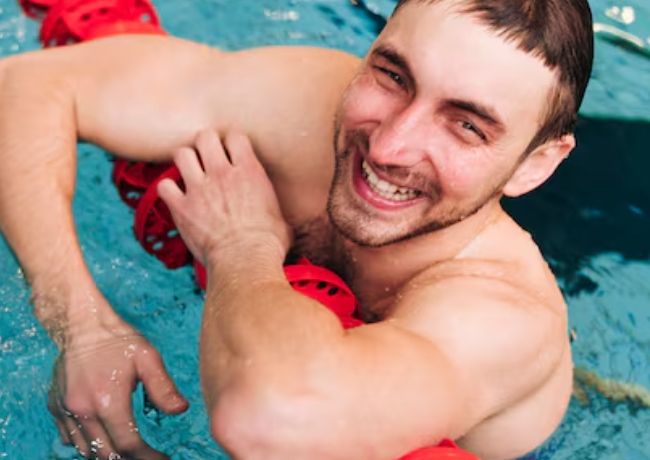
Open-water swimmers talk about a specific sound that occurs right before entry, when the surface becomes silent and breath is the only sound remaining. Regardless of their origins, people who engage in this behavior on a regular basis describe it nearly identically. During that pause, something occurs. What it is is still a mystery to scientists.
Researchers who polled 1,200 outdoor swimmers in 19 different countries for a study published in the “Journal of Environmental Psychology” discovered something they hadn’t anticipated. Swimming in lakes, rivers, and oceans had a greater stress-relieving effect than swimming in pools. Considerably more. The finding spread quickly through wellness circles and eventually into UK government policy discussions because the gap wasn’t small either.
| Category | Details |
|---|---|
| Practice | Outdoor and open-water swimming for stress relief |
| Key Study | BlueHealth International Survey – 1,200 swimmers, 19 countries |
| Published In | Journal of Environmental Psychology |
| Leading Researcher | Dr. James Grellier, University of Exeter |
| Related Author | Dr. Catherine Kelly, University of Brighton |
| Reported Benefit | Reduced cortisol, improved mood, lower anxiety |
| UK Adults Affected | 1.4 million reporting reduced anxiety/depression via Swim England |
| Policy Body | All Party Parliamentary Group on Swimming |
One of the University of Exeter’s co-authors, Dr. James Grellier, specifically mentioned independence. With pool swimming’s lane ropes, chlorine odor, and predictable rectangles of water, open-water swimmers reported feeling more in control of their surroundings. The importance of social bonding was lower than anticipated. Given that swimming groups are frequently marketed on the notion of community, that is the aspect that seems to surprise people the most. The actual draw might be more subdued than that. Even personal.
Not everyone escapes unharmed. According to the same study, more seasoned swimmers who pursued challenging conditions and far-off places occasionally reported feeling more anxious. The entire pursuit is tense. The distinction between excitement and peril can quickly become hazy in chilly currents, and while wild swimming occasionally punishes overconfidence, it also rewards confidence.
Catherine Kelly has been attempting to articulate this for years. Author of “Blue Spaces” and a geographer at the University of Brighton, she has emerged as a sort of unofficial intermediary between government policy and swimmers’ instincts. She argued that blue space access should receive the same level of policy attention as parks and green space when she presented her findings to the All Party Parliamentary Group on outdoor swimming, which was chaired by Lord Bethell, in January 2023.
Winning an argument takes time. “Go swim in a river” doesn’t fit neatly into the current healthcare frameworks, and bureaucracies operate cautiously. There is momentum, though. In some NHS circles, social prescribing physicians recommending swimming in the same manner that they might suggest therapy or fitness classes is no longer a novel concept.
It’s also becoming more apparent what’s physiologically occurring. The vagus nerve, which helps to calm the nervous system after the initial shock wears off, appears to be stimulated by cold water. Cortisol levels fall. Breathing becomes slower.
The body’s stress response, which is momentarily triggered by exposure to cold, may eventually strengthen immune function, according to a 2011 study on winter swimmers that found quantifiable increases in white blood cell counts. This is not entirely established science. Researchers are still figuring out how much of the effect is caused by the cold itself as opposed to the environment, the light on the water, and the erratic nature of the waves.
There’s a sense that something more straightforward could also be at play. It’s difficult to ignore how leisurely everyone appears when swimmers congregate at a lake’s edge before dawn, their wetsuits half-zipped and their breath visible in the chilly air. Discussions are brief. No one is looking at their phones. Deadlines don’t matter to the water, which may be part of its allure a forced detachment that modern life seldom provides voluntarily.
According to data provided by Swim England, about 1.4 million adults in the UK claim that swimming has significantly lessened their anxiety or depression. Afterward, 43% say they feel happier and more motivated. These are not insignificant numbers, and they are increasing as wild swimming becomes a recognized public health topic rather than a niche pastime.
It’s unclear if this turns into official medicine or remains a private custom shared among friends. Kelly has been invited to join a new advisory committee investigating blue space policy, suggesting that Lord Bethell’s parliamentary group is moving toward official recognition. If that occurs, prescriptions for therapy or exercise may eventually coexist with prescriptions for open water.
For the time being, however, most swimmers can tell what they already feel without a study. They simply keep showing up at the water’s edge, chasing something that is still only partially understood. They can be calm or nervous.
i) https://news.exeter.ac.uk/faculty-of-health-and-life-sciences/wild-swimming-boosts-mental-health-more-than-open-air-pools/
ii) https://www.brighton.ac.uk/news/2023/is-open-water-swimming-good-for-you
iii) https://www.swimdesignspace.com/blog/swimming-for-anxiety-stress-mental-health
iv) https://www.sciencealert.com/swimming-in-nature-is-wild-but-is-it-healthier-than-a-dip-in-a-pool
v) https://rnli.org/safety/choose-your-activity/open-water-swimming/what-are-the-benefits-of-cold-water-swimming