

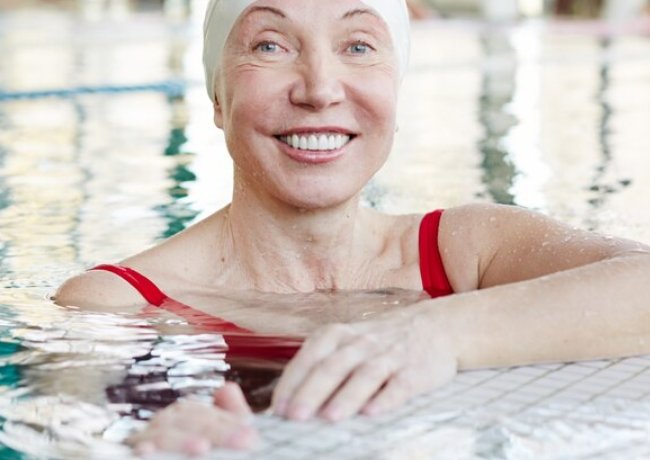
At six in the morning, a pool makes a certain noise. A coach’s voice echoing flat over the water, lane ropes ticking against the gutter, the silence before someone pushes off the wall. Another thing you’ll notice if you walk into practically any Masters swim session in Britain is that the youngest swimmers in the lane are rarely the ones performing the hardest sets. They are the ones who have discovered often the hard way that swimming after 40 isn’t about holding onto a past self. It’s about training like a person who truly knows their own body.
This distinction is more important than it might seem. Research indicates that muscle mass can decrease by about three to eight percent every ten years starting in the thirties. This is the kind of statistic that makes people anxious before they’ve even put on a cap. The same is true for aerobic capacity. Swimmers who have persevered long enough appear to view these figures more as information to plan around than as a verdict.
Sean Riga is familiar with this beat. In his late forties, he made a comeback to the pool in 2018 after being away for years due to kidney stones and the general drift that people fall into. Not the swimming itself, but the recuperation how a 400-yard warm-up that had previously seemed adequate suddenly wasn’t, and how his shoulders hurt until the muscles fully awakened was what really got to him. He began stretching in advance. He added more vegetables, reduced his coffee intake, and drank more water. It wasn’t dramatic at all. Like most beneficial habits, it simply worked, albeit slowly.
| Category | Detail |
|---|---|
| Topic | Swimming After 40 — Masters Swimming, Recovery & Longevity |
| Typical Age Range | 40 to 90+ (five-year Masters categories) |
| Key Physical Factor | VO2 max decline of roughly 0.6% per year up to age 70 |
| Recommended Frequency | 3 to 5 sessions per week |
| Primary Risk Area | Shoulder and rotator cuff strain |
| Supporting Practice | Dryland strength and mobility work |
| Governing Body Reference | Masters Swimming Program history and age categories |
| Notable Finding | Decline accelerates sharply after age 70, not before |
A somewhat comforting version of this story also appears in the research. Although individual trajectories vary greatly, long-term studies of Masters swimming champions have shown how physiological capacity decreases with age, with practice seemingly mitigating the decline. Put more simply, consistency appears to be more important than pure genetics. That is not insignificant. It’s possible that Masters swimming’s real appeal is that it makes aging negotiable rather than outright defying it.
The shoulder is more painful than nearly anything else in adult swimming, so it merits its own paragraph. Masters athletes who swim a lot but neglect dryland work strength training, mobility, and core conditioning are more likely to experience pain and disability, especially in the shoulder. On the other hand, those who add even a small amount of additional training typically avoid both the pain and the subsequent medical expenses. Sitting with the fact that the sport itself isn’t typically the issue is an odd experience. It is frequently the lack of anything outside the sport.
It’s almost like a liturgy when coaches who have worked with adult swimmers for decades repeat the same few cautions. Avoid making significant volume increases from one week to the next. Plan lighter weeks ahead of time rather than as an afterthought. Everyone stretches their hamstrings reflexively, but they should also strengthen their hips and rotator cuff. This isn’t glamorous advice. On social media, it won’t become popular. It’s the kind of unglamorous discipline that seems to distinguish swimmers who quietly stopped training at 45 from those who are still training happily at sixty.
From the outside, it’s easy to overlook how much happiness still permeates these sessions. People pushing through a hard set in a Masters lane, then laughing about it at the wall afterwards, comparing splits, and gently complaining about Sunday’s distance set create an atmosphere that is difficult to replicate elsewhere. Most people still believe that swimming is an exceptionally gentle sport for the body, low-impact compared to running, and social compared to working out alone.
Here, the long-term decline data is somewhat consoling. Up until the age of 70, national champion Masters swimmers’ performance decreases at a rate of about 0.6% annually, after which it increases more dramatically. Not forty, but seventy. The majority of people are unaware that they have thirty years of runway experience. While older swimmers’ motivation to continue competing has, if anything, remained remarkably strong, coaches working with older age groups have adjusted accordingly, incorporating longer warm-ups, longer rest intervals between sets, and generally lighter total volume.
The subtle defiance in that is difficult to ignore. The definition of “decline” tends to change when one witnesses a 70-year-old complete a 200 freestyle with obvious effort and obvious satisfaction. No one can say with certainty whether that applies to every swimmer, every body, or every decade to come. The pattern, which is consistent across pools, decades, and research papers, suggests a positive outcome. It’s not really about slowing down when swimming after 40. It tells the tale of swimmers who discovered how to persevere, frequently later than they anticipated.
i) https://www.swimmingclass.co.uk/blog/masters-swimming-after-40
ii) https://blog.myswimpro.com/2019/03/07/10-tips-for-older-swimmers/
iii) https://www.puregym.com/blog/strength-for-swimmers/
iv) https://www.halocline.co.uk/blogs/news/swimming-workouts-for-over-60
v) https://www.womanandhome.com/health-wellbeing/swimming-as-a-workout-for-beginners/