

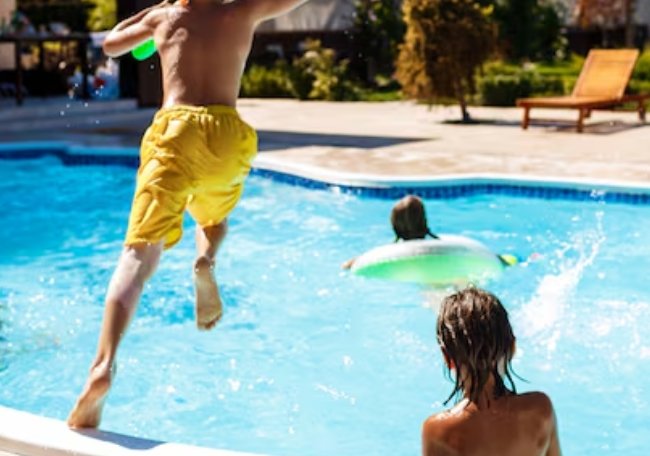
A drowning is preceded by a specific type of silence that is completely different from what people have been taught by television. No yelling for assistance, no flailing arms, no spectacular splash that grabs everyone’s attention on the deck. The surface hardly ripples when a child slips under, frequently within an adult’s arm’s reach. Something has already gone wrong by the time anyone becomes aware of it. It’s the kind of information that, once you hear it, forever alters the way you watch a backyard pool.
For children in the United States between the ages of one and four, drowning continues to be the most common cause of unintentional injury death, and it continues to rank among the top causes until the age of nineteen. Every year, almost 900 children perish in this manner, and thousands more are saved from the water in time but suffer lifelong injuries. The majority of these incidents occur in home swimming pools rather than lakes or beaches, which contributes to the statistic’s unsettling nature. The threat is not far away. The distance from the kitchen window is usually a few yards.
| Category | Details |
|---|---|
| Topic | Pool Safety for Kids |
| Leading Cause of Accidental Death (Ages 1–4) | Drowning |
| Annual Child Drowning Deaths (U.S.) | Nearly 900 |
| Recommended Fence Height | At least 4 feet, four-sided isolation fencing |
| Key Federal Law | Virginia Graeme Baker Pool and Spa Safety Act |
| Recommended Swim Lesson Age | 1–4 years, per American Academy of Pediatrics |
| Notable Advocacy Group | Abbey’s Hope Charitable Foundation |
| Key Statistic | Nearly 70% of drownings occur when children aren’t actively swimming |
An unfenced pool is like an uncaged lion sitting in the backyard, according to Morgan Miller, whose daughter Emmy died in a friend’s pool at the age of nineteen months. Until you sit with it, it sounds dramatic. The analogy is clear to an adult. A toddler sees a pool as shimmering and alluring, something they can stroll toward without realizing what it is. Almost all of the preventative measures that experts now advise are based on this discrepancy between children’s perceptions of water and its true dangers.
Speaking with professionals in this field, it’s remarkable how frequently they mention conversation as a safety tactic. Parents frequently exchange notes regarding screen time, sleep schedules, and car seats. Even though drowning presents a similar or higher risk in early childhood, it is rarely discussed in the same sentence.
This disparity has been brought to light by Nicole Hughes, who lost her son Levi. The topic that could take a child’s life in a matter of seconds hardly comes up in regular parenting conversations. It’s difficult to ignore the extent to which prevention appears to rely on people’s willingness to express the uncomfortable thing aloud.
In theory, supervision seems easy, but in reality, it’s much more difficult. At group swim excursions, “water watching” has taken on a somewhat formal role, with parents exchanging tokens or tags to ensure that one adult is always officially on duty, phone away, and eyes on the water. The reasoning behind it is simple: nobody is actually watching when everyone is, in a loose sense. Lifeguards frequently observe this pattern: children are instructed to stay in the shallow end while the adult supervising them strays toward a phone, and accidents typically occur in the space between intention and attention.
Approximately 70% of drownings in children occur when the child isn’t even swimming. They fall into a few inches of rainwater collected in a children’s pool that no one thought to drain, wander through an unlocked door, or scale a neighbor’s yard. The entire issue is reframed by that figure. It goes beyond the deep end. It’s about any container that can hold water long enough for a young child to locate it, including ponds, buckets, and bathtubs.
One of the more quantifiable interventions is fencing, and the evidence is compelling. In countries like Australia, where pool-drowning deaths reportedly decreased by about half after such laws took effect, four-sided isolation fencing which completely separates the pool from the house and yard rather than depending on the house wall as one side has become standard practice.
Although the Virginia Graeme Baker Pool and Spa Safety Act mandates functional drain covers in response to a different but equally serious entrapment hazard, the United States has not adopted a uniform federal mandate. A fence that is at least four feet high, self-closing and self-latching, and has gaps too small for a small child to fit through is advised by experts. It’s not a design decision. It resembles a seatbelt more.
It’s important to correct the misconception that swim lessons are viewed as a type of insurance policy. According to the American Academy of Pediatrics, lessons can help kids as young as one year old, primarily by making them more comfortable in the water rather than creating anything like drown-proofing. A backyard pool is never safe to leave unattended, no matter how many lessons are taught. The extent to which parents who believe a few weeks of instruction serves as a safety net have actually come to understand that distinction is still unknown.
Conversations with safety advocates frequently bring up the topic of basic CPR knowledge, which is frequently characterized as the difference between doing something in the crucial minutes and helplessly waiting for paramedics.
Because they are rarely fenced and frequently left full long after the day’s swimming has ended, inflatable pools the kind that appear in big-box stores every spring with hundreds or thousands of gallons have become a special concern, particularly for kids under five.
After doing some research, what sticks out is not a single statistic but rather a statement made almost casually by Alan Korn of Abbey’s Hope: regardless of the parent’s subsequent guilt, drowning occurs to the child, not the parent. It shifts the focus of the entire discussion from blame to something more useful. Water-watcher rotations, locked gates, fences, and drained kid’s pools. Nothing is guaranteed by any of it. It subtly moves the odds in the direction that matters most.
i) https://capt.org.uk/drowning/
ii) https://www.parents.com/kids/safety/outdoor/pool-drowning-safety-tips-for-parents/
iii) https://www.aquapros.org/water-safety-tips-every-parent-should-know/
iv) https://www.rospa.com/health-and-safety-resources/keeping-kids-safe-hub/drowning-prevention
v) https://www.iowscp.org.uk/water-safety-for-parents