

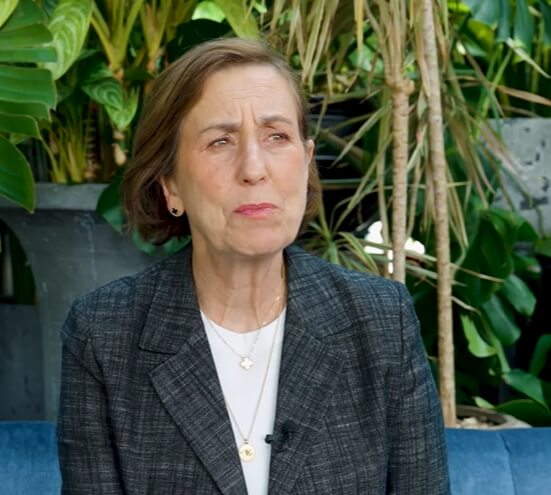
Kirsty Wark has a certain level of poise on TV that she has developed over decades of working in late-night studios and doing political interviews, where the incorrect tone can ruin a discussion. It was therefore more difficult than anticipated when she eventually acknowledged that she had been silently suffering from night sweats for over ten years, sometime in her sixties. Not because the symptoms were out of the ordinary.
They’re not given who was speaking, the silence surrounding them felt odd. After having a hysterectomy at the age of 47. Wark experienced what doctors refer to as a “medical menopause”. In which her body was thrust into a hormonal cliff-edge rather than the slow decline that most women go through.
After that, she was put on the standard route of HRT, and things calmed down for a while. Then came the now-famous American Women’s Health Initiative study from 2002, which connected hormone replacement therapy to breast cancer. She stopped nearly overnight, just like thousands of other women in Britain. Looking back, it’s difficult to criticize that choice. At the time, the headlines read like red-stamped warnings. What came next was more difficult than she had anticipated.
| Key Information | Details |
|---|---|
| Full Name | Kirsty Anne Wark |
| Born | 3 February 1955, Dumfries, Scotland |
| Profession | Journalist, Television Presenter, Author |
| Known For | Newsnight (BBC), The Review Show, election coverage |
| Years Active | 1976 – present |
| Health Event | Hysterectomy at 47, followed by medical menopause |
| Notable Documentary | The Menopause and Me (BBC, 2017) |
| Spouse | Alan Clements |
| Reference Source | BBC – Kirsty Wark on Menopause |
The nights with no discernible pattern, the waking up wrung out as she once described, the disturbed sleep. The way she later described it a woman in her late forties just carrying on because that’s what women of her generation had been taught to do has an almost banal quality. Twelve years went by not much changed. She was the host of Newsnight. She reported on elections. She followed Kirsty Wark’s lead.
Beneath it all, the body continued to misbehave in ways she hardly ever talked about. *The Menopause and Me*, the documentary she eventually produced, may have been both a piece of public service journalism and a reflection on her own quiet endurance. When you watch it now, you can see that she is clearly curious, almost as if she is just now allowing herself to ask questions that she ought to have asked years ago.
Something changes when she meets Dr. Heather Currie, the chair of the British Menopause Society, and finds out that Currie uses hormone replacement therapy. Suddenly, the fear that prevented her from taking medication in 2002 seems less like caution and more like a generation of women being afraid of something that would have been beneficial for many. They were unaware that the science had quietly advanced.
Subsequent analysis revealed that the 2002 data had been exaggerated, that the increased risk of breast cancer primarily affected predisposed women, and that for the majority, the advantages outweighed the risks. Eventually, NICE released new guidelines stating as much. By that time, ten women had already endured their symptoms in stoic seclusion, certain they were acting morally. Observing Wark come to this realization, it seems as though she has been somewhat deceived. She doesn’t mention it. For that, she is too professional.
The pauses reveal the response. She resumed her low-dose HRT regimen and started urging those who had stopped taking it to at least consult their doctors once more. That is a thoughtful, non-preach-oriented piece of advocacy. It also fits her temperament. Wark has never acted out her emotions for a crowd. The other items, the ones layered on top, came next.
She has discussed her brother’s non-Hodgkin lymphoma diagnosis during the pandemic in 2020 with the same blunt candor. She has discussed being harassed by a female coworker at the BBC during the same general time period elsewhere, in the uncomfortable way that only she can. These things don’t fit together well.
Work, family, and health are all urgent at the same time. To be honest, it’s the texture of midlife for many women, but it’s typically not shown on national television. Observing this develop over time, it’s remarkable how people like her have contributed to a change in the discourse surrounding menopause.
Angelina Jolie, Cynthia Nixon, Jennifer Saunders, and Gillian Anderson all contribute a unique note to a chorus that hardly existed fifty years ago. Wark makes a more subdued, reportorial contribution. She doesn’t do confession makes inquiries and that meticulous, almost forensic approach may be just what’s needed in a culture still struggling to be transparent about women’s bodies in midlife.
She is currently 71 years old acknowledged that the hot flashes never completely disappeared. That detail has a stubborn honesty to it. No neat conclusion, no heroic comeback story. Just a woman who persisted in her work and inquiries, ultimately concluding that the silence was the worst symptom of all.
i) https://www.bbc.com/news/uk-scotland-38905528
ii) https://www.thetimes.com/uk/scotland/article/i-still-suffer-symptoms-after-20-years-of-menopause-says-kirsty-wark-f7g785hdn
iii) https://www.totalhealth.co.uk/blog/kirsty-wark-had-hard-menopause
iv) https://www.theguardian.com/society/2017/apr/15/menopause-kirsty-wark-breaking-the-silence