

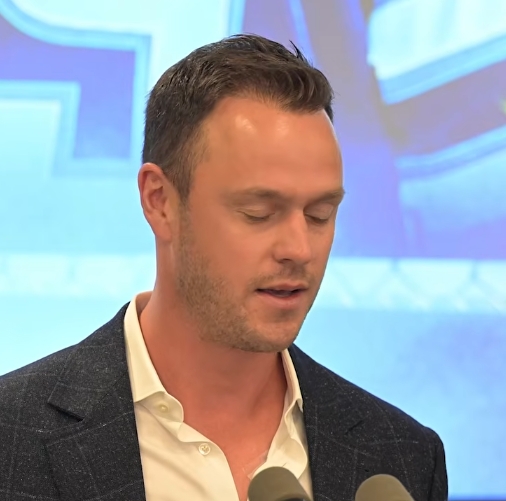
Watching Jonathan Toews wear a Winnipeg Jets jersey has a subtle peculiar quality. It doesn’t exactly look wrong, but for a considerable amount of time, it truly appeared as though no jersey would ever fit him again.
It wasn’t a torn ligament or a bad knee that prevented the man who led Chicago to three Stanley Cups and exuded intensity like a second skin from playing the game that defined him for the better part of five years. It was much more difficult to define and much more difficult to explain to the general public.
Like many stories, the one about Jonathan Toews’ illness starts out quietly. He was diagnosed with Chronic Immune Response Syndrome, a condition linked to an early COVID-19 infection missed the entire 2020–21 NHL season.
The announcement was met with a somewhat awkward silence for a league that didn’t always know how to discuss invisible illness. A fractured collarbone was understood. This was not like the others. He appeared fine. He was thirty-two. For more than ten years, he was among the world’s top two-way players, but something inside of him had stopped functioning properly.
The story of his illness is especially interesting because of how slowly the erosion had occurred. Toews had been secretly dealing with immune and digestive problems since his teens, long before the diagnosis.
He had developed an unrelenting recovery regimen that included daily routines, protocols supplements that piled on top of one another until, by his own admission, he was helping himself very little and doing too much of everything. His output started to decline in 2020 what followed was a gradual disintegration that consumed him from the inside out and seemed nearly undetectable to the outside world.
He spent two more seasons in Chicago, but he never fully recovered. After a career-low finish in August 2023, Toews completely left the Blackhawks after they refused to extend his contract. He required room. He was in need of peace. It’s difficult to ignore the need for someone who had been living life to the fullest since they were fourteen to just give up.
The truly unexpected part is what transpired next. Toews eventually made two trips to India for a months-long detoxification program known as panchakarma after turning to Ayurvedic traditional Indian medicine. The extreme therapies included enemas, mud baths, herbal tonics induced vomiting.
Part of the reason is that it doesn’t sound anything like the field of professional sports medicine. He had attempted the traditional route. It was insufficient.He described the experience as “recalling what it was like to be a 13-year-old kid again”. That picture of a man who had achieved everything hockey had to offer sitting somewhere in India and attempting to recall what it was like to just feel well has a profoundly human quality.
It was almost poetic to return to Winnipeg. He returned to his hometown and signed a one-year contract with the Jets, moving to a sportsplex bearing his name a few blocks from his childhood playground. His point total had nothing to do with the electrifying response he received when he took the ice in front of 15,000 spectators at Canada Life Centre in October. It had to do with the significance of the moment.
His journey has been closely monitored by medical professionals studying long-term COVID. They quickly point out that Toews’s symptoms fatigue, inflammation brain fog are typical of what millions of people are currently experiencing. It’s still unclear if his recovery offers a replicable road map or just a positive tale. For those who are still in the midst of their own quiet struggles, however, his willingness to talk candidly about the years of searching, the frustration the detours through alternative medicine matters.
It’s still too early to predict how his season will play out. An 82-game NHL schedule is harsh in ways that month-long wellness programs in India can’t adequately prepare you for his body isn’t 27 anymore. He’s on the ice, though. After everything, that seems like more than enough on its own.