

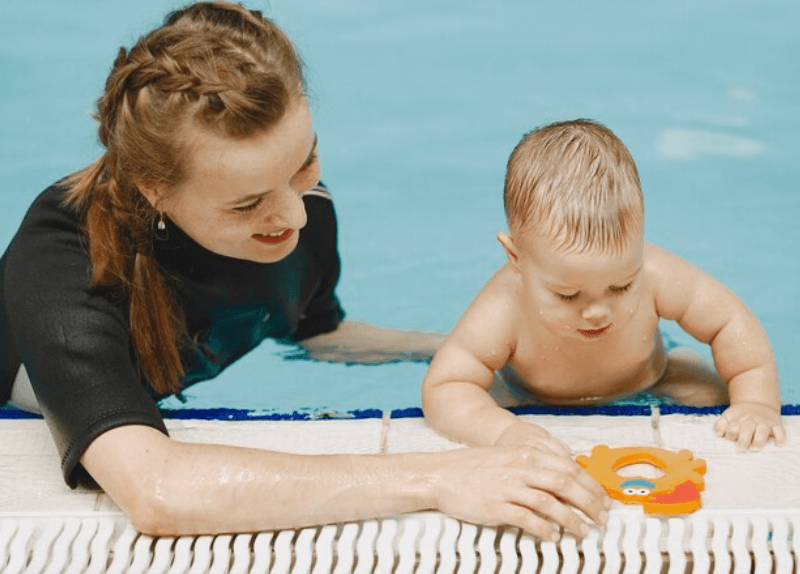
Swim instructors frequently recount a specific incident. For the first time, a young child, perhaps three years old, lets go of the pool wall. Not because they were instructed to. Because their bodies underwent a subtle recalibration that whispered, “You’ve got this”. From the bleachers, it’s hardly noticeable. However, it provides nearly all of the information regarding the effects of swimming on a child’s development. Children are not born with a sophisticated sense of body awareness.
It develops through hands-on experience, slowly and clumsily. It turns out that one of the best conditions on earth for that construction process is water. While requiring constant postural adjustment, the buoyancy lessens the punishing effect of gravity.
Movements are slowed down by the resistance to the point where the nervous system can track them. Land-based activities seldom replicate this type of feedback loop consistently. The developmental difference between the first and eighth lessons is nearly shocking when observing a group of five-year-olds in a Saturday morning swim class.
| Category | Details |
|---|---|
| Topic Focus | Swimming and pediatric physical development |
| Key Benefits | Body awareness, balance, coordination, motor skills, cognitive function |
| Age Range | Infants through school-age children |
| Recommended Start | As early as 6 months (with parental participation) |
| Governing Body | American Academy of Pediatrics (AAP) |
| Expert Sources | Pediatric physical therapists, early childhood development researchers |
| Common Program Types | Toddler swim classes, group lessons, baby swim, school swim programs |
There is a lot of aimless splashing at first, with arms and legs functioning as distinct, loosely connected departments. By the eighth week, coordination has become more apparent. The pull and the kick begin to time themselves against one another.
to breathe, the head turns almost instinctively. For decades. Pediatric physical therapists who focus on early development have observed this pattern and consistently come to the same conclusion. The pool accelerates proprioceptive development. Or the body’s internal sense of where it is in space. In ways that are hard to match elsewhere. Most parents are surprised by balance. It seems illogical. Water appears to be an unstable, shifting environment where falling in is practically the goal, not a balance trainer.
They learn to communicate with their shoulders and hips. For precisely this reason, aquatic therapy has long been used by pediatricians who treat children recovering from neurological difficulties. The learning process is much less daunting than with balance beams or uneven terrain because the water requires balance while also mitigating the consequences of losing it.
The advantages of coordination go far beyond the pool deck. Bilateral coordination, or the ability of both sides of the body to cooperate more effectively, has been shown to improve in children who swim on a regular basis. Later on, this manifests itself in writing, catching a ball, and maneuvering through a crowded hallway without running into anything.
Once you know to look for it, it’s difficult to miss how frequently the children in a swim class are also the ones who appear to be the most physically comfortable everywhere else. It seems as though the water imparts a physical fluency that spreads to other areas. It’s still unclear how much of this is due to swimming in particular as opposed to early exposure to any kind of structured physical activity.
There appears to be something unique about the water environment. A child must slow down and feel every movement more carefully than they would on land due to the resistance of the water. Swimming requires focus, whereas running is quick and frequently careless. Real-time communication between the brain and the body is necessary for every stroke. Apparently, it’s a great practice to constantly negotiate. When discussing swim lessons, the cognitive aspect is often overlooked.
The majority of parents enroll their children for safety reasons, which makes perfect sense given that drowning is still the most common cause of injury-related death in young children. Learning to swim requires a significant amount of mental effort. Coordinating the movement sequence, reading the water ahead, and remembering to breathe at the appropriate time are not passive activities.
Regular swimmers typically exhibit improvements in working memory and focus, which may be because swimming requires them to maintain multiple instructions while performing a physical task under mild physical stress. Teachers who observe the benefits in the classroom perceive them as genuine, even though they are more difficult to measure. Confidence is another more subdued phenomenon that occurs in swim lessons but is not quantified in research.
The deep bodily kind, which arises from realizing that your body is capable, responsive, and, most importantly, recoverable, is different from the loud, performance-based kind. A child gains a basic understanding of physical self-trust when they learn to float on their back after uncomfortably sinking. That is a lesson that spreads.
Regular swimmer’s parents often report that their kids are less reluctant to try new physical situations and are more willing to do so without becoming frightened right away. Although it’s difficult to draw a clear line, it’s possible that this also translates to social confidence. All of this seems to be intuitively understood by the best swim programs for young children. Teachers at successful programs hardly ever discuss technique in the same clinical manner as adult coaches. They play games. They employ music.
They make the child reach for a floating toy, which is actually a lesson in spatial judgment and hand-eye coordination. When a child is playing, their nervous system is fully engaged and they are learning without the resistance that comes from knowing they are being taught. This disguise is part of what makes it work.
If there is one reluctance worth mentioning, it is that access is still unequal. Community pools have been closing nationwide for decades, and swim lessons are costly in many markets. Children who are most in need of early swimming’s developmental benefits those from low-income families and those without access to facilities are frequently the least likely to receive them.
In discussions about childhood development, that gap should be given more consideration than it usually is. The argument for getting started early is strong for families who do have access. It’s not because swimming will turn a child into an athlete. Though it might. And it’s not just because it could save their life in the water. Though that would be sufficient on its own. However.
Learning how to stay afloat while standing at the edge of a pool and letting go of the wall is precisely the kind of physical problem-solving that develops a body that knows itself. Which turns out to be a gift that follows a child for a very long time.
i) https://www.swimstrongfoundation.org/body-awareness-and-swimming/
ii) https://swim-time.com/benefits-teaching-children-swim-early-swimming-lessons/
iii) https://kidscanswimcanada.ca/the-link-between-swimming-and-physical-development-in-children/
iv) https://www.aquabliss.com.au/the-science-of-swimming-how-it-strengthens-your-body-and-mind/