

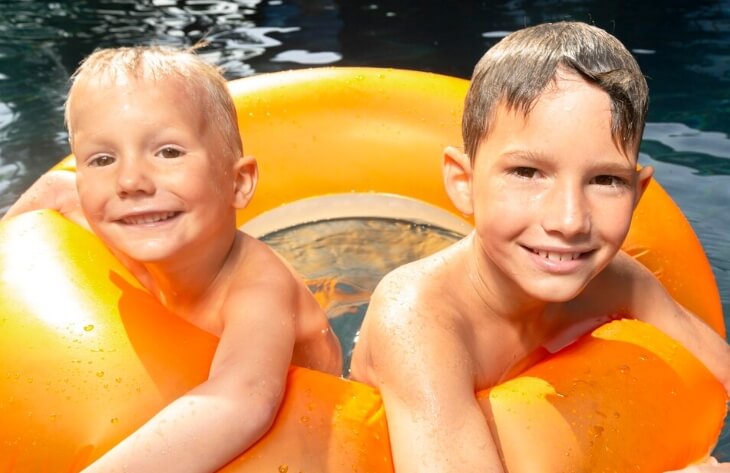
In swim lessons, there’s a certain moment that you can’t help but notice. Ten minutes ago, two children who were strangers were standing at the pool’s edge, laughing because they both fell in at the same moment. It was not planned by either. Neither had much to say. Something clicked that’s how swimming fosters stronger social bonds in children in the most natural way imaginable. Not by following a curriculum. Through a deeply human, somewhat chaotic, shared experience. It sounds almost too easy.
Instructors and parents who work with youth swimming programs will tell you the same thing: the pool does something that a classroom, a playdate, or even a sports field occasionally cannot. There is something about the surroundings the water, the noise, the physical proximity that eliminates pretense and speeds up a development that typically takes months between kids. Let’s call it trust. Let’s call it ease. Whatever it is, it usually appears quickly. By their very nature, group swimming lessons require a level of closeness that is frequently absent from contemporary childhood.
| Category | Details |
|---|---|
| Topic | Social Benefits of Swimming for Children |
| Target Audience | Parents of children aged 6 months – 12 years |
| Key Organizations Referenced | Watermelon Swim, Individuality Swimming, Fitness Champs (Singapore), Pedalheads |
| Core Benefit Areas | Friendship, communication, empathy, confidence, teamwork |
| Early Start Age | As young as 6 months |
| Drowning Risk Reduction | Early swim lessons reduce drowning risk by up to 88% |
| Lesson Formats | Group lessons, parent-and-baby classes, one-to-one, swim teams |
| Geographic Reach | Global — programs in North America, UK, Singapore, and beyond |
Children are waiting their turns, sharing lanes, watching one another try the same scary trick, and applauding when someone succeeds. This dynamic is built into the design of schools like Watermelon Swim, which purposefully maintains small class sizes. The closeness is deliberate.
It turns out that the social outcomes are surprisingly quantifiable, not in terms of test scores but rather in terms of how a child leaves the pool as opposed to entering it. It’s not just the unity that makes it work. It’s the weakness.
Fear of sinking, failing in front of others, or appearing uncomfortable in a bathing suit are all real fears that must be overcome to learn to swim. Something changes when kids experience that together. Since every student in the class eventually understands what it’s like to struggle with a skill, empathy develops almost naturally. Other children don’t need to be reminded to be kind when a peer is upset about not being able to master a technique. They’ve been there before. They comprehend it.
Parents who are preoccupied with the practical aspects of education frequently ignore the communication component. Swimming lessons are fundamentally a continuous practice of listening and reacting. During drills, students ask questions, instructors provide guidance, and peers call out to one another.
Passive disengagement is not tolerated, unlike in a classroom. You must be present in the water. Additionally. Children who at first found it difficult to speak up with adults eventually start to do so more naturally. In part because their relationship with their teacher. Which is developed through encouragement and little successes. Makes trust seem possible.
Pausing on that confidence piece is worthwhile because it often has unanticipated effects on other people. When a child learns to float independently for the first time that is, when they truly float without assistance they remember that moment. In a way that is difficult to duplicate in more structured environments, there is a feeling that the accomplishment is theirs.
Their behavior toward other kids is influenced by that personal victory. Children who regularly swim tend to behave differently in social situations, according to research and observations from programs in Singapore, the UK, and North America. more eager to try. less fear of making a mistake. The diversity dimension comes next. Swim lessons typically draw from a wide range of cultural and geographic backgrounds, especially in community pool settings.
Children who speak differently at home, have different appearances, or adhere to different traditions end up playing together and learning the same tricks. Programs like those at Watermelon Swim specifically point out that this exposure fosters empathy, the kind that results from doing things with people for weeks on end rather than being instructed to include them. It’s possible that children are shaped by this early, unforced mixing in ways that more intentional integration attempts occasionally overlook.
Additionally, sportsmanship appears in the water in a manner that seems more organic than in many competitive environments. The pool does not allow a child to simply walk away after losing a friendly relay race. They are still standing next to the child who beat them, still drenched, and still in the same group that completed the same course.
The ability to deal with that accepting failure or success without letting it define who you are at the time carries over into friendships, education, and eventually the workplace. It’s still unclear if swim programs intentionally teach this or if it just happens as a result of the circumstances. In any case, it is taking place.
Throughout childhood, the social benefits that start in infancy Watermelon Swim programs begin with babies as young as six months continue to build in layers. Near the edge of the pool, a toddler learns to read body language. Without being asked, a six-year-old learns to take turns.
When a teammate’s relay divides the race, a ten-year-old swimmer learns to control her own annoyance. Every step contributes something. Instructors from Fitness Champs and Individuality Swimming both note that the skills developed in the pool are applicable to almost every aspect of a child’s life, including classrooms, friendships, and family dynamics.
All of this is not meant to imply that swimming is a treatment for social anxiety or that all shy kids will change after taking lessons. It’s not very tidy. Some children require more time.
Before group dynamics feel manageable, some people require one-on-one sessions. Circumstances that the pool fosters a small group, a shared challenge, frequent communication, a trusted adult, and genuine accomplishment are extremely uncommon. It becomes difficult to ignore the fact that the water is acting as you watch this develop over the course of a season of lessons. constructing something. The quieter architecture of how kids learn to interact with others is just as important as strokes and safety techniques.
i) https://watermelonswim.com/swimming-and-social-skills/
ii) https://plungesandiego.com/social-benefits-swimming-young-children/
iii) https://fitnesschamps.com.sg/how-swimming-supports-kids-growth-and-development/
iv) https://individualityswimmingandfitness.co.uk/the-impact-of-kids-swimming-lessons-on-social-confidence/
v) https://pedalheads.com/en/blog/swimming-benefits-for-kids