
How Aquatic Movement Supports Physical Development in Early Childhood
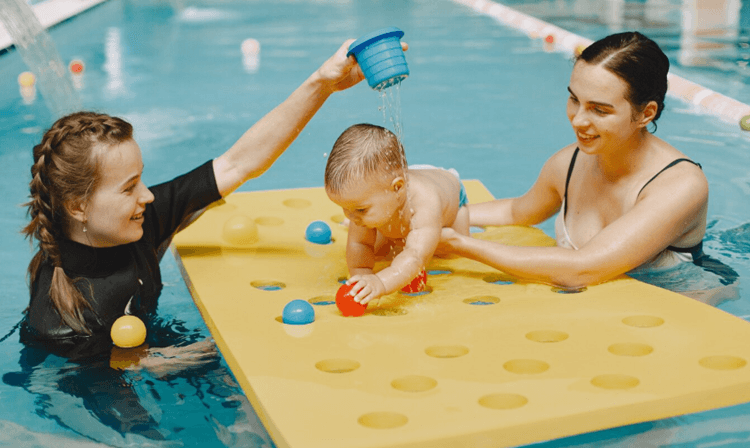
When young children enter a pool, confidence isn’t the first thing you notice. It’s a mixture of hesitation and curiosity. The toes curl. The edge is grasped by hands. When a child rushes across a playground, they might stop and examine the surface as if it were a question.
The rules are altered by water. Gravity becomes less powerful. The limbs feel lighter, then strange. Here, if only momentarily, movements that are difficult on land become feasible.
| Aspect | Key Context |
|---|---|
| Age range | Infants to preschool-aged children (roughly 6 months to 5 years) |
| Physical focus | Gross motor skills, balance, coordination, muscle strength |
| Environment | Shallow pools, warm water, supervised aquatic programs |
| Developmental feature | Buoyancy reduces body weight, enabling early movement exploration |
| Safety dimension | Early water familiarity linked to drowning risk reduction |
| Research grounding | Pediatric motor development and aquatic movement studies |
Toddlers who aren’t yet able to jump have been known to raise both feet off the pool floor and smile in astonishment at their own suspension. It’s not yet a skill. It’s a finding.
Early movement becomes exploratory rather than effortful because water supports body weight. Children do not have the constant balance that land requires, so they kick, sweep their arms, and twist their torsos. Errors are permitted in the pool with no repercussions.
That freedom is important. Early childhood physical development involves more than just strength; it involves discovering the body’s capabilities and spatial location.
On land, the experiment is terminated by a fall. The experiment is carried out in water.
At first, the movements are ineffective. A kid uses one arm to paddle and then forgets the other. Out of rhythm, legs kick. Heads tilt back in strange directions. However, coordination starts with these mismatched motions.
Everything is slowed down just enough by water resistance for the nervous system to catch up. Every push receives feedback. Every kick responds. Repetition that doesn’t feel like drill is how the body learns.
It’s evident in the way kids start to stabilize their cores on their own. It’s necessary for floating. It’s necessary to stay upright. There is no need for a cue.
In water, balance is dynamic. It is continuously renegotiated, which subtly strengthens the muscles surrounding the shoulders, hips, and abdomen areas that will eventually support sitting motionless in a classroom chair, running, and climbing.
Moreover, symmetry appears. Aquatic movement frequently requires the participation of both arms and legs, in contrast to many playground activities that favor one side. The body learns to function as one unit.
Bilateral coordination is sometimes discussed by teachers, but in reality, it is easier to see: a child who used to spin in circles now moves forward purposefully.
A portion of the instruction is carried out in the sensory environment. Skin is compressed by water. The temperature varies with depth. Sound moves in a different way. Children are constantly exposed to information without feeling overloaded by it.
Proprioception, or the sense of where the body is and how it moves, is supported by this sensory richness. That sense is still developing in young children.
It struck me how infrequently land provides them with that type of feedback when I once saw a toddler pause in the middle of paddling, eyes narrowing, as if listening to something inside their own body.
Additionally, aquatic movement encourages early risk-taking in a safe environment. releasing the wall. putting faith in a float. immersing the face for an extended period of time. Every tiny choice improves emotional control and physical confidence.
Strengthening muscles happens almost by accident. Every movement is gently resisted by water. There is no repetitive strain or isolation of a single muscle. The entire body either moves in unison or very little.
This is particularly important for kids who grow at different rates. The difference between early and late walkers gets smaller in water. Everybody floats in the same way.
Early on, breath control also comes into play. Timing and focus are reinforced while the diaphragm and chest muscles are used when learning when to inhale, hold, and exhale into bubbles.
Even though it appears to be play, the cardiovascular effort is real. Children frequently come out of a session feeling hungry, flushed, and exhausted the kind of exhaustion that indicates productive effort.
Swimming teaches safety first, as parents often expect. However, endurance is the less obvious advantage. The ability to continue moving without losing heart, not the kind that is measured in laps.
Additionally, shared movement has a social component. Imitation is encouraged when a child witnesses another child attempt a kick. Without lectures, waiting for one’s turn teaches patience.
Some kids are wary. They hold on. They observe. Then they let go one day, usually without warning.
The choice to trust one’s own body is the pinnacle of physical development.
The pool can be surprisingly leveling for kids with developmental delays or sensory sensitivity. Water’s constant resistance and enveloping pressure tend to soothe rather than excite.
Rarely is progress linear. A child may decline today if they floated last week. Development is influenced by a variety of factors, including temperature, mood, fatigue, and missed naps.
However, patterns show up over time. more powerful kicks. more straight backs. movements that appear to be more intentional than they are an attempt.
Play on land is not replaced by aquatic movement. It enhances it. Climbing frames, bike pedals, and eventually the everyday physical demands of life are examples of how what is learned in the water spreads.
There is no magic in the pool. It’s a medium. One that permits young bodies to experiment before they are completely prepared to thrive.
And that permission might be the most crucial support of all in early childhood.