

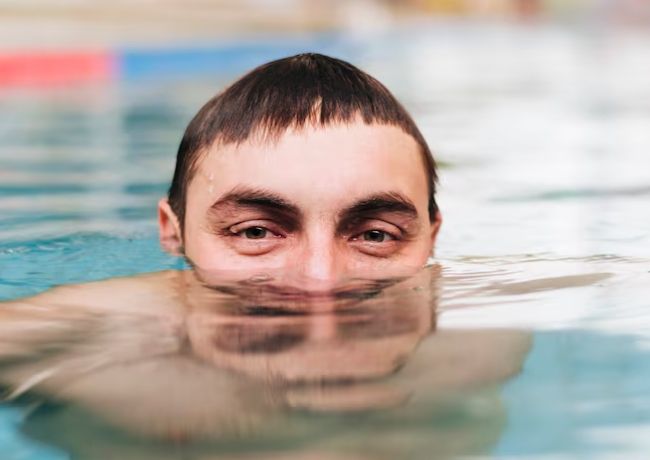
In adult swim lessons, there is a specific type of panic that almost always stems from breathing. Not the actual swimming, not the kicking, not even the arm stroke just the terrifying reality that your face must eventually emerge from the water, and you may only have a split second to do so. Coaches see this all the time. You’ll see at least one person gulping air like they’ve just surfaced from a shipwreck if you watch any Tuesday night masters swim session.
The peculiar thing is that breathing while swimming isn’t actually lung-related. Most people are unaware that it has to do with physics until someone properly explains it to them. Breathing poorly tends to destroy three of the four forces that a body moving through water must contend with: weight, buoyancy, drag, and propulsion. Your hips drop as you raise your head to get air. Drag increases when you lower your hips. You are suddenly working twice as hard for half the speed when you increase drag. The interconnectedness of it all is almost unfair.
| Category | Detail |
|---|---|
| Topic | Freestyle swimming breathing technique |
| Core skill | Side breathing using the bow wave |
| Key forces involved | Weight, buoyancy, drag, propulsion |
| Common error | Lifting the head to breathe |
| Recommended drills | Sink-downs, bilateral breathing, sidekick drills |
| Helpful equipment | Swim snorkel and fins for technique work |
| Expert reference | Coaches with British Triathlon Level 3 certification |
| Best for | Triathletes, distance swimmers, sprint swimmers |
| Skill level | Beginner to advanced |
This is where things start to get interesting and many swimmers have their first “oh” moment. Similar to how a boat creates a wake, every body moving through water does the same. A bow wave, a tiny peak of water that rises exactly where your head pushes forward, is located at the front of that wake. A trough, a dip in the water level so low you can turn into it and breathe without raising your head at all, is nestled just behind that peak. There it is, sitting in front of every swimmer’s face, largely unnoticed, even though it sounds almost too convenient to be true.
The fact that swimming faster actually makes breathing easier rather than harder is counterintuitive and a constant source of confusion. There is more space to breathe without turning around or raising the head when the bow wave is larger and the trough is deeper. Slower swimmers experience the opposite issue. More headlifting, more drag, less wave, less trough, and more rotation are required. Beginners become trapped in this tiny, harsh feedback loop and never fully comprehend why their breathing feels like such a struggle.
When it comes to where things go wrong, coaches who have worked on pool decks for years tend to agree. Seldom is it the breath itself. It’s the impulse to gasp for air just before it happens instead of having faith that air will arrive. Experienced teachers believe that the majority of “breathing problems” are actually trust issues related to breathing costumes. Anxiety causes swimmers to hold their breath underwater, starve for oxygen on the surface, panic-gulp, and then alter their stroke timing in an attempt to recover. One bad habit leads to four.
Strangely, the solution frequently has nothing to do with inhaling. It involves continuously and completely exhaling while submerged, long before the head turns. Sink-down drills, which involve sitting at the bottom of the shallow end, hugging your knees, slowly exhaling, and observing whether you continue to sink, are designed for precisely this purpose. You’re exhaling correctly if you do. When you hover, you’re probably holding more air than you realize, and this trapped air is probably what causes your inhalation to feel so shallow and hurried.
A swim snorkel is another piece of gear that subtly resolves more of this than most people realize. For a while, it completely eliminates breathing, allowing swimmers to concentrate only on head position, rotation, and rhythm without having to worry about timing an inhale. When you first try it, it almost feels like cheating. It’s one of the quickest ways, according to several coaches, to rebuild a stroke that has been damaged by years of breathing anxiety. When combined with fins, which increase speed and create a larger bow wave, the idea of trough-breathing becomes tangible for swimmers.
All of this takes time, and it most likely shouldn’t. For most adults, it takes weeks for bilateral breathing which alternates sides every three or five strokes rather than locking into one side to feel natural; it takes longer for swimmers who learned to swim defensively rather than effectively. A 50-meter sprinter might hold their breath for the first ten meters and hardly breathe at all, whereas a distance swimmer settles into something steady and almost meditative, breathing every three or four strokes to keep clearing stale air. In the end, sprinters and distance swimmers require completely different rhythms.
When you watch professional swimmers compete, you hardly notice that they are breathing. In a way, that’s the point. The entire system is intended to be imperceptible, to blend into the stroke to such an extent that oxygen and effort no longer seem like distinct issues. It takes longer than anyone would like to get there. Swimmers who give up fighting the water and begin to read its waves eventually succeed, and when they do, they typically appear a little taken aback.
i) https://www.speedo.com/blog/techniques/how-to-improve-your-breathing-technique-for-swimming/
ii) https://www.swimschoolacademy.com/breathing-basics-how-to-breathe-like-a-pro-swimmer-a-how-to-guide-for-beginners/
iii) https://vasatrainer.com/blog/how-to-breathe-while-swimming-master-the-technique/
iv) https://www.liquidtri.com/blog/breathe-easier-swimming
v) https://tritrainingharder.com/blog/2026/03/breathing-in-freestyle-how-to-fix-common-mistakes