

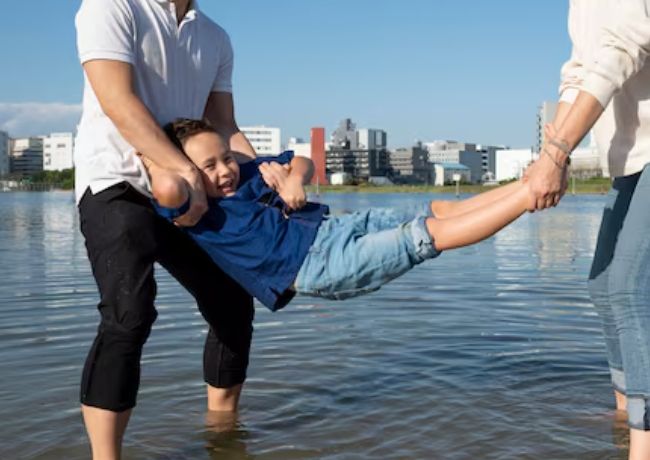
Teenagers who are near water exhibit a certain level of confidence that is largely unrelated to their actual swimming ability. It’s the self-assurance that comes from warmth, friends observing, and a phone camera held up by the river. In reality, the danger is typically quieter than that, but parents often picture it as something dramatic, like a flash flood or a rogue wave. On a 28-degree afternoon, a 14-year-old is wading in up to their waist without realizing that the water beneath them is still cold enough to take their breath.
Nearly all significant open water incidents involving teenagers in the UK revolve around this discrepancy between the perceived temperature of the water and its actual temperature. The brain is persuaded that the water will feel the same by sunlight on the skin. Seldom does it. Even during a heat wave, temperatures in reservoirs, quarries, and shaded river sections can drop well below 15°C. When a body suddenly comes into contact with water that cold, it doesn’t soften. It gives a gasp.
The swimmer experiences what physiologists refer to as “cold water shock,” which affects both strong and weak swimmers equally. The swimmer’s heart rate increases, blood pressure rises, and they lose control of their breathing for a few terrifying seconds.
| Category | Details |
|---|---|
| Topic | Teen open water risks (rivers, lakes, reservoirs, canals, quarries) |
| Highest-risk age group | 13–17 years, with a drowning rate of 4.51 per million |
| Share of child drownings in inland water | Nearly 47% of all child drownings occur in rivers and lakes |
| 2025 UK accidental water deaths | 202 confirmed fatalities, 57% inland |
| Heat-and-water link | Three times more fatalities on days above 25°C |
| Core survival technique | RNLI’s Float to Live method |
| Emergency contact (inland) | Call 999, ask for Fire and Rescue Service |
| Emergency contact (coastal) | Call 999, ask for the Coastguard |
| Leading UK authority | RNLI Water Safety |
It’s important to take a moment to consider that fact because it contradicts a common parental belief that children who are unable to swim are the most dangerous group. A more complicated picture is revealed by the data. According to research from Bournemouth University and the Royal Life Saving Society, there are three times as many fatal incidents on days with temperatures above 25°C as on a typical day. The trigger is not a lack of skill, but heat.
In Britain, teenagers between the ages of 13 and 17 have the highest drowning rate of any age group. Almost half of all child drownings occur inland, where no one is keeping an eye on canals behind industrial estates, flooded quarries, or river bends where the current appears to be motionless.
When you watch footage of these locations, you are not struck by how dangerous they appear. It’s how commonplace. a level section of river under a railroad bridge. A grassy reservoir that gently slopes to the edge. There’s no obvious churn in the water, no warning signs of danger. More than anything, that might be the real issue—open water seldom poses a threat. Lifeguards, depth markers, and painted lane lines are all present in pools. Rivers lack all of that, and a current that appears sluggish from the surface can actually be moving three feet below the surface, dragging at ankles in a way that even experienced swimmers find surprising.
Additionally, there is the social layer, which is not neatly represented in a safety pamphlet. Adolescents tend to behave differently in groups. A dare turns into a leap. Few 15-year-olds want to be the one to say no on a hot afternoon by the water, and hesitation begins to appear like weakness in front of friends. As teenagers get older, alcohol exacerbates this problem by narrowing their judgment at the exact moment when it matters most and slowing their reaction time in an emergency.
All of this does not imply that open water must be completely avoided, despite the fact that the majority of water safety organizations are quite adamant about that. Teenagers still benefit greatly from rivers and lakes in terms of self-esteem, physical fitness, and just spending time outside rather than indoors in front of a screen.
This is the reason behind the RNLI’s main piece of advice, Float to Live: instead of fighting the initial panic of cold water, the advice is to tip the head back, let the ears go under, spread arms and legs, and simply float until breathing settles, usually within a minute. It seems almost too easy to do. The same thing is often described by survivors who have used it: a strange, purposeful stillness that defied instinct and saved them nonetheless.
There isn’t a single rule that is taught once before the school holidays that seems to really change the results. It’s a continuous, somewhat repetitive dialogue about never swimming alone, checking the depth of the water before jumping, telling someone where you’re going, and calling 999 and requesting the Coast Guard or Fire and Rescue instead of pursuing a friend in need. The majority of teenagers won’t mention this on their own.
Given that swimming proficiency among children in the UK is reportedly still below pre-pandemic levels, it is still unclear whether classroom water safety lessons reach every child who needs them. What is evident is that a parent who is prepared to engage in an unglamorous, somewhat repetitive discussion about currents and cold water is doing something that no warning sign by a riverbank ever quite accomplishes.
i) https://lifeleisure.net/blog/staying-safe-around-open-water/
ii) https://ribbletrust.org.uk/water-safety-our-guide-to-river-safety/
iii) https://www.cambsfire.gov.uk/news-and-incidents/news/2025/04/2025-04-08-warm-weather-highlights-dangers-of-open-water
iv) https://thelink.slough.gov.uk/news/water-safety-reminder
v) https://canalrivertrust.org.uk/support-us/our-campaigns/safety-on-our-waterways/water-safety-for-teenagers-and-young-people