

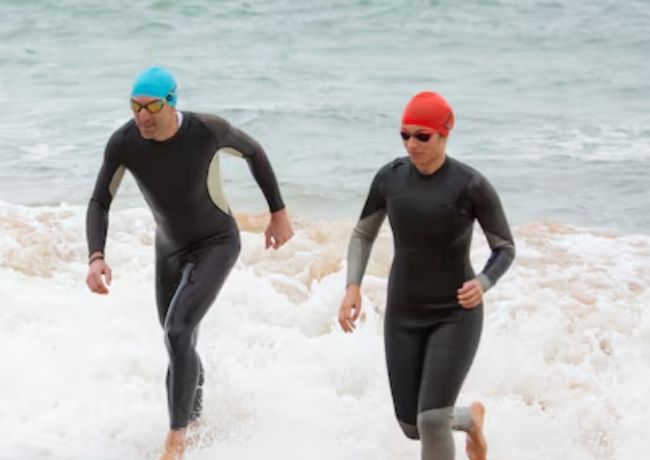
Every January, a certain type of person shows up at the gym with a question they believe has a clear answer: run or swim? They want a verdict, a number, something they can print off and stick on the refrigerator. The trainer will typically shrug and advise them to “just pick one and stick with it” instead. That advice isn’t entirely incorrect. It ignores some truly fascinating distinctions between the two activities, which are more significant than most people realize.
Everyone always starts with the numbers. Approximately 216 calories are burned in 30 minutes by a 155-pound runner running at a moderate pace. When swimming laps for the same amount of time, a 125-pound swimmer burns closer to 180. Running is ahead on paper. The paper ignores the fact that swimming uses muscle groups that a treadmill never uses, as well as water resistance, which is about twelve times greater than air resistance. The calorie spreadsheets may understate the true metabolic cost of swimming, especially when you consider how much more difficult it is to kick against water than to just put one foot in front of the other.
| Category | Details |
|---|---|
| Exercise Type | Swimming — full-body, low-impact cardiovascular activity |
| Exercise Type | Running — weight-bearing cardiovascular activity |
| Average Calorie Burn (30 min) | Swimming: ~180 cal (125 lb person); Running: ~216 cal (155 lb person) |
| Primary Muscles Worked | Swimming: shoulders, arms, back, core; Running: legs, glutes, core |
| Joint Impact | Swimming: low impact; Running: higher impact, weight-bearing |
| Bone Density Benefit | Running has the stronger documented effect |
| Common Injuries | Swimming: shoulder/rotator cuff strain; Running: shin pain, stress fractures |
| Mental Health Effect | Both release endorphins; comparable mood benefits reported by the American Council on Exercise |
| Equipment Needed | Swimming: suit, goggles, pool access; Running: shoes, minimal gear |
| Best Suited For | Swimming: joint pain, full-body toning; Running: convenience, bone health |
Around six in the morning, you’ll see the regulars at any public pool: people breathing in a rhythm they’ve been practicing for years while making slow, deliberate laps. Compare that to a running trail at the same hour, where joggers wearing reflective vests can be seen, their breath visible in the chilly air. Both scenes appear to be disciplined. Neither appears especially glitzy. That’s likely the reason why, in reality, weight loss appears more like routine than transformation.
The comparison is further complicated by interval training. Benefits that might otherwise require an hour of steady-state cardio can be obtained in thirty minutes with brief bursts of high effort interspersed with rest intervals. This applies to both running down a pavement stretch and running down a lane in the water. The process is the same: the body continues to burn at a high rate long after the workout is over. The heart rate spikes, recovers, and then spikes again. Fitness researcher Gatses, who is frequently cited on this subject, has observed that the intensity of an activity is what actually drives fat loss rather than the activity itself.
Intensity isn’t everything, though. Exercise that people can maintain over years, as opposed to weeks, is subtly influenced by joint health. For those who are concerned about osteoporosis in later life, running, being weight-bearing, strengthens bone density in ways that swimming just doesn’t. A lot of seasoned runners eventually experience shin splints, stress fractures, or knee pain that prevents them from running for extended periods of time due to the same weight-bearing nature. Swimming avoids almost all of that. Physical therapists frequently recommend pool workouts to runners recuperating from injuries, and this is no coincidence.
Convenience, which seldom appears in official health discussions but subtly influences people’s behavior, also has merit. In just a few minutes, a runner can get dressed and head out of the house. A swimmer typically needs a drive, a pool, a suit, and goggles. It is evident that access is just as important as physiology when one observes how people’s routines actually change over several months. Long after the initial motivation wanes, a person will frequently continue to perform the “better” exercise in February, March, and April.
Another wrinkle is caused by cold weather. While cold-weather running seems to increase brown fat activity the type that burns calories instead of storing them outdoor cold-water swimming has been associated with higher white blood cell counts and better circulation. Together, they imply that temperature rather than just the type of activity plays a subtle role in how the body reacts to exercise. Neither benefit is significant enough to base a fitness program solely on.
Which, then, prevails? The truthful response is not as satisfying as a headline would have you believe. For most body types, swimming probably burns a few fewer calories per minute, but it uses more muscle and spares joints. Running increases bone density, burns slightly more, and requires very little equipment, but it also increases the risk of injury over time. Neither is the clear winner. Observing people pursue both over time, what seems to matter more is which one a person can envision continuing to do in a year because consistency rather than a single workout is what ultimately appears on the scale.
i) https://www.healthline.com/health/swimming-vs-running
ii) https://www.formswim.com/blogs/all/swimming-vs-running
iii) https://www.fullarmourswimteam.com/post/swimming-vs-running-muscle-building-and-weight-loss
iv) https://www.womenshealthmag.com/uk/fitness/fat-loss/a70151661/cycling-vs-swimming/
v) https://www.saguaroaquatics.com/swimming-vs-running-which-is-a-better-workout/