

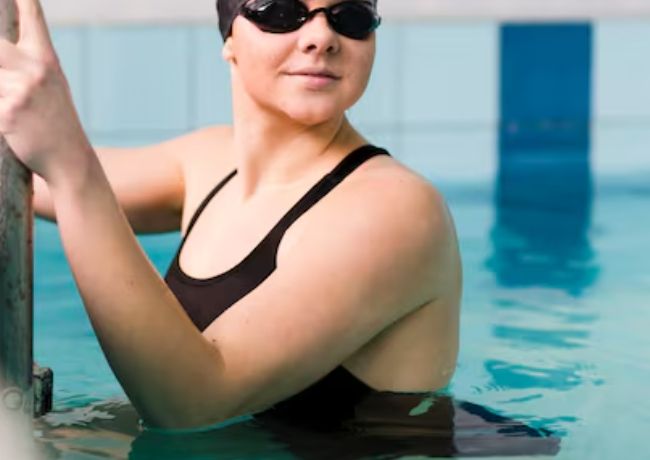
Some people visit the pool in January, complete four laps, and then give up by February. It’s possible that swimming’s negative reputation among novices stems from its marketing as either a gentle pastime for retirees or a competitive sport with little to offer in between. On a Tuesday morning, you’ll see both extremes in most public pools: an older crowd performing slow breaststroke laps close to the wall, while teenagers in lane four perform flip turns. The majority of new swimmers really need to be somewhere in that gap.
When all the marketing is removed, weight loss is just math. The scale shifts when you burn more than you consume. Because the effort is concealed by the water, swimming effectively complicates that straightforward equation. There’s a feeling that this lulls people into either overdoing it or, more frequently, underestimating how much they’re actually burning because you don’t feel the sweat like you would on a treadmill. A beginner who weighs 160 pounds can burn between 420 and 715 calories by swimming at a moderate pace for an hour. These numbers are directly comparable to those of running, but without the knee pain that causes so many novice exercisers to limp back to the couch.
| Category | Details |
|---|---|
| Topic | Swimming for weight loss (beginner-focused) |
| Best Strokes | Butterfly, Freestyle, Backstroke, Breaststroke |
| Calorie Burn (160 lb person) | ~423–715 cal/hour, depending on intensity |
| Recommended Session Length | 30–60 minutes |
| Workout Types | Low, moderate, and high-intensity intervals |
| Equipment Needed | None essential; goggles and a proper swimsuit recommended |
| Suitable For | Nearly all fitness levels and ages |
The harshness of the first week’s learning curve is rarely discussed. The butterfly is the most difficult stroke by far, using the chest, back, and stomach while burning nearly 450 calories in 30 minutes. A beginner is most likely to feel as though they are drowning gracefully while performing this stroke. The more sensible entry point is freestyle, also known as the front crawl. It’s quick, tones the shoulders and glutes, and most adult swim instructors teach it first for a reason: the mechanics, despite their initial awkwardness, settle in more quickly than the others.
Backstroke is underappreciated, particularly by those who spend their days bent over a desk. Staring at the ceiling rather than the bottom of the pool has an almost therapeutic quality, and the stroke is great for spinal strength and posture the kind of unglamorous benefit that no fitness poster highlights.
Breaststroke, on the other hand, is the stroke that practically nobody performs correctly but that everyone believes they already know. It burns the fewest calories per minute roughly 200 in thirty minutes but if done correctly, it’s undeniably one of the better choices for cardiovascular health. The majority of novices pretend to get through it, and the body manages to put up with the inefficiency.
At least initially, intensity is more important than stroke selection. Because it is repeatable, moderate-intensity swimming, which requires between 70 and 80 percent effort, is typically the foundation of a long-term weight-loss regimen.
For someone who is already afraid of the water, high-intensity intervals are difficult to sell because they require a longer recovery period but burn more in less time. Low-intensity workouts that allow you to converse in between laps are also important, especially for novices who are still having trouble with technique. A slow lap is not really shameful. The clock is unaware of the distinction.
It’s difficult to ignore how frequently the psychological barrier of simply going to the pool on a regular basis is overlooked in discussions about swimming. That calculation has been somewhat altered by indoor, heated facilities, particularly during the darker months when an outdoor jog begins to feel taxing. When you combine a swim with ten minutes in the sauna afterward, the habit begins to develop almost automatically.
Although it’s an imprecise science at best and depends on metabolism, diet, and a dozen other factors that no one can completely control, thirty minutes, three or four times a week, seems to be the approximate threshold where beginners start noticing changes. One thing that seems to be constant is that, at least initially, swimming rewards patience over intensity, and those who persevere are typically the ones who gave up trying to swim like Olympians in week two. As it happens, the water is a pretty patient teacher.
i) https://www.sunsationalswimschool.com/blog/swimming-workouts-for-weight-loss-for-beginners
ii) https://www.usms.org/fitness-and-training/articles-and-videos/articles/best-swimming-workouts-for-weight-loss
iii) https://www.villagegym.co.uk/blog/swimming-for-weight-loss/
iv) https://www.myjuniper.co.uk/articles/is-swimming-good-for-weight-loss
v) https://www.healthline.com/health/fitness-exercise/swimming-is-the-best-workout-you-need-to-do