

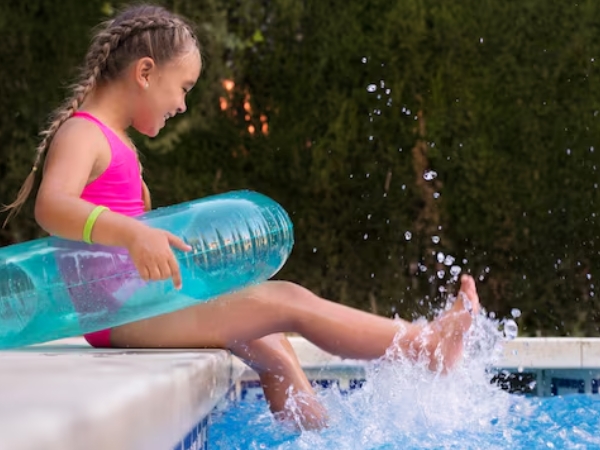
A garden hose running, a plastic paddling pool slowly filling up a small child already in their swimsuit before the water is even knee deep are all examples of a certain type of summer afternoon that seems almost too good to be true. It’s one of those simple British delights. A fact that is difficult to read is often overlooked in that happy chaos: a small child can drown in as little as 2 cm of water.
That’s not a frightening statistic that was disregarded. The Royal Life Saving Society has been reiterating this warning for years, but it still doesn’t seem to have enough of an impact on the general parenting consciousness. In the UK, 236 people drowned just last year. One of the top ten causes of death for kids between the ages of five and fourteen is still drowning. The cheerful, colorful completely unremarkable paddling pool in the backyard is not as safe as it appears.
The London Fire Brigade has given this considerable thought. The Brigade released an interactive water safety map earlier this year that shows the locations of over 1,500 water-related incidents attended since 2020, including 112 accidental drownings in London alone, in response to a series of unintentional drownings that occurred during a heatwave.
It’s an eye-catching tool seeing those incidents plotted across well-known streets and green areas has a subtly sobering quality. The plan is for parents and guardians to use the map to find high-risk areas before a child ever approaches them.
The majority of accidents start with the supervision question or could have been avoided. A young child can drown silently in thirty seconds or less, according to Dr. Lois Lee of Boston Children’s Hospital. Not even a minute Not two.
The time it takes to quickly answer someone at the door, refill a drink, or take a quick look at a phone is thirty seconds. The RLSS is clear on this point: unless specifically agreed upon, never leave a child unsupervised near water, not even for a brief period of time never assume that another adult is taking care of them.
More than most parents probably realize, properly setting up the pool is important. The pool should be situated on level ground and free of anything that could trip a toddler on the way in or out, such as overhanging branches or sharp objects.
For families with younger children who have a tendency to wander, a barrier or fence that is at least four feet tall and encircles all edges adds a significant layer of protection. It’s crucial to cover the pool when not in use. So is completely emptying it afterward and flipping it over instead of leaving it full and unattended.
Although they don’t have to, rules seem to make things less enjoyable. When kids are aware of the rules no pushing, no diving no entering without an adult present they actually react well. It usually works better to set boundaries early on, before the first splash, than to try to enforce them in the middle of chaos.
Families often overlook the topic of emergency preparedness because it seems too important on a summer afternoon. An irreversible situation could be reversed with the help of the RLSS’s free online course, Lifesaver, which is specifically designed for families and teaches basic CPR and water rescue techniques. It seems like a long overdue step that water safety will also be included in the secondary school curriculum in England starting in September 2026.
The familiarity of the paddling pool may contribute to the issue. Unlike a river or reservoir, it doesn’t feel hazardous. They own it, it’s tiny it’s in the garden. It is precisely because of its accessibility and seeming innocence that it is worth taking seriously.
The majority of accidents near paddling pools can be avoided, which is good news. Clear rules, sensible setup, supervision a little preparation go a long way. It should feel light in the summer. It can if the proper safety measures are taken.
i) https://www.rlss.org.uk/splash-safely-in-the-garden
ii) https://www.london-fire.gov.uk/news/2026-news/june/london-firefighters-warn-parents-and-young-people-about-water-safety-as-part-of-drowning-prevention-week/