

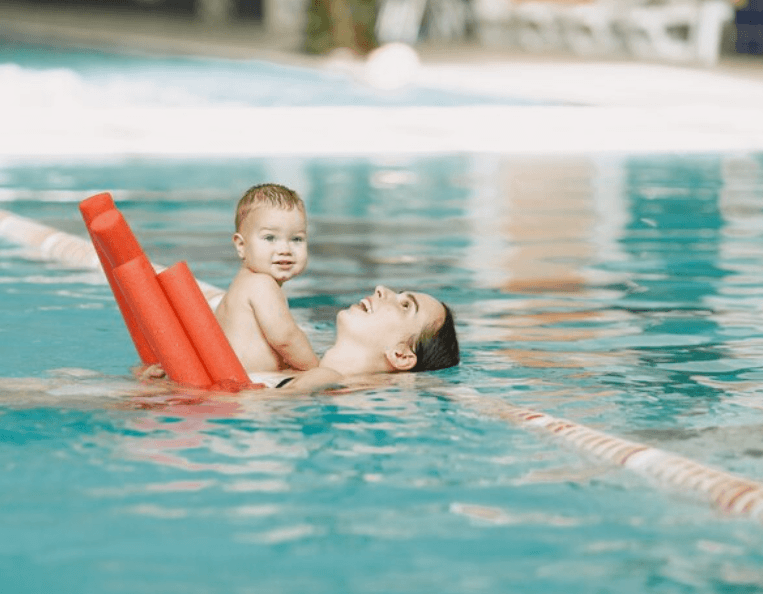
Almost every beginner swim class has a turning point around the third or fourth lesson. A week ago, the child was clutching the pool wall with white knuckles, but now they are tentatively pushing off on their own, their face dipping below the surface. That wasn’t imposed.
It was not required by any rule. The child discovered what they needed to do to pass through the water, which simply continued to be the water. That’s what makes swimming so easy to overlook. It appears to be a sport from the outside. a physical ability. Something you learn to avoid drowning while on vacation with your family.
If you spend enough time with swim programs, you will begin to see the true narrative, which takes place in the spaces between each lesson’s kick drills and breath control exercises. Youngsters are quietly developing self-governance skills. Structure, not strictness, is what makes it happen.
| Category | Details |
|---|---|
| Topic | Swimming and Child Development |
| Focus Area | Discipline, Focus, and Mental Resilience in Children |
| Age Group | Children (Preschool to Primary School) |
| Key Benefits | Self-discipline, goal setting, time management, emotional regulation |
| Related Programs | Swim schools, structured lesson programs |
| Research Backing | Physical activity shown to improve cognitive function and emotional control |
Each lesson builds upon the one before it. A child must put in incremental effort, sometimes over months, to go from floating to freestyle in a single afternoon. Children absorb the progression’s inherent logic almost without realizing it.
They discover that things take time, that it is ineffective to skip steps, and that some objectives necessitate repeated attendance before they are achieved. This is discipline the kind that comes from experience rather than the kind that is passed down from authority. It makes sense that a lot of parents enroll their kids in swimming classes mainly for safety.
It makes perfect sense to be afraid of drowning, which is still one of the main unintentional causes of death for young children. Even though they are more difficult to observe on a progress report, it’s possible that the mental advantages are equally important. Parents frequently talk about seeing improvements at home. Such as a child who is better at handling frustration. Who takes longer to solve a challenging homework problem. Or who doesn’t lose it when something doesn’t work out the first time.
How much of that can be attributed to the pool is difficult to ignore. Unlike many childhood activities, swimming requires a certain level of focus. While kicking across the pool’s width, a child must simultaneously consider their arms, legs, breathing, and position in the water.
The entire stroke collapses if you miss any one of those. Research generally supports instructors’ descriptions of it as a full-brained workout. Neural pathways linked to attention, memory, and problem-solving are strengthened by coordinated movement on both sides of the body.
This type of engagement is especially important for younger children. Children in structured swim programs frequently exhibit longer attention spans in classroom settings, according to teachers and parents from various communities. This is not because swimming teaches academic content, but rather because it trains the mind to concentrate under mild physical challenges.
It is important to acknowledge that things can go wrong in the pool as well. Swimming can become a source of fear for kids if the teacher emphasizes discipline in the strictest sense obedience, silence, and exact compliance or if the class is overly focused on repetitive drills. The balance is crucial.
A well-conducted lesson follows a pattern of play, challenge, and practice. Games help kids stay engaged and refocus their attention, so they’re not a waste of time. The best swim instructors appear to have an innate understanding that having fun isn’t the antithesis of learning.
It’s frequently the mechanism. Whether someone says it aloud or not, goal-setting is ingrained in the framework. For the first time, a child has accomplished something tangible and quantifiable when they swim one width of the pool without assistance.
They are fully aware of what they achieved, and they are certain that it was their own work. Many kids don’t often have that experience the clear connection between effort and outcome. It adheres.
Sometimes parents describe how their kids announce what they’re trying to get right the next time, with remarkable precision, when they get home from class. That’s a big deal. It’s easy to undervalue the role routine plays.
When a child goes swimming twice a week, they are organizing their schedule, getting ready, showing up on time, and mentally switching from school to the pool. These behaviors compound over the course of months and years. Even on days when motivation is low, it becomes second nature to be prepared, ready, and present.
That’s precisely the kind of consistency that counts in the future, whether it’s in relationships, academics, or whatever they decide to do as adults. It’s still unclear if all kids achieve these results from swimming or if some kids are just better off in a structured classroom setting. There are individual differences, so what suits one child might put pressure on another.
The pattern appears to be consistent across a wide range of personalities and backgrounds. Children who swim regularly over time tend to develop a quiet internal discipline that wasn’t there before and probably wasn’t forced there. The majority of the work was done by the water. That contains something worthwhile to sit with.
Swimming offers something almost counterintuitively gentle during a time when parents are frequently worried about their children’s focus, resilience, and capacity to sit through challenges rather than run away from them. It doesn’t give lectures. It doesn’t penalize. It simply keeps asking, “Can you do this again, a little better, a little further?” until the response is consistently affirmative.
i) https://fitnesschamps.com.sg/do-swimming-lessons-improve-focus-and-discipline-in-kids/
ii) https://wdswimming.com/swim-school/how-swimming-lessons-improve-your-childs-focus-and-discipline/
iii) https://hydrotigers.com/swimming/how-swimming-helps-children-with-focus-and-discipline/
iv) https://www.swimminglessonsideas.com/blog/finding-a-balance-between-fun-and-discipline/