
How Swimming Encourages Kids to Take Healthy Risks Safely Without Eliminating Fear
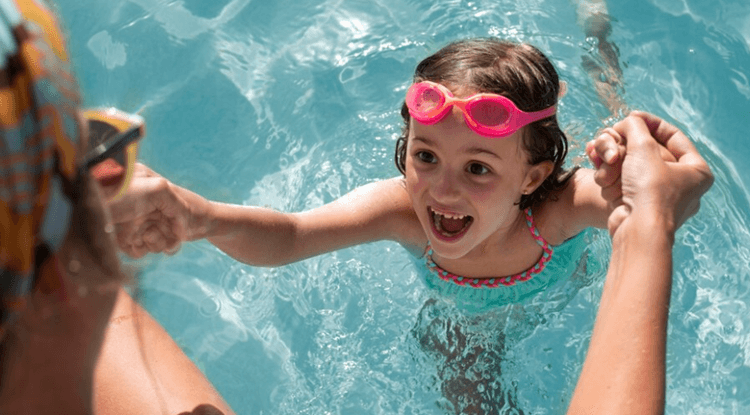
It’s usually a hand easing away from the wall or a face dipping under for one more breath while the rest of the body waits to see what happens next. This quietness is exactly what makes the first significant risk a child takes in a pool so powerful.
Because the water reacts quickly and honestly, providing clear feedback without being punishing, swimming introduces risk in a way that is remarkably effective at teaching judgment. Instead of carrying the weight of failure forward, children can experiment, recalibrate, and try again in a matter of seconds.
| Key factual context | Details |
|---|---|
| Typical age range | Many children begin guided swim lessons between ages 1 and 4, depending on readiness |
| Safety relevance | Swim instruction and water survival skills are linked to significantly reduced drowning risk |
| Physical impact | Low impact, full body movement suitable for varied fitness levels |
| Developmental effect | Supports coordination, confidence, emotional control, and judgment |
| Learning environment | Controlled pools with instructors, clear rules, and progressive challenges |
Swimming continues to be one of the few activities where adults routinely agree to step back, trusting a system that is structured, supervised, and significantly improved through decades of safety research. However, parents have become more cautious in recent years, sometimes exhibiting strikingly similar fears regardless of background.
Swimming does not hide its difficulties, unlike playground climbing frames or contact sports, and the water makes it very evident when balance is lost, breath is rushed, or energy is waning, transforming abstract lessons about boundaries into tangible experiences that kids can relate to.
Curiosity combined with self-control is rewarded in the pool because a child who kicks wildly will exhaust themselves quickly, whereas a child who listens, adjusts, and breathes deliberately will move forward sometimes surprisingly faster learning that effort alone is insufficient without awareness.
I’ve seen teachers wait an extra beat before stepping in, and that pause is frequently when a child realizes they are more capable than they thought.
Swimming lessons, which gradually introduce risk, help children learn that fear is not an indication to stop completely but rather information to be interpreted. This is especially helpful for the development of emotional regulation at a time when reactions frequently occur before reasoning has caught up.
Many children’s first lessons emphasize staying afloat rather than swimming forward, and floating is a subtly radical concept since it asks a child to trust the water instead of resisting it, turning natural tension into practiced calm.
By emphasizing control, posture, and breathing, instructors streamline movements and prevent children from flailing in panic, which is similar to learning to ride a bicycle slowly before attempting speed. This calm is not passive.
As a child jumps, another pauses, and a third follows, group lessons foster a rhythm of observation and imitation that feels noticeably better than forced participation because children watch one another closely and risk becomes social rather than competitive.
Additionally, swimming is a very adaptable learning environment because it can accommodate children of all temperaments, giving the bold enough structure to prevent overreach while allowing the cautious to move in inches.
From letting go of the wall to swimming a short distance by themselves, then turning back without help, and finally navigating the pool without continual visual reassurance from adults, the risks gradually change in a way that feels natural rather than forced.
This progression is important because it teaches kids that mastery is frequently the product of numerous small, flawed attempts rather than a single, decisive leap, and that confidence is developed through repetition and reflection rather than abrupt bravery.
Additionally, swimming teaches kids when to stop, which is a crucial skill in resilience discussions because identifying exhaustion and deciding to rest is a judgment that extends far beyond the pool.
A child who ignores signs of exhaustion quickly learns that strength must be managed, not spent recklessly. This lesson is especially pertinent in a culture that frequently celebrates endurance without discernment. The water also enforces honesty about limits.
Children learn that freedom works best within structure by practicing risk in an environment with clear rules and manageable consequences. This concept feels abstract on land but becomes real in the pool.
When a child jumps earlier than anticipated, parents who are watching from the sidelines frequently feel a mixture of pride and anxiety. However, these moments are carefully scaffolded and supported by teachers who have been trained to strike a balance between autonomy and safety.
In this way, swimming lessons are made to be incredibly dependable because they are a trusted setting for measured risk-taking because they emphasize repetition, supervision, and clear boundaries over improvisation.
Since children who learn to control their fear in the water frequently exhibit noticeably increased confidence in social situations, classrooms, and new situations where the stakes feel higher but the skills transfer, the emotional benefits subtly carry over into other spheres of life.
The idea that respect and confidence are partners rather than antagonists, each enhancing the other via experience, is reinforced as the pool grows accustomed over months and years without ever becoming reckless.
In order to help children develop realistic assessments of risk rather than false certainty, instructors take care to emphasize that swimming does not promise invincibility and that lessons are merely one layer of safety rather than a guarantee.
Perhaps the most important lesson of all is that realism, since children emerge from the pool knowing not only how to swim but also how to make decisions, having practiced courage that is deliberate, reversible, and based on awareness rather than instinct.