

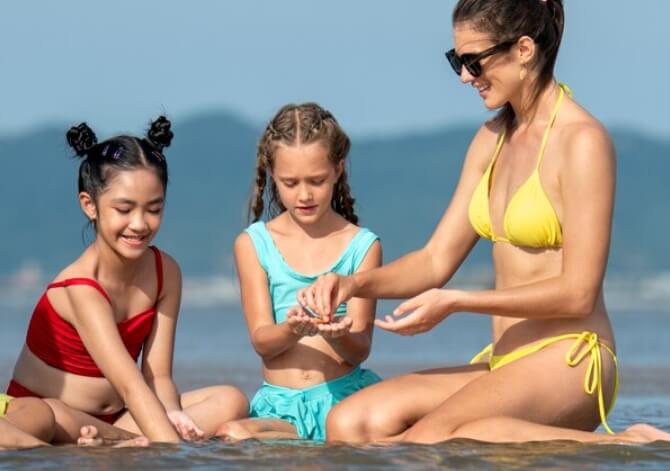
There’s a certain noise that beach towns make in late June, a combination of car doors slamming, kids yelling, and parents calling names into the wind. Beneath all of that lately, there’s another sound: a more subdued, methodical kind of preparation. Bookings for short, intensive courses that are specifically scheduled around half-term and summer vacation departures have increased noticeably, according to swimming lesson providers in the UK. It’s no longer the relaxed Saturday morning swim class. It’s more akin to training.
A UK-based company called Cindy’s Swim School has created whole seasonal programs around this change, specifically marketing crash courses for families traveling to the coast. The logic isn’t nuanced. According to statistics the school has cited from national drowning prevention data, over 40% of accidental drownings occur during the summer. This makes sense given that more people are near open water in July and August than at any other time of the year. It appears that parents have taken this in. A growing number of people believe that swimming ability and beach safety are no longer distinct issues, whether they have read the statistics or just seen the headlines.
| Category | Details |
|---|---|
| Topic | Family beach holiday safety and swimming lessons |
| Key statistic | Accidental child drowning deaths in England rose from 20 (2019–20) to 41 (2022–23) |
| Total reported | 125 children lost to accidental drowning over four years |
| Peak risk season | Summer, accounting for over 40% of accidental drownings |
| Leading safety body | Royal Life Saving Society UK |
| Common preparation | Crash-course swimming lessons before summer holidays |
| Key swimming skills taught | Floating, holding pool edges, calling for help, sea awareness |
Demand is not the only thing that has changed. It’s the lessons’ actual content. Water safety is increasingly incorporated into baby and toddler swim programs from the very first session, teaching babies how to float, reach for the pool’s edge, and distinguish between play and danger.
In an effort to promote water safety education earlier in a child’s development than was typical ten years ago, Water Babies, which is frequently referred to as the largest baby swim school in the world, has centered its entire safety messaging around this concept in collaboration with the Royal Life Saving Society UK. It’s important to remember that this is more than just marketing jargon.
According to RLSS UK, accidental drowning deaths among children have nearly doubled since 2019–20, rising from 20 to 41 over a three-year period, with a total of 125 children lost over four years. Such figures tend to alter the way organizations communicate with parents.
Additionally, there is a cultural undertone that is less quantifiable but nonetheless exists. A few years ago, swimming in the sea with small children was generally regarded as a matter of common sense: keep an eye on them, stay close, and don’t go too far. Rip currents, flag systems, tide tables, and sandbank drop-offs are some of the more structured terms used to describe it. A type of beach literacy that wasn’t previously felt necessary, or at least wasn’t discussed as openly, is now being demanded of parents.
Nowadays, beach safety guides frequently describe how to spot a rip current and, more crucially, what to do if you find yourself in one swim parallel to shore rather than against the pull. Most importantly, though, don’t panic. It’s difficult to ignore how much of this terminology has permeated common parenting advice from professional lifeguarding.
In response, swim schools have combined traditional stroke development with scenario-based safety training, introducing what they refer to as “rookie lifesaving skills” into more advanced sessions. Not only are kids learning how to swim more quickly, but they’re also learning what to do in the event that a sibling gets into trouble nearby or if they drift past a flag.
Since causality in safety education is notoriously difficult to separate from other factors like improved lifeguard coverage or more visible signage, it is still somewhat unclear whether this actually lowers drowning incidents in any quantifiable way. It’s hard to argue against teaching a child to recognize danger before they’re old enough to fully understand it, and the educators advocating this approach seem convinced it matters.
There’s a tension that runs through all of this that isn’t often discussed, and it came to light in an unexpected place: a parenting podcast where a mother talked about how her eighteen-month-old cried during every swim lesson and openly questioned whether she was violating her daughter’s bodily autonomy for the sake of safety.
The host, Janet Lansbury, a child development specialist, did not downplay the issue. She regarded it as a legitimate question with no simple solution. It serves as a reminder that, despite statistics and organized programs, beach safety culture still manifests itself in highly personal, occasionally awkward situations involving a parent and a sobbing toddler at a pool’s edge.
It’s evident that swimming lessons are no longer solely seen as a recreational milestone—the kind of thing you do because other kids do it. They are being presented more and more as preparation for a particular, predictable risk. It remains to be seen if that framing endures beyond this specific cultural moment or eventually fades like some health scares.
For now, however, swim school waiting lists are longer, beach parking lots are filling up earlier in the season, and parents are probably asking more pointed questions about flags and currents than they did five years ago. Even though no one can pinpoint the exact moment, something in the calculation has changed.
i) https://www.wiltshire.gov.uk/article/19031/Summer-water-safety-starts-in-the-pool-as-families-encouraged-to-book-swimming-lessons-now
ii) https://www.janetlansbury.com/2021/04/water-safety-bodily-autonomy-and-emotional-health/
iii) https://www.swimtastic.com/blog
iv) https://www.happiestbaby.co.uk/blogs/parents/beach-ocean-safety
v) https://bumpdateapp.com/blog/4-things-i-wish-other-parents-knew-about-isr-water-safety/