

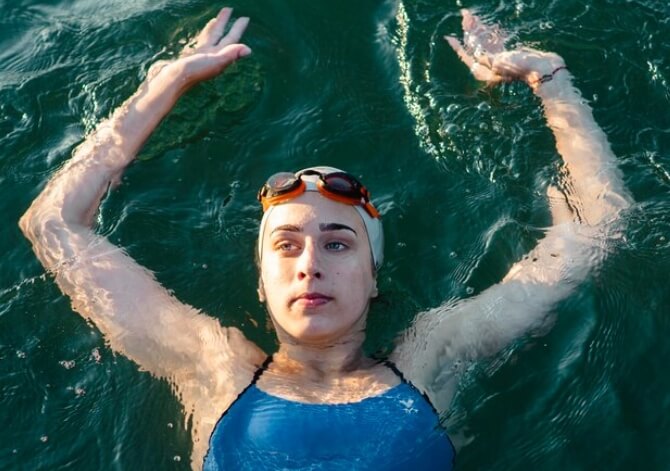
A beginner eventually stops fighting the water, usually around the third or fourth lesson. It doesn’t occur all at once. One lap they are crooked and gasping, slapping the surface with their arms as if to punish it, and the next they glide for perhaps four seconds longer. No one applauds. The swimmer is the only one who notices. Something has changed, and it usually happens when people realize they genuinely enjoy freestyle.
In theory, freestyle permits any stroke. The rule is that. When given the option, very few swimmers do anything but front crawl, and the reason is more mechanical than artistic. In a way that breaststroke and butterfly just cannot match, the arms move in opposition to one another, the legs kick in a steady alternating rhythm, and the entire arrangement maximizes propulsion while minimizing drag. It’s more of a successful compromise than a stroke.
It’s not that freestyle is simple that makes it accessible to novices. Really, it isn’t. The forgiving nature of the learning curve is the reason. Rough technique swimmers can still advance, albeit slowly and carelessly. The underwater recovery phase will quickly humble you if you try that with breaststroke. The majority of adult learn-to-swim programs start with freestyle for a reason. People are encouraged to return to the pool deck rather than giving up after a frustrating session because it rewards small improvements almost instantly.
| Category | Details |
|---|---|
| Stroke Name | Freestyle (Front Crawl) |
| Also Known As | Front crawl, the fastest competitive stroke |
| Best For | Beginners, sprinters, and long-distance swimmers alike |
| Core Skills | Body position, breathing, pull, and kick |
| Calories Burned | Roughly 529 calories per hour for a 150-pound swimmer |
| Common Injury Risk | Shoulder strain from repetitive motion |
| Race Distances | 25 yards up to 25 kilometers |
When one is in a certain body position, everything tends to either stay together or fall apart. New swimmers frequently swim with their hips sinking and their head raised, an instinct that feels safer but has the opposite effect. It seems a bit paradoxical. The explanation doesn’t make sense until someone feels it, but the water actually supports a horizontal body better than a tilted one. It takes years for a student to understand what coaches are saying, and there is a nearly universal delay between hearing advice and having enough faith in it to put it into practice.
Breathing is a unique form of grief. Instead of rotating to the side, the majority of beginners attempt to raise their head straight up, gasping as if they have just surfaced from underwater, which leads to a stroke that breaks apart in real time. The hips fall. The beat falters. One bad breath can ruin someone’s entire technique, demonstrating the true interdependence of these abilities. In contrast, a clean breath is hardly noticeable. The goal of the best swimmers is to appear as though they are not breathing at all.
The majority of the real work, the unglamorous task of pushing water backward so the body moves forward, is performed by the pull. Without realizing it, beginners often shorten this, slicing their hand through the water rather than catching the resistance of a full paddle. There is a claim that in the pull, feel is more important than strength. It’s not about using force. It’s about timing, angle, and a level of patience that doesn’t come easily to someone who is worried about surviving.
In contrast, kicking is consistently undervalued. It’s actually more of a stabilizer than propulsion, as most people think it’s just an engine bolted on for extra speed. The entire body twists out of alignment when the hips sink due to a weak or poorly timed kick. There is no universally accepted number of kicks per stroke cycle; some swimmers kick twice, while others kick six times. Body type, flexibility, and even swimming distance all play a role. Many novices are surprised by the fact that elite swimmers don’t all kick in the same way.
All of this has an emotional component that is rarely covered in technique manuals. Adults who are learning freestyle may feel more vulnerable than they anticipate. In front of strangers, you lack coordination. You ingest water. You make unfair comparisons between yourself and the swimmer in the adjacent lane. It’s important to keep in mind that before any of this became automatic, even competitive swimmers were just this awkward, splashing and overcorrecting.
Due to the intense repetition and wide range of motion required for each stroke, injuries do occur, primarily to the shoulders. It’s a stroke that puts a lot of strain on one joint thousands of times in a single workout. Here, pacing is more important than enthusiasm, which is something that novices usually discover on their own instead of being taught.
Natural talent doesn’t seem to be what distinguishes those who continue freestyle from those who quietly give up. It’s acceptance of gradual, sometimes imperceptible advancement. Urgency is not rewarded by the water. It rewards the swimmer who is prepared to feel a little silly for a few weeks in the hopes that the feeling of gliding will eventually surpass the feeling of gasping. The majority of those who stay long enough discover that it does.
i) https://www.usms.org/fitness-and-training/guides/freestyle
ii) https://restube.com/blogs/news/freestyle-swimming
iii) https://puddlesswimschool.com/blogs/adult-swimming-lessons/
iv) https://www.aquaducks.com.sg/how-to-swim-freestyle/
v) https://www.wikihow.com/Swim-Freestyle