

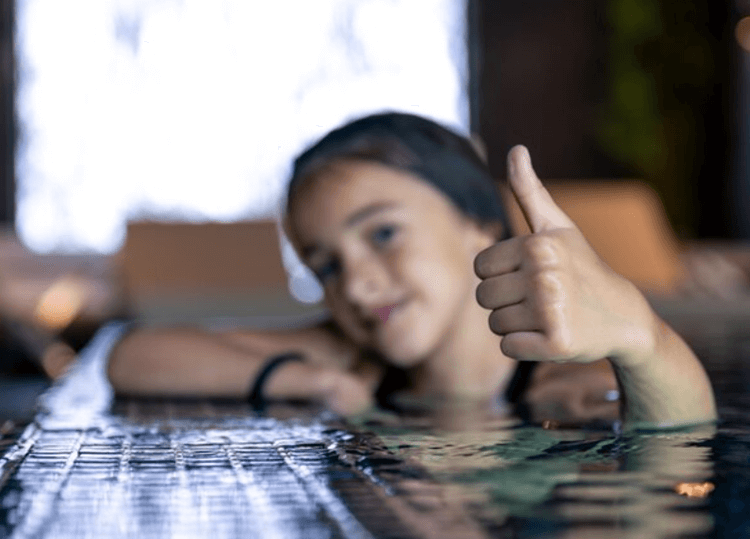
Early in the evening, when the lane lines are motionless and the water hardly moves, a certain silence descends upon a pool. After a few teenagers enter with goggles on, the outside world homework, group conversations, and the mild social anxiety that comes with being sixteen disappears beneath the surface in a matter of seconds. It is not magical. However, it’s sufficiently close.
Observing this occur week after week at swim clubs across the nation makes it difficult to ignore the fact that something other than fitness is occurring. Teens are going back to the pool because it provides them with something that is truly difficult to find elsewhere: a place where the noise stops, in addition to helping them get faster.
| Governing body | World Aquatics (formerly FINA) |
| Primary age groups | 10 & under, 11–12, 13–14, 15–18 |
| Weekly training load (competitive teens) | 7–10 sessions per week |
| Key mental benefit | Meditative repetition; stress reduction; mood regulation via endorphin release |
| Physical benefit | Full-body, low-impact; joint-friendly; builds endurance and power |
| Peak participation age (Sweden data) | 12 years old – sharp drop off follows |
| Notable alumni | Katie Ledecky, Michael Phelps, Sarah Sjöström, Therese Alshammar |
| Reference | worldaquatics.com |
The head coach of Sweden’s national performance team, Ulrika Sandmark, has talked extensively about the precipitous decline in swimmer participation that occurs at age twelve. Puberty, school pressure, and social life all pull in different directions, causing the number of children in the water to peak there before sharply declining. It’s a serious issue for the depth of the sport. Interestingly, though, a lot of the teenagers who do stay or return after a vacation use nearly the same description of the pool: it’s where they go to unwind.
That expression appears so frequently for a reason. The mental demands of swimming are unique from a physical standpoint. Between laps, you can’t check your phone. While someone else completes the difficult task, you are unable to relax. Whether the swimmer intended it or not, the rhythm of breathing, the repetition of strokes, and the feeling of moving through water as opposed to a hard surface all contribute to a state that is similar to meditation. That involuntary calm is significant for a generation of teenagers juggling the demands of school, family expectations, and the never-ending scrolling of social media.
When you ask nearly every high school student who continues to participate in competitive swimming throughout their junior and senior years, the response is almost never “because I thought I’d go D1.” More often than not, it sounds like what swimmer Josie Wise, who grew up through summer leagues, said about her last years in her age group: the pool was a “safe space” where the chaos of high school seemed manageable, at least for a few hours each day. She said that staring at a black line for hours on end actually relieves some of the tension. Until you do it, it sounds ridiculous. Then everything makes perfect sense.
Swimming’s connection to time and advancement contributes to its effectiveness as a mental anchor for teenagers. Swimming has a way of humbling everyone equally, in contrast to most aspects of teen life, where success is visible, comparative, and frequently public. The bad times don’t last forever. Shaving seconds gets harder the longer you swim, as coach Rachel Jenkins has pointed out. It is possible for a swimmer to gain one hundredth over the course of a season. It’s not a lack of effort. It’s simply the way the body functions. Additionally, teaching teenagers to distinguish their value from the clock is a truly crucial lesson for those who are accustomed to being measured all the time. This slower, more inward kind of development may be part of the reason why the sport subtly fosters resilience in ways that manifest later in life, such as in relationships, classrooms, and how you deal with setbacks.
Teenagers value the physical advantages in ways that go beyond performance. Swimming strengthens the entire body without causing joint deterioration. After an hour-long session, you won’t wake up the following morning with the kind of soreness that makes you dread returning. Having a physical practice that feels good and isn’t punishing is more valuable than it might seem for teenagers whose bodies are changing in ways they can’t always control or understand. Swimming for extended periods of time releases endorphins, which have been shown to improve mood. Teenagers are particularly vulnerable to the negative effects of winter and academic stress, so the pool has a kind of subliminal therapeutic effect that many people rely on but no one officially prescribes.
A swim team’s social architecture is another aspect that should not be overlooked. You hang out with the same people for fifteen hours every week. Together, you travel to meetings. Exhausted, you crawl into hotel beds after standing around in chilly natatoriums supporting one another. The friendships that emerge from that experience are typically more resilient than most. Teenage swimming coaches frequently notice that the team itself turns into a social environment, which is crucial during high school when peer acceptance is paramount.
Nevertheless, there are conflicts in the sport. Concerns about body image are legitimate. Early morning routines go against the current understanding of teenage biology by sleep researchers. Additionally, something that began as joy can become something that feels obligatory due to the pressure to cut time, which is subtly conveyed through parental expressions, missed celebrations, and nervous meet-day energy. Adolescents who continue swimming are typically those who eventually find a parent or coach who is prepared to consider the wider picture. Who realized that whether a swimmer still wants to be in the water at seventeen is more important than what happens in the water at fifteen?
It appears that the most resilient form of swimming for teenagers isn’t the one based solely on cuts and times. It’s the one where the pool is permitted to serve as more than just a venue for competition; even as the stakes rise, it continues to be a place to move, breathe, and momentarily escape everything else. Offering a teenager something like that is not modest. The black line at the bottom of a lane may be one of the better ones we have in a world that is finding it more and more difficult to provide young people with even a single quiet place.
i) https://www.swimmingworldmagazine.com/news/growing-up-through-the-eyes-of-an-age-group-swimmer/
ii) https://thelaneline.wordpress.com/2020/01/13/times-arent-everything-why-swimming-is-more-than-just-the-clock/
iii) https://theswimmingexpert.com/swimming-personal-best-times/