

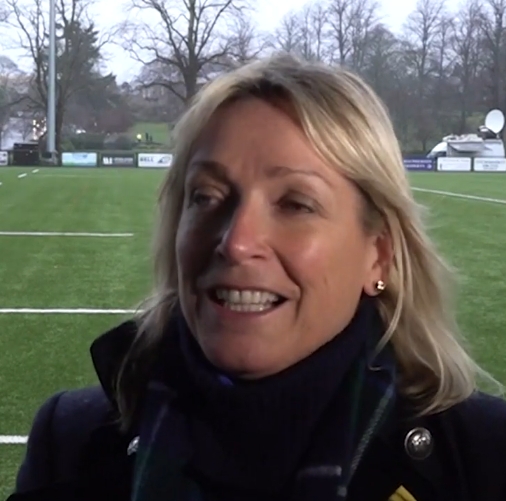
Being on television for thirty years brings with it a certain kind of attention. Every haircut attracts attention. Every change in your energy and, unavoidably, your appearance. When viewers started making comments about her noticeably altered appearance, Jill Douglas, the Scottish sports presenter who has anchored coverage of everything from the Rugby World Cup to the Olympic Games, faced quiet but unmistakable scrutiny.
There aren’t any dramatic disclosures or attention grabbing surgery confessions in the Jill Douglas weight loss story. The lack of noise is exactly what makes it intriguing. She hasn’t organized a press conference around it. The phrase “my transformation journey” has not appeared on the cover of any glossy magazine photo shoot. That self-control makes some sense for a woman who has made a living by asking the questions rather than responding to them.
What is known and it’s important to be clear about what isn’t is that Douglas seems to have taken a disciplined approach to both exercise and nutrition. The details are still hers. It’s unclear if that was the result of years of making healthier choices, a structured diet plan, or a fitness regimen. A shift in priorities that many people experience in their mid-fifties, when the body begins to make demands that cannot be delayed, may be the cause of the change.
If anything, Douglas, who turned 56 in December of last year, appears more alert and focused on screen than she did in the past. She seems to carry herself differently, not with the anxious vigor of someone attempting to prove something, but with the quiet assurance of someone who has just made the decision to look after herself better. Even if they are unable to express it clearly, viewers seem to sense this important distinction.
It’s difficult to ignore the fact that one of the most trying times in her life has coincided with this metamorphosis. Since taking over as CEO of the My Name’5 Doddie Foundation in 2017, a charity founded by Scottish rugby legend Doddie Weir to support motor neurone disease research Beyond her work as a broadcaster, Douglas has carried an emotional burden. Weir passed away in November 2022. Losing a combat partner alters your life. Those who have experienced such grief frequently come out of it with a new perspective on what is important. Unsurprisingly, health tends to rise higher on the list.
In a podcast with fellow presenter Gabby Logan, she candidly discussed midlife motivation and how she has become more, not less, driven as she has aged. That is consistent with what we are witnessing. In many respects, the discussion surrounding Jill Douglas’ weight loss is actually about a woman who has subtly decided to change how she presents herself in the second half of her life.
Her professional path has consistently indicated that she is a dynamic individual. She began her career at a local Scottish newspaper, received training at Edinburgh’s Napier College, anchored regional news on Border TV eventually made her way to Sky Sports, the BBC BT Sport ITV, where she covered some of the most emotionally charged sporting events of the previous thirty years, including the Olympics and the Six Nations. In a field that is so focused on youth, such longevity is not something that happens by coincidence. It occurs as a result of someone’s constant adaptation.
It’s difficult to predict whether the weight loss will continue to garner attention or fade into the background of a demanding career. It is evident that Douglas has little desire to make it the narrative. She would much rather talk about many other topics.