

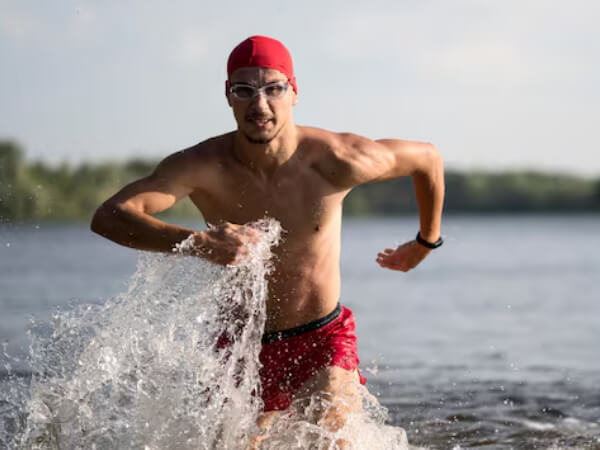
It takes a certain kind of insanity to look at forty kilometers of open water and say, “Yes, that’s the goal”. It’s not a pool lane or a serene lake on a still morning open ocean, with currents, jellyfish salt in every crevice of your face after ten to fourteen hours of nonstop swimming. New Plymouth, New Zealand resident Paul Feltoe, 45, has done it multiple times. In the six months leading up to a major race, he builds up to 35–40 km “per week” in preparation for swims like the Molokai Channel in Hawaii, which is over 40 km of infamously choppy Pacific water.
It’s not just the volume that makes this type of training remarkable. When your body begs for rest, it’s the discipline of structure. Feltoe usually swims in the ocean for 15 to 20 kilometers every couple of weeks after running four pool sessions and one open water swim each week. Most people seem to underestimate the cumulative nature of these sessions; it’s not about hammering out one heroic long swim. It involves gradually persuading your body that being far away is just… normal.
Working in stages is necessary to prepare for a 40-kilometer event. Aerobic steady, controlled distance at a pace you could maintain for hours is the main focus during the first few months. While short intervals are useful for preserving stroke efficiency, anyone preparing for an ultra-marathon distance must fight the urge to chase speed.
Time in the water, not clock times, is the aim of training. The majority of coaches who work with open water swimsuits at this distance advise increasing weekly volume at a rate of no more than 10–15% per week in order to prevent shoulder injuries and fatigue, which typically manifest subtly before becoming painful.
Many otherwise well-prepared swimsuits fall short when it comes to the feeding plan, which is where things really get complicated. The majority of serious ultra-marathon swims are governed by English Channel regulations, such as Feltoe’s ban on touching the support boat. Bottles or bags are thrown to the swimmer while they are treading water, or they are passed on a pole. Usually, stops last between thirty and sixty seconds.
Feeds every 30 to 45 minutes are crucial for both calories and psychological rhythm during a swim lasting more than ten hours. The majority of swimsuits use a combination of real food in the later hours (bananas, rice balls, small sandwiches), liquid nutrition (maltodextrin-based drinks, electrolyte mixes) caffeine in the last stretch when the mind begins to wander. It takes practice in training, not improvisation on race day, to get used to eating while cold, while moving while feeling queasy from saltwater.
During his lengthy training swims, Feltoe has expressed that he feels as though the lifeguards believe he is a little crazy. It’s possible that long-distance swimming encourages a willingness to continue moving even when stopping seems like the only sensible course of action in order to achieve true comfort with discomfort.
There isn’t enough talk about the psychological aspects of 40km. Most swimsuits enter what is sometimes referred to as the “dark middle” around the halfway point of an ultra, which is too far in to feel close to the beginning and not close enough to the finish to find inspiration. The only way to develop the resilience for that stretch is to train in the open ocean under actual conditions.
It’s difficult to ignore how much of this sport depends more on perseverance than motivation. Paul Feltoe did not accidentally become an ultra-marathon swimmer. He has been recording every session for years, making the weekly mileage goal unachievable. That habit takes precedence over the distance plans. The feed schedule is important. The mileage is more important.
i) https://blog.myswimpro.com/2018/09/25/oceans-7-circuit-training-for-ultra-marathons-with-myswimpro/
ii) https://williamstownopenwaterswimcoaching.com/2022/09/20/how-to-train-for-a-long-distance-swim-event-or-tri/
iii) https://www.usms.org/fitness-and-training/articles-and-videos/articles/how-to-train-for-a-long-open-water-race