

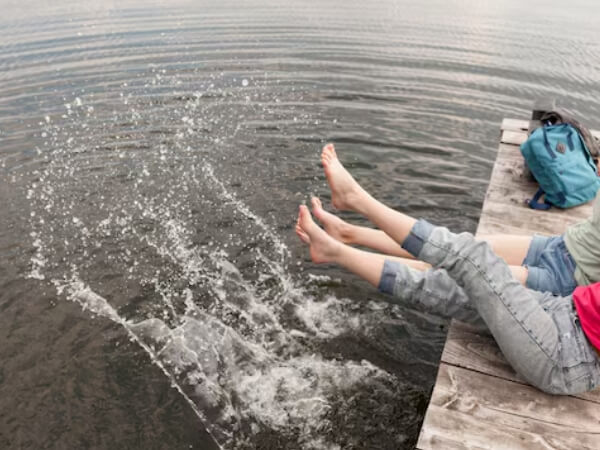
A British heatwave has an almost irresistible quality. People cram themselves into their cars with rolled towels tucked under their arms and drive to the closest river, reservoir, or stretch of coast as soon as the temperature rises above twenty degrees. Somehow, all those gloomy months are finally paying off. The water those sun-warmed bodies are diving into has not received the same memo as the weather it is this mismatch quiet and easy to overlook that kills people every summer.
The body’s involuntary response to abrupt submersion in water below 15°C is known as cold water shock. Even in the hottest summer months, UK coastal waters hardly ever rise above that threshold, which makes it seem extreme and possibly even hypothetical. Inland lakes and rivers may be even lower.
Even though the sky is a picture-perfect blue and the air is scorching, your nervous system recognizes an emergency and reacts appropriately as soon as your skin touches water. Even proficient swimsuits may find it difficult to overcome the uncontrollable gasp, heart rate spike nearly instantaneous increase in breathing rate. After entering, the entire cascade can start in a matter of seconds.
The false confidence that the heat creates is what makes summer especially dangerous. Open water is approached cautiously, if at all, during the colder months. The risk calculation changes during a heatwave. Inhibitions diminish.
Careful thought is subordinated to the need to cool down. Instead of wading, people jump. They have a drink before. They swim farther out than they had planned. Two out of every five outdoor drowning incidents in 2022 were caused by cold water shock, according to research into the heatwaves that caused temperatures in the UK to rise above 40°C for the first time ever.
That statistic is not out of the ordinary. The Royal Life Saving Society Additionally, the UK has found that accidental drownings are roughly five times more common on days with average temperatures above 17°C than during cooler times. Swimsuits are not protected by warmer days. They reveal them.
Understanding the physical mechanics of what occurs is important because it may be able to save someone’s life. Following the initial gasp reaction, breathing turns into shallow, rapid hyperventilation that is uncontrollable.
Then comes disorientation. At this point, a lot of inexperienced swimsuits automatically turn upright in the water, which is exactly the position that decreases buoyancy and increases the risk of going under. The first ninety seconds are crucial. The acute reaction starts to fade if a person can maintain composure, remain horizontal resist the impulse to thrash or struggle with the water.
The RNLI’s seemingly straightforward advice, “Float to Live”, is physiologically sound: tilt your head back, submerge your ears extend your arms to let your body do what water permits. From a deck chair, it sounds simple. It’s not in cold water, when your heart rate spikes and your chest tightens.
Cold water poses a second, less well-known risk even after the shock phase: cold incapacitation. This is what occurs when a swimmer who felt fine twenty minutes ago finds that their body is no longer cooperating, their limbs are slowing down their stroke is becoming shorter. Muscles lose their power source as blood returns to the core organs.
When you’re halfway across a lake and your arms start to feel like they belong to someone else, a seemingly crossable lake becomes completely different. Experienced open water swimsuits discuss staying close to the shore for a reason: distance is the variable they can most consistently control, not because they are timid.
This summer, preparation is more important than bravado if you’re going to open water. Let your body adjust as you slowly enter. If you have a wetsuit, wear it; it will blunt the shock response but not completely eliminate it.
Select supervised areas whenever you can, abstain from alcohol never swim by yourself. Refrain from intervening if you witness someone in danger. Request HM Coastguard by dialing 999. Throw a floating object. You run the risk of making two victims rather than just one if you go into the water yourself.
Seeing summer after summer go by with the same tragedies featured in the same headlines makes it difficult to avoid feeling as though the message isn’t quite being understood. Extreme athletes are not at all concerned about cold water shock. Anyone who steps off a sunny riverbank and believes the fun starts right away runs the risk.
i) https://www.metoffice.gov.uk/blog/2025/cold-water-shock-how-to-stay-safe
ii) https://www.redcross.org.uk/stories/health-and-social-care/first-aid/five-things-to-know-about-drowning-in-open-water