

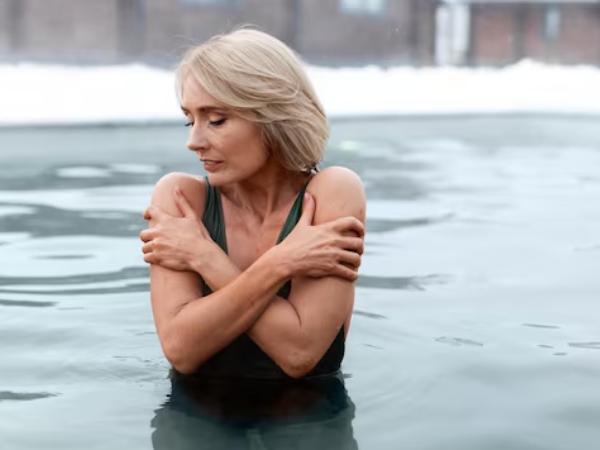
When you’re standing next to a tub of cold water with a thermometer in your hand and no steam rising from anything, there’s a moment when you genuinely question whether the number that’s staring back at you really matters. Everybody has a viewpoint. The gym guy is adamant that the only true threshold is 38°F. A colleague swears by 55°F. Some online influencer is pretending it’s Tuesday while submerged in a frozen lake. Perhaps they are all benefiting from it. This does not imply that temperature is unimportant.
It isn’t. In cold water immersion, temperature is perhaps the most important factor more so than duration, frequency, or the type of tub you’re sitting in. If you do it correctly, your body will respond to the practice. If you’re too cautious or too forceful, you’re either wasting time or permanently frightening yourself away.
The ideal temperature range for the majority of people is consistently found to be between 50 and 59°F (10 and 15°C). That’s where the physiological machinery really comes into play, not because it’s arbitrary. Blood vessels narrow.
The neurochemical responsible for focus and mood regulation, norepinephrine, floods the system. The skin protests, the breath catches the shock is genuine. That’s the idea. To elicit those reactions, you don’t have to descend. For most beginners, the trade-off is not worth it because colder water simply reduces the amount of time you can tolerate it.
Start at the warmer edge, between 57 and 60°F, if this is unfamiliar territory. It’s still really chilly. It will feel more difficult than anticipated during the first 45 seconds. It’s easy to see starting warm as a sign of a lack of ambition, but this isn’t the case.
When beginners jump right into 40°F water, they typically have one terrible session and quietly quit the entire endeavor. For that, there is no badge. Progress necessitates a first session that doesn’t feel like punishment in order to return.
The rate of adaptation is higher than most people anticipate. Every week, the temperature drops by one or two degrees after a month or two of regular sessions, the once-impossible temperature begins to feel almost normal. Experienced cold plungers frequently settle between 39 and 50°F because the body has adapted and requires a stronger stimulus to produce the same response, rather than because they are chasing extremes.
It’s important to note that the temperature doesn’t always remain where you set it during a session. Setups with ice and water melt. The weather affects outdoor tubs. It can be challenging to monitor progress or determine what is truly effective when a session is held at 52°F one morning and 62°F the next week. This is the quiet, pragmatic case for temperature-controlled equipment not luxury, but repeatability. Consistent input is necessary for a consistent practice.
It’s frequently overly complicated, duration also matters. According to research, the majority of the quantifiable benefits can be obtained with about 11 minutes of cold exposure per week, spread over multiple sessions.
Two to three-minute plunges can significantly improve mood and reduce anxiety. For the purpose of lowering inflammation and muscle soreness, longer sessions lasting five to ten minutes are typically more beneficial. In all honesty, both are effective; the more important question is which one you plan to repeat tomorrow.
There seems to be a performance culture surrounding cold plunging: the more dramatic the content, the longer the bravery the colder the better. The value of the practice is lost in that framing. Your dedication has no bearing on the water. It reacts to physics rather than willpower. The key is to find a temperature that causes a real physiological reaction that you can maintain, repeat build upon. Theater is everything else.