

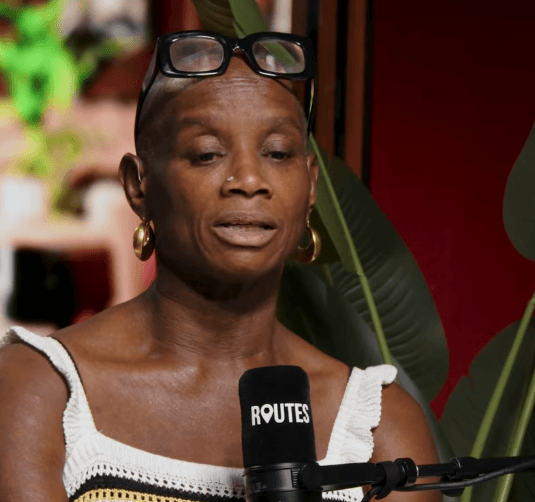
Witnessing someone who has fought their own body for decades come to peace is subtly amazing. Over the past four and a half years, Andi Oliver, the chef, broadcaster velvet-voiced host who has turned Great British Menu into an event rather than a program, has lost five stones. She is sixty-three years old she isn’t talking about how she accomplished it. She is communicating in a straightforward manner that inspires total trust.
Peloton training and significant dietary adjustments helped achieve the first three stones. It was the slow, grinding discipline of showing up on the bike and paying attention to what she was eating, not fads or dramatic elimination. It’s the kind of unglamorous work that doesn’t often make news, but it was important.
Mounjaro, the weight-loss injection that has emerged as one of the most talked-about pharmaceutical innovations in recent years, was what altered the last chapter. Oliver said, “The jab was brilliant for me”, to Good Housekeeping. “I can’t recommend it enough and I’m not ashamed of it”. After six months, she stopped because she had reached a weight where she felt stronger instead of just smaller.
When you read her story, you are struck by how well she captures the mental aspect of it all. She was playing squash, riding her bike going to the gym even when she was at her heaviest. Effort was never the issue. “My mind is no longer a cacophony of “Should I? She described what Mounjaro had given her, saying, “Shan’t I?’ about food. The phrase “the noise stopping” is worth pondering. That description sounds like a diagnosis you didn’t realize you needed to anyone who has experienced that specific exhaustion and the ongoing struggle with hunger and guilt.
Oliver has previously discussed how her brother Sean’s tragic death from sickle cell anemia at the age of 27 contributed to her compulsive eating disorder, which sent her into residential care in her thirties. She continues to see herself as recovering. therapy once a week, if her schedule permits.
This background is important because this isn’t a story about weight loss taken out of its context; rather, it’s about a person who has had a difficult relationship with food for a long time and has finally found something that worked after decades. She takes care not to simplify it too much. “I still love food, but it’s both my best friend and my challenge”, she said. This kind of honesty might be more elusive than the five stone itself.
She also discusses shame in a way that is noteworthy. Directly, honestly without regret. She claims that being overweight makes one feel alone. You are deeply ashamed. She talks about it anyway because she believes it might be helpful to someone else it’s difficult not to get the impression that she truly means it when you watch this happen in interviews and magazine features not in a performative way, but in the way of someone who has earned the right to speak honestly about difficult things.
She knows exactly where she wants to end up. Strong, slender attached to her body. She was present in her own skin in a way she hadn’t felt in years not skeletal, not aiming for some externally imposed ideal. “I was walking like a Weeble for two, nearly three, years”, she said, referring to the time before her knee physio healed and she was able to resume regular training. She went hard as soon as it did. “The fitting for this shoot was fantastic I could wear anything on the rack”.
Thrown out with characteristic wit, that line says more than a contemplative paragraph could. The satisfaction of just fitting into clothes off the rack after years of struggle is not insignificant. It’s a particular kind of relief. Mounjaro, the Peloton, or any one intervention isn’t the main focus of Andi Oliver’s weight loss tale. It tells the story of a woman who overcame all obstacles to return to her own body by refusing to give up on herself.