

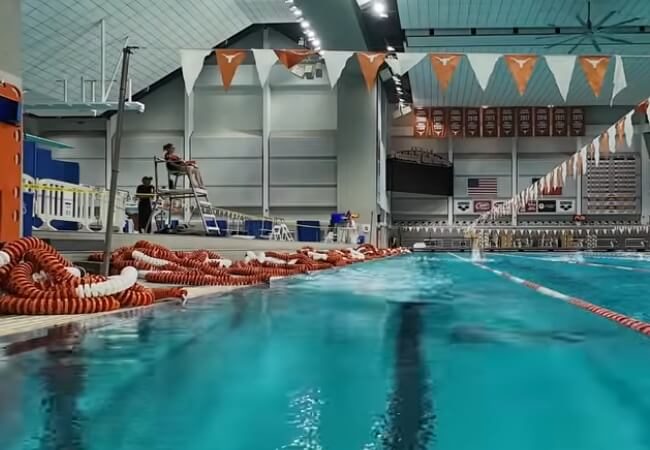
The atmosphere of a competition is altered when records are broken in the California sun. With two years until a home Games, the 2026 Para Pan Pacific Championships, held at Mt. San Antonio College in Walnut, were meant to be a benchmark, one of those international competitions that shows where things stand. It had already transformed into something completely different by the end of Day 2.
As soon as Katie Kubiak touched the wall during opening night’s preliminary round, she became the talk of the town. With only three years of paraswimming experience and congenital myopathy, the Wisconsin swimmer finished the women’s S5 50 butterfly in 37.21 seconds, almost a full second faster than the world record set at the Paris Paralympics.
From what anyone observing could tell, the crowd’s response appeared to be a mix of controlled excitement and genuine surprise, which is what happens when people are unsure of what they have just seen. Kubiak didn’t end there. Additionally, she achieved a time of 1:16.10, which was 17 seconds faster than the women’s S5 100 freestyle American record set by Alyssa Gialamas in 2015.
It’s important to note that the 17-second difference is not a slight improvement; rather, it’s the kind of difference that leaves you wondering what was going on before. By the end of Saturday’s session, Kubiak had set four personal records in the first two days, including the S5 50 backstroke American record.
She only started para swimming in 2023, but the fact that she has already won four gold medals at the 2025 World Para Swimming Championships suggests that she has either discovered something in the water or is just at a level that the sport isn’t quite tracking yet. Most likely both.
World records in breaststroke from programs outside of the United States were also awarded on the second day. Alessandra Oliveira Dos Santos, 18, of Brazil, broke her own world record for the SB4 100 breaststroke, clocking in at 1:40.63, almost a full second faster than her previous benchmark set in December 2025.
A teen’s self-improvement in less than a year is the kind of development that coaching staff who monitor these things usually notice with quiet alarm. In the very next event, Naohide Yamaguchi of Japan lowered his own SB14 men’s 100 breaststroke world record from 1:02.53 to 1:02.38. On the same Saturday, two world records from two different countries were set in successive events. It’s not a typical evening anywhere.
But the American story of the meet extended beyond Kubiak. Ali Truwit, a two-time silver medalist in the Paralympic Games and the swimmer who founded the $400,000 Stronger Than You Think Performance Incentive Fund the first prize-money program of its kind in US paraswimming broke her own American record in the S10 100 backstroke, finishing in 1:08.40 to earn a silver medal.
After discovering that 57% of Team USA athletes make less than $50,000 a year, Truwit established the fund. In a sport that has traditionally offered very little money, the $10,000 world-record bonuses she incorporated into the program are real money. On opening nite, Kubiak and Leanne Smith both received that bonus.
Mallory Weggemann, a 37-year-old veteran who may be competing in her fifth Paralympic cycle, won gold in the SM7 200 individual medley in 2:54.60. She is from Eagan, Minnesota has been competing at this level long enough for younger swimsuits to have grown up watching her.
After the race, she remarked, “Having Para Pan Pacs on home soil two years out from LA28 is really exciting”. “We’re marching toward a home Games I think that’s awesome” . Observing a swimmer who has been competing at the front of the field since before the majority of her rivals were teenagers makes it difficult not to feel something.
Day 2 saw Evan Wilkerson gain momentum as well. He would end the meet on Sunday with a world record of his own in the S11 men’s 100 backstroke. About a month before the competition, he was reclassified from S12 to S11, which created a degree of uncertainty that might have caused a less confident competitor to falter.
Rather, under his new classification, he had already broken four American records at the Jimi Flowers Classic when he arrived in Walnut. There’s a feeling that the reclassification might have opened a new chapter he was already prepared to write rather than making things more complicated.
As it has done at every Para Pan Pacs event since the meet’s establishment in 2011, Australia topped the overall medal standings. Whether any country can close that gap by LA28 is still up in the air.
Six world records set over three days in California, including a string of American records in almost every event category, indicated that the gap might not be as great as it appeared prior to Walnut. The US Paralympic swimming team did not just do well here, with 23 months remaining before Los Angeles. They responded in some way.