

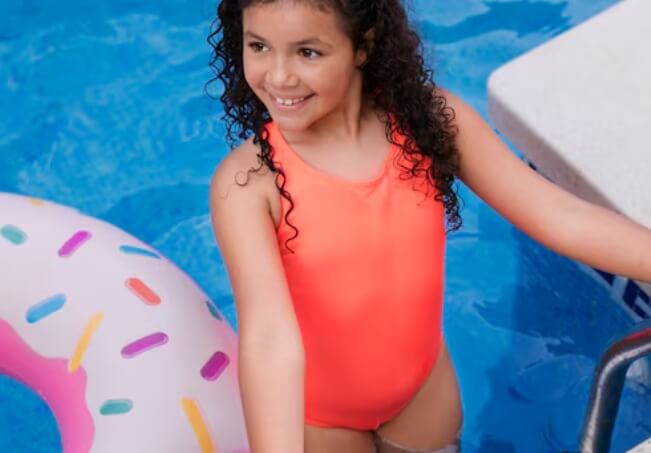
On the first warm Saturday of summer, a certain kind of chaos takes place at a public pool. Parents struggling with the straps. A toddler who won’t wear anything. A small child running somewhere close to the shallow end in a swimsuit that was two sizes too big, the waistband falling with each stride. It’s difficult to ignore how much of that morning hinges on one tiny, easily missed detail: the child’s actual attire in the water.
Children’s swimwear was practically ignored for years. You bought something inexpensive, reasoned that it would be outgrown by August anyhow, and moved on. That way of thinking has subtly changed. The options are nearly overwhelming when you walk into a store like Simply Swim or browse a brand like Muddy Puddles. swimwear with long sleeves. Surfwear. vests with rashes. ponchos made of towels. Changing robes. They all made promises that the previous generation of swimwear didn’t even bother to bring up.
| Information | Details |
|---|---|
| Topic | Swimming Suit For Kids (Children’s Swimwear) |
| Common Types | One-piece swimsuits, swim shorts, bikinis, rash vests, surf suits, towel ponchos, changing robes |
| Key Feature | UPF 50+ sun-safe fabric for skin protection |
| Typical Materials | Recycled, quick-drying, machine-washable performance fabrics |
| Leading Brands | Speedo, Zoggs, Muddy Puddles, Splash About |
| Size Range | Baby/toddler through pre-teen and competitive teen sizing |
| Useful Accessories | Goggles, swim caps, sun hats, pool games, training aids |
| Price Range | Budget-friendly to premium, depending on brand and features |
| Reference Website | https://www.speedo.com |
The sun is responsible for the majority of that change. In response to parents’ increased awareness of the harm that too many summers of unprotected skin can cause, brands have designed swimwear with UPF 50+ fabric. The pitch is straightforward, almost comforting: you don’t have to worry about reapplying sunscreen every twenty minutes, and kids can splash around all day. This seems to be more than just marketing. Families’ expectations for swimsuits have truly changed, and the entire market is changing as a result.
The issue of materials comes next. Many of the more recent collections are made from recycled materials, are machine washable and quick-drying, and are made to withstand a harsh summer without being passed down to a younger sibling. It’s still unclear how much of the sustainability language on a brand’s label stands up to scrutiny. The durability aspect seems genuine. Swimwear suffers the most from children‘s extreme treatment of clothing being soaked, stretched, and dragged over uneven poolside concrete.
Here, the big names still have a lot of weight. Since they have been in business long enough, Speedo and Zoggs have gained the kind of trust that is difficult to replicate, the kind of brands that parents instinctively choose. Like any heritage brand, Speedo had its share of rivals over the years, but it managed to maintain its hold on both the casual family market and the competitive lane. It’s strangely heartwarming to see that devotion transfer from one generation to the next. At school galas, many adults who are now purchasing for their own children used to wear the same logo.
Looking closely, I was most surprised by how much consideration is now given to the little things. goggles with an adjustable nose bridge and a soft seal fit. Wet hair won’t be pulled by a split-yoke silicone strap. These are insignificant engineering choices that are simple to ignore until you witness a six-year-old lose it due to a pinching goggles. The difference between a swimsuit that is balled up at the bottom of a beach bag and one that is worn again is frequently determined by how well those details are done.
Recalling the true purpose of these garments is helpful. One of those subtle rites of passage that connects a child splashing in a paddling pool today to an adolescent performing laps ten years from now is learning to swim. That trip goes a little more smoothly if you wear the appropriate suit. Simply put, a child is more inclined to enter the water when they are at ease, covered, and free to move. Additionally, early-developed confidence in the water tends to stick.
All of this does not imply that choosing the less expensive option is always incorrect. Sometimes a toddler will actually outgrow everything by the end of a single vacation, and it seems a little ridiculous to spend a fortune. A middle ground is beginning to emerge where premium prices are no longer necessary for decent quality. Companies like Splash About have bet that parents want both functionality and a little fun, so they have leaned toward bold prints and friendly design while maintaining the functional elements.
It’s unclear where all of this will end up in a few years. Perhaps sun-safe fabric will eventually become the standard, much like seatbelts. Perhaps the sustainability claims are tested covertly or tightened up. But for the time being, the change seems worthwhile. Of all things, parents now genuinely consider their children’s swimwear, which in a tiny way speaks to how we care for our youngest swimmers.