

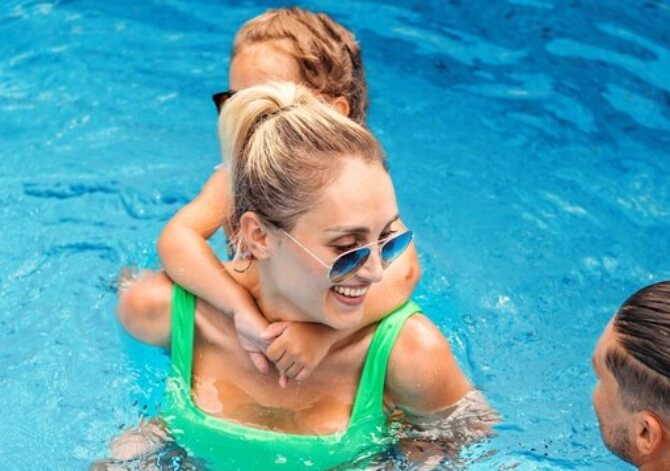
Every swimming pool in Britain is filled with a certain sound on Saturday mornings: a parent yelling encouragement from the poolside, rubber armbands squeaking, and echoing laughter. That sounds familiar to anyone who has participated in a learn-to-swim program. Seldom does it alter. The advice parents receive regarding when their child should be in that water in the first place appears to be constantly changing.
The ideal age to start swimming lessons seems like a straightforward question. It isn’t. Ten swimming instructors will probably give you ten slightly different answers, each influenced by their personal observations of kids at various developmental stages as they move through the water. Some vow to begin before a baby turns one year old. Others maintain that a child’s true progress doesn’t start until they are four or five years old, at which point their patience and muscles match their ambition.
Strangely enough, Michael Phelps doesn’t resolve the issue; instead, he makes it more complicated. Parents who believe early exposure to the water is the only way to become competent are often surprised to learn that the most decorated Olympic swimmer in history didn’t begin lessons until he was seven years old. His case may speak more about what happens when natural talent meets the right coaching at the right time than it does about perfect timing. Even so, it’s the kind of story that is frequently brought up during conversations by the pool to defend waiting longer than is usually advised by experts.
| Category | Detail |
|---|---|
| Topic | Best age for swimming lessons |
| Commonly cited starting age | As early as 3 months for water familiarization; ages 1–4 for structured lessons; 5–6 years for stroke readiness |
| Key risk factor | Children not swimming independently by age 9 face significantly reduced odds of ever learning |
| Notable late starter | Michael Phelps began formal lessons at age 7 |
| Governing guidance body | American Academy of Pediatrics |
| Primary early goal | Building water confidence and comfort, not technical stroke mechanics |
| Stroke-readiness research | Study on children aged 2–8 found 5–6 year olds best suited for front crawl with unilateral breathing |
Because the available data points in a less reassuring direction. The likelihood that a child will ever learn to swim independently drops sharply if they haven’t done so by the time they are nine years old. That’s not a guess; it’s a pattern that has been observed in several studies, and it’s the kind of detail that tends to subtly change a parent’s calculations. In the moment, waiting seems harmless. Only years later does the cost become apparent.
Teachers who have spent decades observing toddlers wade into shallow pools for the first time say that separating two distinct goals is what seems to matter most. There is technical stroke development, which is a completely different skill that calls for coordination and focus that younger children usually lack, and water confidence, which is the ease of just being in the water without fear. The former can be started by babies as early as three months of age. The latter usually holds off until a child is between four and six years old, at which point they are able to follow multi-step instructions and maintain focus throughout a thirty-minute lesson without losing the thread.
Five and six-year-olds demonstrated the strongest readiness for learning front crawl with proper unilateral breathing, according to a 1995 Australian study that examined children between the ages of two and eight. Younger kids could be fine in the water. They were just unprepared for the more difficult mechanics of a competitive stroke, both mentally and physically. The American Academy of Pediatrics takes a similar stance, stating that while lessons can start at age one, true stroke development typically takes four years or more.
Speaking with educators who have instructed hundreds of kids gives me the impression that the “sooner is better” instinct isn’t incorrect; rather, it’s just lacking. One of the main reasons people of all ages never learn to swim correctly is fear, which can be overcome by starting early. Even if that early exposure wasn’t teaching them to swim in any technical sense, a toddler who is already comfortable in the water has a significant advantage when formal lessons start.
The most honest thing to say about it is probably that none of this comes down to a neat formula. When parents decide whether to enroll their child in swim lessons or wait until they start school, they are actually balancing two distinct goals: comfort now and skill later. Both are important. Neither takes the place of the other. Additionally, teachers seem to agree that consistency over time is more important than the start date of lessons, regardless of the child’s age.
i) https://www.bbc.co.uk/tiny-happy-people/articles/zyhptrd
ii) https://www.healthychildren.org/English/safety-prevention/at-play/Pages/Swim-Lessons.aspx
iii) https://www.placesleisure.org/blogs/when-should-your-child-start-swimming-lessons/
iv) https://www.swim-central.uk/what-age-should-children-learn-to-swim/
v) https://www.better.org.uk/what-we-offer/lessons-and-courses/swimming