

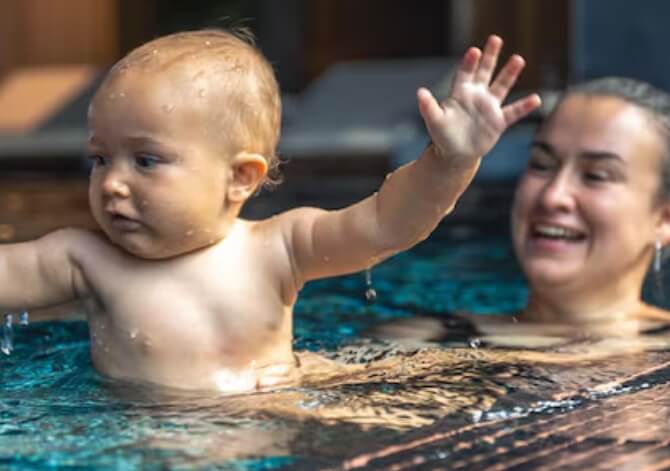
In the past, a song about kicking your legs, a few splashes, and relatively narrow armbands were all considered aspects of baby swim safety. At least at the swim schools closely monitoring what has been happening in pools, lakes, and rivers throughout the United Kingdom this year, that isn’t really what it means anymore. In recent months, a number of child drowning incidents have made headlines, and instructors’ reactions have been more akin to recalibration than outright panic. It turns out that safety in the water was never the same as confidence.
Schools like Tiny Swimming, which is based in Telford and Shropshire, now organize their lessons around that distinction. The founder has publicly stated that a toddler’s ability to swim the entire length of a pool is not a measure of success. It is determined by whether the child has the maturity to avoid trouble if something goes wrong. Speaking with people in this field gives me the impression that the traditional metrics—stroke technique, distance, and badges—were always a bit irrelevant.
| Category | Details |
|---|---|
| Topic | Baby and toddler swim safety education |
| Leading UK swim schools cited | Tiny Swimming (Telford & Shropshire), Water Babies |
| Global drowning statistics source | World Health Organization |
| UK drowning data source | Royal Life Saving Society UK |
| Key research cited | Griffith University, Queensland, Australia (early-years swimming study) |
| NHS guidance | Babies may swim at any age, vaccinated or not |
| Core safety reflex discussed | Laryngeal (gag) reflex in infants |
| Recommended approach | Water safety integrated into every lesson, not taught separately |
The shift is explained by the numbers. Drowning is the third most common cause of unintentional injury death globally, according to the World Health Organization. This statistic is nearly unbelievable until you consider that it is made up of individual children and families. For years, the Royal Life Saving Society has monitored accidental drowning as one of the most common causes of unintentional death among children and adolescents in the United Kingdom. The issue is not brand-new. The understanding that swimming proficiency and water safety are two distinct skill sets that just so happen to overlap appears to be new.
When you walk into a Tuesday morning baby swim class, you’ll see that the choreography is more intentional than it first appears. In chlorinated water that has been heated a few degrees above a typical lap pool, parents are holding their babies chest to chest. Before any submersion takes place, teachers call out a name and ask, “Are you ready”? Repeated dozens of times during a session, this little ritual is more effective than it seems.
Instructors have learned to cooperate with babies’ innate laryngeal reflex, which is the body’s mechanism for closing the airway when water strikes the face. A crying or half-asleep baby is not submerged. It seems that trust develops slowly and is easily broken. The data from Griffith University in Queensland, which tracked kids through early swimming programs for three years, has an almost paradoxical quality.
By school age, children who had received formal instruction demonstrated quantifiable benefits not only in the water but also in physical coordination and, the researchers hypothesized, cognitive development. Since correlation and causation become hazy quickly in studies like this, it’s the kind of finding that’s easy to be skeptical of. However, the more general claim that babies can move more freely in the water than they can on dry land is consistent with what physiotherapists have been saying about hydrotherapy for years.
The framing surrounding the swimming has changed more than the swimming itself. The first time a child falls into a cold river with no walls to cling to, they may swim confidently across a familiar, warm pool but still freeze. The boring-sounding things like knowing to stop and look before entering water, realizing that strong swimmers shouldn’t try to save someone twice their size, and realizing that every body of water behaves differently are all included in the definition of water safety used in schools today. It doesn’t take good pictures. None of it appears on the Instagram reel of a school. However, more and more teachers view stroke technique as a byproduct and treat it as the final product.
The tension beneath all of this is difficult to ignore. When parents watch videos of toddlers bobbing joyfully and fearlessly, they want to see confidence. However, safety advocates are concerned about the gap between confidence and judgment. A child who underestimates a current at the beach might also feel unstoppable in the pool. Swim schools appear to be carefully balancing the needle, attempting to create enthusiasm for the water without creating a false sense of security.
Nobody can say with certainty whether this strategy will significantly lower drowning rates over the next ten years, but the data takes years to come to light, and behavior change in young children is notoriously difficult to measure. It is evident that the discourse has changed. Swimming was once sold by swim schools. They are increasingly marketing discernment, self-control, and the unglamorous ability to know when to stop.
i) https://www.tinyswimming.co.uk/news/water-safety-for-children
ii) https://www.waterbabies.co.uk/blog/the-importance-of-baby-swimming/
iii) https://pmc.ncbi.nlm.nih.gov/articles/PMC2791436/
iv) https://www.ocaquatics.com/swim-lessons-6-months-infant-water-safety
v) https://funtoswim.com/swimming-lesson-safety-tips/