

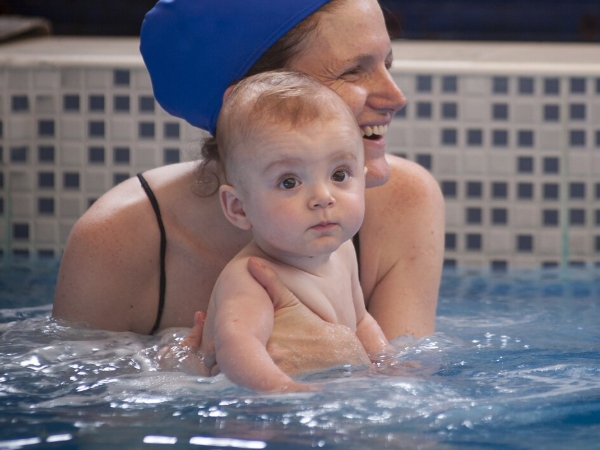
Anyone who has spent time poolside at a Saturday morning baby class will immediately recognize the sound a baby makes the first time their feet leave the pool floor, which is somewhere between a gasp and a giggle. It’s the sound of real-time trust building. In an odd way, that tiny, involuntary sound is at the core of a dispute that has been subtly escalating throughout the UK swimming industry for the past few years.
The question of whether or not infants should be able to swim is not really at issue. Most people concur that they ought to. “How” is the key the gentle, parent-led method, which is preferred by organizations like Turtle Tots, Water Babies, and Baby College, involves babies floating, kicking, and splashing in warm water with their parents while progressively becoming more comfortable. Conversely, a more aggressive approach known as “infant self-rescue” or “drown-proofing” involves teaching very young children to roll onto their backs and float on their own, sometimes while clearly upset.
| Category | Details |
|---|---|
| Topic | Baby Swim Safety & Children’s Swimming Confidence |
| Recommended Starting Age | From birth, though most UK providers suggest around 6 weeks |
| Typical Pool Temperature | Around 32°C for infant comfort |
| Leading UK Bodies Involved | RLSS UK, STA, Swim England, NCT |
| Industry Position | Against forced “drown-proofing” or infant self-rescue conditioning |
| Key Benefit Cited | Builds genuine water confidence without trauma-based conditioning |
It is uncomfortable to watch footage of the latter. Over the past two years, a number of videos featuring crying and struggling infants being repeatedly submerged and guided back to a floating position have gone viral. As expected, parents were divided online. It was dubbed “lifesaving preparation” by some. Some referred to it as cruelty disguised as security. The UK’s leading aquatic organizations, RLSS UK, STA, and Swim England, eventually felt obliged to speak together because this type of dispute is rarely settled by anecdotal evidence alone.
The researchers’ “Sink or Swim” report, which outlines their shared stance, is clear. They contend that forced drown-proofing may pose a serious psychological risk and has no demonstrated drowning-reduction benefit. A longtime researcher in this field and medical anthropologist at Cambridge, Dr. Francoise Freedman, has been especially outspoken. Simplified, her argument is fairly straightforward: a baby conditioned by fear may comply in the swimming pool, but the child’s eventual cessation of crying does not necessarily erase the memory of that fear. It’s possible that trauma is forgotten rather than dealt with, reappearing years later as inexplicable anxiety around water.
The researchers themselves admit that there is an ethical barrier preventing anyone from conducting controlled trials on distressed infants, which makes it challenging to prove that claim with certainty. The lack of evidence on one side does not necessarily support the other, and it appears that this asymmetry is what drove the industry to reach a consensus.
In the meantime, the more subdued model continues to gather evidence of its own. Because water offers just enough resistance to strengthen muscles without straining them, babies in structured group classes seem to develop gross motor coordination earlier. Even though they aren’t particularly dramatic, things like kicking against that resistance, reaching for a parent’s hands, and learning to control your breath close to splashing water add up. It’s also easy to ignore a sensory aspect: infants appear to develop what researchers sometimes refer to as a body map an early sense of where they are in space through the use of warm water, echoing sound, and light pressure against the skin.
The social layer is more difficult to measure, but if you’ve watched enough sessions, you can’t miss it. Babies are aware of other babies. They observe, imitate, and occasionally display obvious annoyance when a song ends prematurely. When teachers use the same rhymes and cues repeatedly, week after week and over months, a sense of anticipation develops. A baby who used to recoil from the water now reaches for it. This change appears to be more significant than any one skill taught separately.
For the record, parents are not required by NHS guidelines to wait for vaccinations before beginning lessons, which surprises some new parents who believe there is a medical obstacle. There isn’t really a set schedule; instead, it’s advised to ease in gradually and follow the baby’s comfort level.
It’s difficult to ignore the underlying tension in all of this: the need to prepare kids for a real threat drowning is still a major cause of unintentional death in young children conflicts with growing concerns about what preparation ought to entail. The current response from the industry strongly favors repetition over force, patience over panic, and the quiet trust that is developed through hundreds of small, unforced moments in the water. It is genuinely unclear whether that consensus is maintained or if drown-proofing techniques continue to be used covertly outside of official classroom settings. What is evident is that confidence, whether in adults or toddlers, seldom survives being manufactured through fear.
i) https://www.turtletots.com/uk/news/national/benefits-of-baby-swimming/
ii) https://www.swim.co.uk/blogs/are-baby-swimming-lessons-worthwhile/
iii) https://britishswimschool.com/blog/explore-our-swimming-lessons-for-kids/
iv) https://babycollege.co.uk/splish-splash-learn-the-developmental-benefits-of-swimming-with-your-baby/
v) https://www.sta.co.uk/news/2017/06/23/drown-proofing-your-child-the-baby-swimming-industry-speaks-out/