

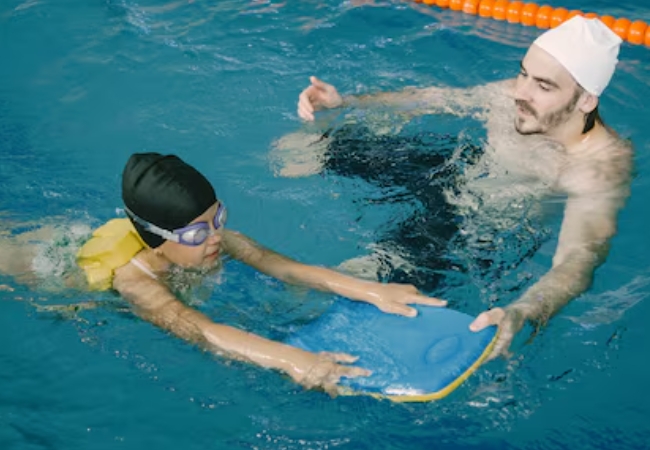
In the back of their minds, the majority of parents are aware that it’s best to get their kids into the pool as soon as possible. Then life takes place. Summer passes. One more passes by. The child turns three, then four, and somehow swim lessons have become a thing that’s always almost been sorted. Many families are unaware of how important this well-known tale is.
A few years ago, the American Academy of Pediatrics changed its recommendations, lowering the age at which swim lessons should begin to just one year old. You shouldn’t take that headline figure lightly. It’s not the fact that kids drown at swimming pools during swim time that makes the statistics sobering drowning is still one of the most common causes of death for young children. It’s that most toddler drowning incidents happen when a child slips away unnoticed during a moment no one was thinking about water at all a birthday party in a backyard, a gate left unlatched, thirty seconds of distraction.
At one year old, many children are newly walking and newly mobile. They make their way into areas that adults haven’t yet considered blocking. This is partly why the AAP recommends beginning water competency training so early not because a one-year-old will be swimming lengthy.
But because learning to float on their back, to recognise water, to stop panicking in it, builds a kind of physical memory that takes time to develop. According to studies, these early survival skills can significantly lower a child’s risk of drowning between the ages of one and four. That’s not a marketing line from a swim school; it’s from researchers tracking what actually happens to children who’ve had lessons versus those who haven’t.
Regarding infants younger than twelve months, there is a legitimate question. The truth is that formal swim programs for infants under one year old are not supported by the available data. Although it’s impressive to watch, some babies can be trained to reflexively roll onto their backs and float, but they are still unable to consistently raise their heads to breathe. While a parent-child water play class is acceptable and even beautiful, it should not be confused with safety instruction. Those are different things.
Pediatricians claim that most children are developmentally ready to move beyond simple floating by the time they turn four. A four-year-old’s body and brain can start to develop the ability to tread water, move toward an exit point, and realize that water is something to approach with respect rather than fear. Most kids in regular classes are able to perform the front crawl on their own after a year or two, at the age of five or six. Naturally, the window isn’t closed at age seven, eight, or beyond, but the earlier the skills become ingrained, the more likely they are to persist.
It’s important to be clear about something that is frequently softened in this discussion: swim lessons are only one line of defense, not the complete solution. Even children who are proficient swimmers drown. Constant supervision what the AAP calls “touch supervision”, meaning an adult within arm’s reach remains essential for any child near water, whatever their ability level. Pool access needs to be physically blocked when swimming isn’t happening. In open water, life jackets are important. These aren’t optional extras added on top of lessons; they work in parallel, filling the gaps that lessons alone can’t cover.
Quality matters in choosing a programme. Lessons that focus only on stroke technique miss the point for young children. The ability to reach a surface, move even a short distance, and exit is what a three-year-old needs, not a textbook front crawl.
Seek out programs that allow parents to watch a session before enrolling, instructors certified by a nationally recognized curriculum, and classes that are small enough for individual attention. The water temperature for children under three should sit between 87 and 94 degrees Fahrenheit; hypothermia is a real risk in cooler pools, and a child who’s cold and miserable isn’t learning anything.
Many YMCAs, park departments, and community organizations run programs specifically for young children during the summer, so it’s possible that there are free or subsidized options closer to home for families where cost or access is a barrier. Finding what’s available locally can often be done practically by consulting a child’s pediatrician.
The purpose of the urgency is not to incite fear. There is still time, and the majority of kids who have not yet begun classes are doing well. But “still time” doesn’t mean unlimited time. Every year, the pool season arrives. It’s worthwhile to inquire as to what precisely is waiting for it to feel more convenient if it keeps getting postponed.
i) https://www.beckyadlingtonsswimstars.com/blogs/what-is-the-best-age-to-start-swimming-lessons/
ii) https://www.mumsnet.com/talk/extra_curricular_activities/657573-What-age-is-the-best-to-start-swimming-lessons
iii) https://www.better.org.uk/what-we-offer/lessons-and-courses/swimming/children-swim