

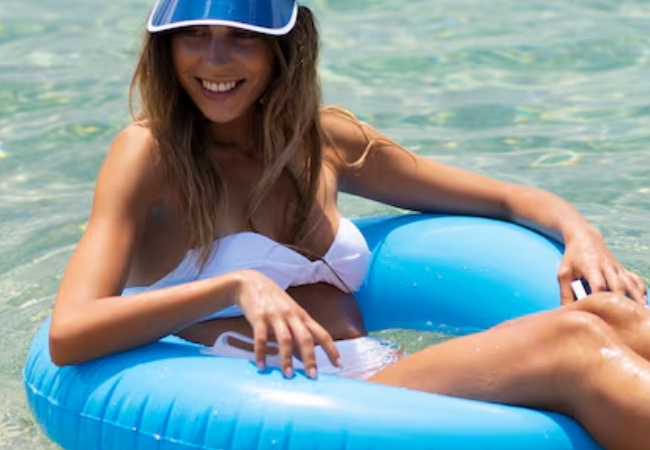
When you find out you’re on your period the morning before a beach getaway, there’s a certain kind of anxiety. The majority of women understand what it’s like to stand in the restroom and decide whether to face it or completely cancel plans.
The good news which, for some reason, hasn’t reached everyone yet is that swimming during your period is quite feasible. It basically comes down to picking the appropriate tampon and knowing a few things most people were never actually taught.
Tampons work in water for a rather obvious reason: they absorb menstrual blood before it leaves the body. A well inserted tampon creates an interior barrier, in contrast to pads or liners, which sit outwardly and absorb any moisture they come into contact with, even pool water.
Water pressure does temporarily restrict menstrual flow while you’re immersed, which is why some swimmers feel they don’t require protection at all. As soon as you get out of the water, that reasoning breaks down. Both the strain and the relief have vanished.
Absorbency is the most crucial factor that most manuals ignore. It is more important than cotton’s organic status, brand, or applicator style. On heavy flow days, a light tampon will fill up faster than expected, especially if you’re also absorbing some surrounding water. Sport-style tampons, which enable 360-degree expansion, are often the best choice for the first day or two of a period.
A thin, low-absorbency choice makes more sense on lighter days when you’re not sure if you’ve finished. The discomfort of removing a high-absorbency tampon with a mild flow is something most individuals only feel once before modifying their technique.
How long you can truly stay in the water is another issue. Although most manufacturers advise changing tampons every four to eight hours, swimming actually causes them to absorb more than usual. The cleanest habit is to change right before and straight after going into the water. In the worst cases, it decreases bacterial accumulation and shortens the window of exposure to moisture, which might result in toxic shock syndrome. TSS remains rare, but it’s serious enough to take seriously.
For people who find tampons uncomfortable or simply don’t want to use them, there are acceptable alternatives. Menstrual discs lie higher in the vaginal canal and can be worn for up to twelve hours, which some swimmers prefer for the decreased insertion-and-removal cycle.
Menstrual cups have gained popularity among swimmers, in part because to their reusable nature and in part due to their convenience. Quietly, period swimwear with hidden absorbent layers has also gained popularity, especially on lighter days or as a backup item. If tampons have never felt just right, it’s important to know that they are available.
Swimmers who are picky about what they ingest in their bodies are increasingly using organic and natural-fiber tampons. Plant-based cotton, biodegradable applicators, and products devoid of chemical treatments and artificial dyes are now available from a number of brands.
Whether such distinctions impact therapeutically is somewhat uncertain the data isn’t definitive but for folks who care about ingredients, the possibilities are there. What counts more, realistically, is fit and absorbency level. Tucked string and all, a well-fitting tampon should blend in perfectly with a swimsuit.
When experts first began investigating it, they were actually shocked to learn that menstrual blood does not draw sharks. The myth has circulated for so long that it almost feels unpleasant to disprove it, but the volume of blood shed over a complete menstrual cycle across multiple days is around six teaspoons. Only a small portion of it is lost in a single swim. The ocean is not waiting.
The main idea is that having a period shouldn’t be an excuse for not participating. It takes approximately three minutes to prepare: pick the appropriate tampon for your flow, put it in before entering, tuck the string, and make plans to switch it out after you’re finished. After that, neither the water nor anybody else is aware of it.
i) https://www.healthline.com/health/menstruation/tampons-for-swimming
ii) https://www.getrael.com/blogs/r-blog/tampons-and-swimming
iii) https://www.whowhatwear.com/best-tampons-for-swimming