

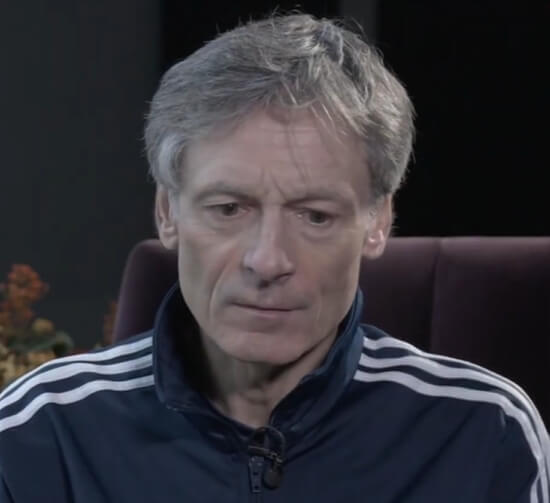
If you spend enough time searching for his name online, you will eventually come across a trail of inquiries concerning Gabriel Clarke’s health in forum posts, social media threads, and the occasional news comment section. It’s the kind of thing that happens to any broadcaster who has been a fixture on British television for thirty years and then all of a sudden appears to be a little less. People take notice. Those who have watched someone through numerous Champions League nights and six World Cups have a way of keeping tabs.
Based on the information at hand, the truth is that Gabriel Clarke is not afflicted with any confirmed, publicly known illness. No reliable publication has reported a confirmed diagnosis. There has been no statement released. There are searches, but they don’t seem to be based on any actual medical disclosure; instead, they seem to be mostly the result of absence and conjecture. Since Clarke has not publicly indicated that anything serious is wrong, it is important to acknowledge the gap between what people fear and what is actually known.
In actuality, we do know a great deal about the man and his career. Clarke is the son of the late director Alan Clarke, whose films “Made in Britain” and “Scum” continue to have an impact on British cinema. After completing his studies in English literature at the University of London, he worked for local newspapers in Somerset and Bristol before relocating to Radio Trent in the East Midlands, where he covered Nottingham Forest in the last, waning years of Brian Clough’s tenure. It’s difficult not to picture a young Clarke nervously phoning Clough’s offices in Nottingham, notebook in hand, and wondering if the great man would answer. He eventually transitioned to television, working as a reporter on “Saint and Greavsie” for ITV Sport in 1991. Since then, he has been a member of the ITV staff.
| Category | Detail |
|---|---|
| Full Name | Gabriel Clarke |
| Date of Birth | c. 1964 |
| Nationality | British |
| Education | English Literature, University of London |
| Career Start | Local newspapers, Somerset and Bristol |
| Radio | Radio Trent, East Midlands |
| TV Debut | ITV Sport, 1991 (Saint and Greavsie) |
| Notable Events Covered | FIFA World Cups (2006, 2010), UEFA Euro 2012, Rugby World Cups, World Championship Boxing |
| Awards | RTS Sports News Reporter of the Year (2001, 2002, 2005); RTS Sports Feature (2002, 2005); RTS Sports Creative Sequence (2002) |
| Documentaries | Calzaghe: No Average Joe, Steve McQueen: The Man & Le Mans, Brian Clough documentary (Grierson Award nominee) |
| Family | Son of film director Alan Clarke (1935–1990); named after Scotland/Everton footballer Jimmy Gabriel |
In 2001, 2002, and 2005, Clarke won the Royal Television Society’s Sports News Reporter of the Year award three times. He established a reputation for not only being in the right place at the right time, but also for asking the right questions once he arrived. The post-match touchline interview requires a certain skill that most people don’t realize. You have ninety seconds, a camera that doesn’t tolerate hesitation, and a manager who might be angry, ecstatic, or just worn out. According to Clarke, his method consists of purposefully direct, brief questions with no preamble and a single follow-up that occasionally reveals more than the initial question. “Why”? as a whole query. “Really”? as a prompt. It sounds almost too easy. You can see the discipline behind it when you watch it work on people as guarded as Alex Ferguson or as theatrically unpredictable as José Mourinho.
His first meeting with Mourinho is the kind of tale that should be included in a documentary. Prior to a Champions League semifinal in May 2000, Clarke was in Valencia attempting to get an interview with Louis van Gaal. Barcelona declined, offering an unidentified assistant manager in its place. Clarke had no idea who he was approaching. It was Mourinho, sharp and charismatic, already playing for a crowd he hadn’t quite won over. Years later, Clarke remembered “Classic José” with what sounded like sincere affection. That evening, Barcelona lost 4-1. Presumably, Mourinho made notes.
Outside of the spotlight, Clarke’s documentary work reveals a different side of himself, one that may be more in line with his true passion. Movies like “Calzaghe: No Average Joe” and “Steve McQueen: The Man & Le Mans” imply a person who is more interested in the psychology behind the score than the score itself. His documentary about Brian Clough received a nomination for the Grierson Award, a prestigious honor in a cutthroat industry. It seems as though Clarke views himself as a filmmaker who also happens to be a skilled interviewer rather than the other way around. Gabriel has carefully and precisely acknowledged the impact of his father, British TV drama director Alan Clarke. He is well-known for having a father who passed away when he was young, and the two had very different working styles. It’s possible that some of the visual instinct that willingness to locate a scene rather than merely describe one passed through nonetheless.
Why, then, are people worried about his health online? It’s really hard to identify a single trigger. Broadcasters of Clarke’s generation and profile occasionally take on fewer live responsibilities, move away from some assignments, or focus more on documentary production. Loyal viewers notice any change in visibility because they have grown accustomed to seeing a familiar face on the schedule. It’s unclear if Clarke has encountered any personal health issues, and that’s just the truth. There are no credible reports to rely on, and he has not discussed illness in public.
It is safe to say that Gabriel Clarke is still among the most accomplished and well-respected sports journalists that Britain has ever produced. Thirty-plus years of live broadcasting, multiple RTS awards, acclaimed documentaries, and a relationship with the viewing public built on clarity and trust. He’ll probably deal with any health-related news the same way he deals with everything else directly, without needless embellishment, and according to his own terms.
i) https://champions-speakers.co.uk/speaker-agent/gabriel-clarke
ii) https://www.theguardian.com/football/2020/jun/12/gabriel-clarke-i-asked-alex-ferguson-actual-questions-so-we-got-on-well
iii) https://en.wikipedia.org/wiki/Gabriel_Clarke
iv) https://www.independent.ie/irish-news/health/motor-neurone-disease-is-a-massive-burden-but-there-is-only-one-nurse-per-100-people-with-the-disease/a/133476343.html
v) https://community.sports-interactive.com/forums/topic/601515-the-world-cup-on-itv/