

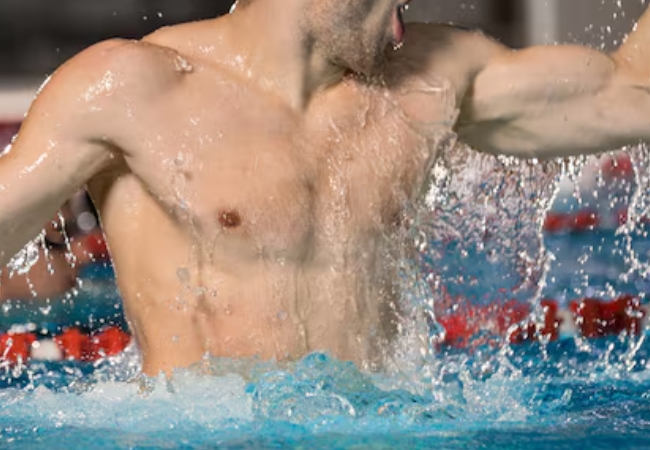
Walk into any aquatic centre on a weekday morning, and you’ll find the serious swimmers already halfway through their second kilometre before most people have finished breakfast. As they turn toward the wall, pay close attention to their well-defined shoulders, flat core, deliberate leg drive, and developing question. Does all that time in the pool actually build muscle? Or are those bodies the product of something else entirely?
The answer is yes, swimming builds muscle. It does so in a way that frequently shocks those who assume it will function similarly to lifting weights because it doesn’t. Water is its own form of resistance, and the pool is its own training environment. Every stroke, pull, and kick requires more effort from your muscles than the corresponding motion on dry land because it is about 800 times denser than air. Without the barbell, that continuous push-and-pull across the entire body is essentially resistance training.
Heidi Portlock, a swim coach who also leads a community health programme in West Oxfordshire, puts it plainly: regular swimming can help build lean muscle mass. What she means by lean is important. Instead of the hypertrophy-focused bulk associated with intense gym work, swimming primarily develops what you might call functional muscle the toned, athletic kind that enhances how your body moves and feels. It remains muscle. It is still important. It simply has a different appearance.
This is supported by the research. A brief but insightful study that was published in the “Journal of Exercise Rehabilitation” tracked women between the ages of 40 and 60 who swam for 60 minutes three times a week for three months. By the end, they had measurably improved both upper and lower body muscular strength, along with better muscular endurance.
Considering the age range, that outcome is not insignificant. From around 30, the body begins losing muscle mass at a rate of three to eight percent per decade a condition known as sarcopenia and that rate accelerates after 60. Swimming, it turns out, is one way to push back against that decline.
Different strokes engage the body differently, and it’s worth knowing which ones do what. Because butterfly and breaststroke produce a lot of frontal resistance, they are particularly useful for developing arm, shoulder, and chest muscle.
Freestyle and backstroke, though less forceful in that frontal plane, do a better job of engaging the core, glutes, hip flexors, and leg muscles over time. Carl Cawood, a swim coach and product development manager at Total Fitness, notes that for real muscle-building results, adding resistance equipment hand paddles, kick-boards, drag suits can make the water work even harder against you. The muscles adjust to the increased load.
There is a warning worth mentioning. For some people, swimming might not be sufficient to achieve their goals, especially if gaining a significant amount of muscle mass is the top priority. According to a 2022 study, swimming and resistance training work better together than either strategy alone.
“If you want to focus more on building muscle, try incorporating some strength work such as resistance training where you would be lifting weights along with swimming regularly”, says Dr. Jonathan Taylor, a former middle-distance runner and senior lecturer in sport and exercise at Teesside University. It’s more of an honest assessment of what each training technique can actually accomplish than a critique of swimming.
Observing professional swimmers gives one the impression that the pool is accomplishing something that most gym patrons haven’t fully considered. Because it is low-impact, the muscles can be worked hard without the cumulative strain that higher-impact exercise tends to put on the bones and joints.
The pool offers something unique: a full-body challenge that the body can genuinely sustain over time. This is beneficial for people recovering from injuries, older adults managing joint pain, or just anyone looking to add real physical work without beating themselves up in the process.
It almost doesn’t matter if swimming increases muscle mass the same way a heavy deadlift does. For the majority of people, it is more than sufficient to build muscle in the manner required by swimmers.
i) https://www.brioleisure.org/blog/does-swimming-build-muscle
ii) https://www.saga.co.uk/magazine/health-and-wellbeing/how-swimming-can-build-muscle
iii) http://ymcacky.org/blog/what-muscles-does-swimming-build-muscle-building-guide