

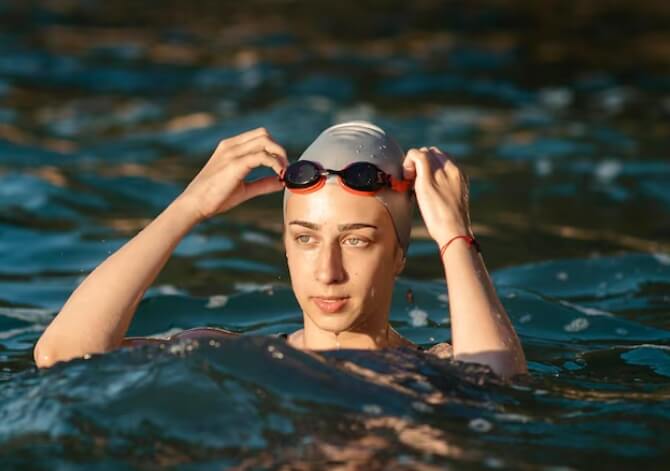
When you say sixteen degrees Celsius aloud, it doesn’t sound like much. It’s not freezing. It’s not soothing. It’s in that uncomfortable place where a swimmer in a wetsuit standing on a riverbank may feel fine while the person standing next to them, bare-skinned and dedicated to the cold-water purist approach, is already gasping. In a sense, the whole story of 16°C is that contradiction.
A triathlete will probably shrug if you ask them. At this point, wetsuit-legal racing starts to feel more at ease than harsh. 16°C may sound almost tropical to a winter swimmer who has just finished a Serpentine Club session in January. Before assuming that there is only one right way to describe this water, it is important to consider the peculiar ways in which context affects perception.
| Category | Detail |
|---|---|
| Topic | Open water swimming at 16°C |
| Classification | Borderline/transitional cold water temperature |
| Comparable pool temperature | Indoor pools typically run 26–31°C |
| UK context | Average UK/Ireland sea temperature is around 12°C year-round |
| Main physiological risk | Cold water shock, most acute below 15°C |
| Relevant sporting context | World Aquatics race range is 16–31°C |
| Governing research body | Loughborough University, in partnership with European Aquatics |
| Recommended safety gear | Wetsuit, thermometer, lifejacket where appropriate |
| Key safety guidance | RNLI advises floating 60–90 seconds if shocked by cold water |
Swimmers seem to discuss 16°C in the same way that hikers discuss a moderate trail that is neither particularly hazardous nor to be taken lightly. When you first enter, it’s fresh. The skin becomes tighter. Breathing shifts, but not drastically. Even though 16°C isn’t physiologically close to the most dangerous range, it can still feel like a real shock to someone accustomed to heated pools that are between 26 and 31°C.
The picture is further complicated by research from Loughborough University. They tracked elite swimmers competing in water between about 18 and 25°C as part of their work with European Aquatics, and what they discovered wasn’t the neat narrative you might anticipate. Clinical hypothermia was experienced by a few swimmers in the same race, water, and circumstances. Others were on the verge of becoming overheated. It turns out that a person’s body temperature has just as much to do with them as it does with the thermometer’s reading. Whether this is due to acclimatization, preparation, or something more peculiar about how each body controls heat under stress is still unknown.
Because 16°C is just above the threshold that most safety bodies take seriously, that uncertainty is significant. In water between 10 and 15°C, cold water shock the type that can cause cardiac strain even in healthy, fit swimmers tends to peak. Therefore, 16°C is the temperature that is just on the edge of that danger zone close enough that caution is still advised, but not so low as to trigger the body’s most aggressive reactions. In a way, swimmers who take it lightly because it’s “not that cold” are betting on a margin that isn’t quite as big as it appears.
When you watch open water swimmers get ready for these kinds of sessions, you’ll notice a familiar ritual: checking forecasts, testing the water with a probe thermometer or your hand, and making a real-time decision about whether to wear a wetsuit or bare skin. According to triathlon coaches, the official wetsuit regulations begin to loosen around 16°C, at which point swimming “comfortably” without neoprene becomes feasible for individuals who have developed tolerance. That sharp intake of breath that takes newcomers by surprise can still be caused by the same water for everyone else.
Additionally, there is a psychological component that is seldom given enough consideration. 16°C can be almost unimpressive for open water swimmers who have spent the winter chasing the so-called cold water high, that rush of endorphins after a short, brutal dip. As the temperature rises, the excitement wanes. Wanting water that hurts a little more is an odd complaint, but it keeps coming up in swimming communities, and it says something about how quickly the body recalibrates what constitutes cold.
For a well-prepared swimmer, none of this implies that 16°C is intrinsically dangerous. Most people get through it without any problems, especially if they have a wetsuit, a friend, and a basic understanding of how long they’ve been in. Both elite competition data and decades of RNLI guidance lead to the same quiet conclusion: a body’s reaction cannot be predicted solely by its temperature. Equally important are preparation, acclimatization, and honest self-evaluation.
It’s not always incorrect for swimmers to view 16°C as a known quantity, comfortable, predictable, and low-stakes. The science indicates that the margins are thinner than intuition suggests, which is likely sufficient justification for treating the water with a little more respect than the figure suggests.
i) https://www.outdoorswimmingsociety.com/cold-water-feels-temperature-guide/
ii) https://www.lboro.ac.uk/media-centre/press-releases/2024/november/health-risks-caused-by-swimmers-body-temp/
iii) https://www.rya.org.uk/water-safety/cold-water-shock-safety/cold-water-shock/
iv) https://temperature.co.uk/a-temperature-guide-to-safe-cold-water-swimming/
v) https://zone3.com/blogs/inside-zone3/cold-open-water-swimming-safety-tips