

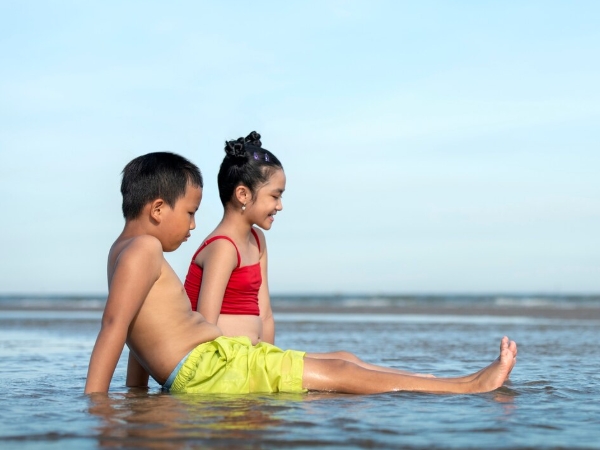
Every parent who lives close to a river or the coast will recognize a certain type of summer afternoon: it’s warm enough that the water appears inviting rather than hazardous, it’s crowded enough that no one feels personally accountable, and it’s just unsupervised enough that a group of teenagers can transition from swimming to paddling to something riskier without anyone noticing. The majority of these stories start that afternoon and almost never end where anyone anticipated.
Open water hazards for teenagers are rarely as dramatic as people think. It turns out that drowning doesn’t make an announcement. There’s no scream that pierces the cacophony of a crowded riverbank, no frantic flailing visible from the beach towel. It is quieter than that, frequently over in a matter of seconds, and it is precisely because of this quietness that adults tend to underestimate it.
| Category | Details |
|---|---|
| Topic | Teen open water safety and drowning risk in the UK |
| Highest-risk group | Males aged 10–19, according to the National Water Safety Forum |
| Most common location of teen drowning | Open water (rivers, lakes, coastlines) rather than swimming pools |
| Leading UK organisations involved | RNLI, HM Coastguard, the Canal & River Trust, Open Water Education Network |
| Key risk factors | Peer pressure, overconfidence, cold water shock, hidden currents |
| RNLI recommended response | “Call, Tell, Throw” — call 999, tell someone, throw a flotation aid rather than entering the water |
This is supported by the data in a way that should worry parents. Boys between the ages of 10 and 19 are among the most vulnerable to drowning in the UK. Researchers attribute this tendency less to swimming prowess and more to the unique psychology of that age group, which includes testing independence, proving something to a group of friends, and believing that confidence in the water equates to competence. Seldom is it.
Reading the testimonies gathered by water safety organizations reveals how frequently a single choice made in a split second can mean the difference between tragedy and a happy ending. Evan, 16, survived a rip tide off the coast of Northumberland because he knew to lie back and float instead of fighting the current. A surfer and an RNLI lifeboat crew later had time to act on this small, almost unglamorous piece of knowledge. The same margin did not apply to Liam Hall, a teenager who drowned after his dinghy got into trouble off Sunderland. Long before either boy reached the water, the difference between those two outcomes was shaped by a few seconds of decision-making rather than pure chance.
There’s also a more subdued tale worth sharing about a group of East Sussex teenagers who decided to toss a life ring from the shore rather than swim out to assist two friends in need. When compared to the heroism of a rescue film, it sounds almost anticlimactic. Rather than saving two lives, it most likely saved four.
It’s difficult to ignore the gender pattern that permeates everything. Research indicates that in open water, all-boy groups are more likely to take risks than mixed groups, and that risk decreases when girls are present and willing to speak up. Charities operating in this field have begun actively promoting that dynamic, portraying it as a shared lifesaving culture where saying “let’s not” is just as important as daring someone to jump, rather than as girls policing boys.
Swimming lessons are important, but none of this suggests that they are the solution. Because ability fosters a false sense of control over cold water, currents, and exhaustion that has little to do with stroke technique, strong swimmers also drown, sometimes more confidently than weak ones. Even though it seems repetitive, going over the family’s rules five minutes before a beach trip seems to actually alter the results. Even though repetition irritates a fifteen-year-old, it seems to be what endures when panic strikes.
It’s also important to discuss how we specifically discuss fear with boys. Fathers who exhibit composure instead of arrogance and who portray declining a challenge as a sign of strength rather than weakness appear to influence their sons’ behavior under duress over time not immediately, but gradually. Compared to a poster on the wall of a beach hut, this type of safety education is slower and possibly more long-lasting.
Nothing is guaranteed by any of this. Teenagers naturally push against boundaries set for them by adults, and water does not negotiate. The families who have turned near-misses or losses into documentaries, education packs, and charities seem to agree on one uncomfortable point: the discussion must take place before the water, not after. When a teen gets into trouble in open water, it’s too late to intervene.
i) https://blogs.bournemouth.ac.uk/research/tag/teenagers/
ii) https://the-european.eu/story-61565/i-drowned-as-a-child-every-parent-should-watch-this-water-safety-documentary.html
iii) https://www.mirror.co.uk/news/uk-news/swimming-lessons-covid-generation-drowning-37274815
iv) https://www.waterwisekids.com/education/water-safety-teens.html
v) https://www.bbc.co.uk/news/articles/c3v2ywy69g9o