

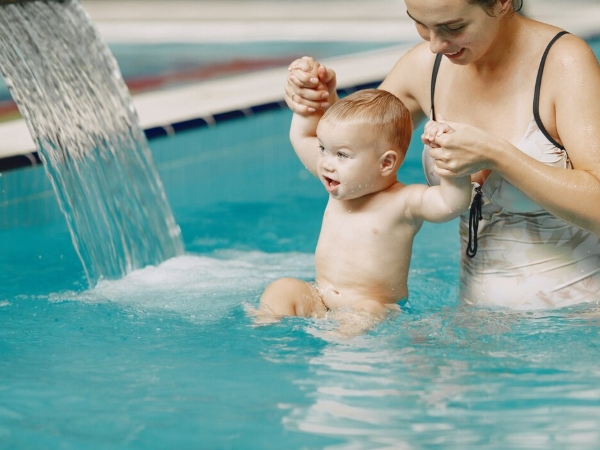
On a Tuesday morning, the YMCA pool doesn’t appear to be the scene of a public health discussion. Mothers hum nursery rhymes, teachers count kicks, and a row of babies in swim diapers bob along the wall. To be honest, it appears somewhat boring. Anyone who works in drowning prevention will tell you that this setting bright, supervised, and chlorinated is precisely where the safest swimming occurs and where the majority of families completely stop considering risk.
Swimming safety for babies has quietly emerged as one of those subjects that parents think they understand until they don’t. Backyard pools, unlocked gates, and a few unattended minutes were the main topics of discussion for years. That narrative still holds true. For children between the ages of one and four, drowning is still the most common cause of unintentional death. It rarely occurs as people imagine, with no splashing or screaming, just a small body slipping under in near silence while an adult sits ten feet away, checking a phone.
| Category | Key Information |
|---|---|
| Leading cause of death, ages 1–4 | Drowning remains the number one cause of accidental death for toddlers in the United States |
| Risk reduction from formal lessons | Structured swim instruction can lower drowning risk by as much as 88 percent in young children |
| Flotation device guidance | Inflatable arm floaties create a false sense of security; the US Swim School Association recommends Coast Guard-approved life jackets instead |
| Teen open-water risk | Boys aged 15–19 account for roughly half of all open-water fatalities among adolescents |
| Industry context | Aqua-Tots, the largest international swim school franchise, has operated for more than 30 years across multiple countries |
| Behavioral factor | Public health researchers describe “risk compensation,” where swimming skill breeds overconfidence rather than caution |
Parents seem to be most surprised by the silence. The same pattern was described by a number of teachers I spoke with: the child becomes motionless, tilts their head back, and presses their arms down instead of waving, and it ends in twenty or thirty seconds. It’s not at all cinematic. It’s difficult to ignore how commonplace the scene appears until it isn’t when watching old hotel pool footage used in lifeguard training.
The way early families are initiating the conversation is currently changing, albeit slowly and somewhat unevenly. Infants as young as four months old are increasingly being enrolled in swim schools that used to accept toddlers around the age of three, not to teach strokes but rather to develop breath control and water comfort. Pediatricians frequently cite research showing that formal education can reduce the risk of drowning by nearly 88%. Enrollment at several swim franchises has increased steadily over the past two summers, so it appears to be working. That statistic is so frequently mentioned in parenting forums that it has almost become a cliché.
There’s also a more subdued myth-busting going on, the kind that modifies behavior but doesn’t make headlines. Floaties, which were once thought to be a suitable replacement for supervision, are now seen with suspicion. Pediatric safety organizations have been criticizing them for years without much success because they force a child into a vertical position in the water, which is the opposite of what swimming actually requires. Only lately, as more parents share their near-miss experiences online, does the message appear to be getting through.
Another pattern that has nothing to do with toddlers at all appears when you speak with enough lifeguards who work in rivers and lakes rather than pools. Teenage boys, who are frequently proficient swimmers, struggle in open water because their pool skills don’t translate as people would think. Almost nothing about a current pulling sideways or a sandbar that suddenly drops six feet can be learned from a flat-bottomed rectangle with lifeguards every fifty feet. It’s possible that the increased awareness of infant water safety among families stems from the difficulty of ignoring the open-water risk for older children.
A story about a mother from Michigan that frequently appears in safety newsletters describes how her son and his friends, all of whom were competent and self-assured swimmers, waded past a sandbar at a Great Lakes beach until an undertow dragged them thirty yards down the shore before anyone could intervene. That day, nobody drowned. She later acknowledged that she had never considered asking because she was completely unaware that rip currents could form in lakes.
All of this does not imply that panic is necessary. It implies a recalibration, which is smaller and perhaps more beneficial. It appears that families are beginning to view “can swim” as a starting point that is totally dependent on the water’s location, depth, temperature, and unpredictability rather than as a finish line. Self-latching gates, open-water orientation for teenagers, arm’s-reach supervision for infants, and four-sided pool fencing are all not novel concepts. The degree to which regular families are taking them seriously is shifting.
It’s genuinely unclear if this is a long-term change or just another seasonal attention spike that ends by Labor Day. Nothing has changed with the water. The degree to which families are willing to acknowledge their incomplete understanding of it is gradually shifting.
i) https://www.aqua-tots.com/aqua-tots-swim-school-sheds-light-on-common-drowning-misconceptions-during-national-water-safety-month/
ii) https://www.endlesspools.com/blog/post/isr-monterey-bay-interview
iii) https://practicalhealthpsychology.com/ro/2025/07/above-water-rethinking-drowning-prevention-at-all-levels/
iv) https://hookswimschool.co.uk/why-teen-open-water-risks-are-making-families-rethink-water-safety/
v) https://jacksonvillemom.com/news-current-events/child-safety/isr-more-than-blowing-bubbles/