

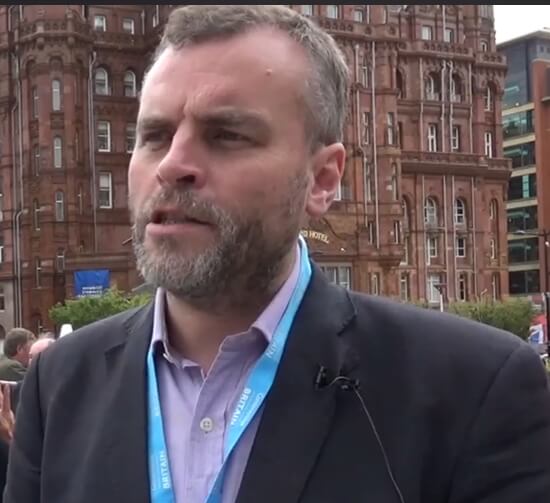
When public figures openly discuss their mental health, something happens to them. The words leave them in one form careful, thoughtful, and bravely offered and arrive on the internet in a completely different one. This story really starts with that discrepancy between what Tim Montgomerie actually said and what a dozen clickbait websites have since claimed he said.
Online rumors concerning Tim Montgomerie’s health have proliferated, ranging from Parkinson’s disease to strokes, none of which are supported by any solid proof. If Montgomerie hadn’t given one truly important interview about his mental health during the pandemic years, it’s possible that none of this would have gained any traction at all. He was truthful. He was precise. And of course, the internet went in a different direction than he had planned.
In an interview with Peter Whittle for the New Culture Forum in June 2022, Montgomerie called the COVID-19 lockdown one of the most agonizing times of his life. He claimed to have reached “dark places” as a result of living alone and being cut off from his regular social and professional routines. Anyone who is familiar with Montgomerie’s usual demeanor calm, self-assured, and infrequently vulnerable in public will find that the revelation carried some weight. His candor struck a chord with many who went through similar struggles during that trying time. He admitted that living alone at the time was emotionally taxing and that the isolation had a negative impact on his mental health.
| Detail | Information |
|---|---|
| Full Name | Timothy Montgomerie |
| Date of Birth | 24 July 1970 |
| Place of Birth | Barnstaple, Devon, England |
| Education | University of Exeter (Economics & Geography) |
| Known For | Founder of ConservativeHome, political commentator, columnist |
| Career Highlights | Co-founded Centre for Social Justice with Iain Duncan Smith; speechwriter for William Hague; adviser to Boris Johnson; founded UnHerd (2017) |
| Faith | Practising Christian |
| Current Affiliation | Reform UK (joined December 2024) |
| Health (Confirmed) | Publicly discussed depression and mental health struggles during COVID-19 lockdown |
| Physical Illness | No confirmed chronic or serious physical illness as of 2026 |
In order to help stabilize his emotional state, he was prescribed short-term antidepressant medication and attended counseling sessions. In an honest admission that goes beyond the typical sanitized version of recovery that public figures typically offer, Montgomerie talked candidly about how the medication helped him cope but also mentioned that he felt “flattened” and lacking enthusiasm while taking it. The rarity of that type of specificity is difficult to ignore. When asked about health, the majority of politicians and pundits retreat into evasive assurances. Montgomerie gave a description of its texture.
The support he received from his late friend Sir David Amess, the Conservative MP who was tragically killed in 2021, is an important aspect of his story. Throughout Montgomerie’s recuperation, Amess’s frequent check-ins and encouragement to get in touch with him whenever he was feeling down became a vital source of consolation and hope. Montgomerie took the experience seriously, as evidenced by his public discussion of it and his obvious gratitude. This wasn’t a brief period of hardship rewritten for an empathetic headline. He appears to have recognized that it was a true time of darkness.
He used his position to normalize open discussion about mental health, particularly among men in politics and the media, where stoicism is frequently confused with strength, in contrast to many public figures who conceal vulnerability. Many people respected this public admission. Actually, that is important. Male vulnerability of any kind has historically caused discomfort in British political culture. Being a member of the traditional right by nature, Montgomerie’s presence there was subtly important. Even though no one could quite put their finger on it at the time, it seemed to grant others permission.
But what came next is a well-known tale. When a public figure speaks candidly about mental health, the discussion lasts forever on the internet. It produces searches. Additionally, there are websites built to profit from search traffic. The process is sadly simple: a hypothetical term is appended to a real person’s name, it begins to show up in autocomplete suggestions, and in a matter of weeks, a claim with no medical foundation appears in search results. That is essentially what transpired with the illness searches for Tim Montgomerie. A large portion of the noise stems from that mental health disclosure, which is often misinterpreted as an indication of a more serious illness when, in fact, it was an act of bravery rather than a sign of decline.
Montgomerie does not appear to be experiencing any confirmed or unconfirmed health issues as of 2026. Since joining Reform UK in December 2024, he has continued to be involved in public life, posting frequently, offering political commentary in broadcast and digital media, and actively participating in discussions concerning immigration policy, British conservatism, and the future of the UK right. His output hasn’t decreased in volume. His departure from the Conservative Party has, if anything, enhanced rather than diminished his public persona.
Montgomerie views mental health as a social obligation as well as a personal challenge. His co-founding of the Centre for Social Justice with Iain Duncan Smith in the early 2000s helped to shape his conservatism, which has always had a social conscience. This framing is consistent with who he has always been. His readiness to relate his own experience of lockdown depression to more general issues of public health policy seems more like a logical extension of his way of thinking than a political stance. People are more important than systems, in his opinion. He had a personal reason to mean it because of the pandemic.
It’s still unclear if the broader discussion about men, mental health, and the unique loneliness of political life that his disclosure helped spark will have a long-term impact on British public culture. These are slow-moving objects. It’s not insignificant that a man with Montgomerie’s profile and ideological background sat down and openly stated that he went to dark places and asked for assistance. The true story is far more intriguing and human than any of the rumors that have been spread about him since then.
i) https://www.walesonline.co.uk/lifestyle/tv/jeremy-clarkson-issues-apology-clarksons-34071533
ii) https://www.mirror.co.uk/tv/tv-news/jeremy-clarkson-issues-apology-fans-37252124
iii) https://www.bbc.co.uk/news/articles/c206z9qw533o
iv) https://www.walesonline.co.uk/lifestyle/showbiz/kaleb-coopers-cheeky-jab-jeremy-34122484
v) https://www.taxicoventry.com/west-midlands-villages/dilwyn-taxis/taxi-to-car-showrooms