

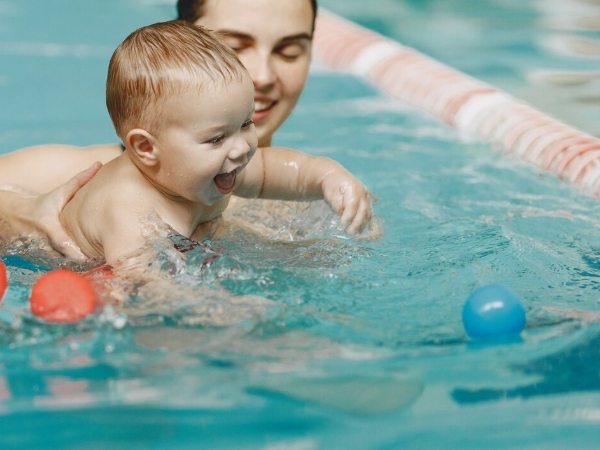
Most parents don’t give water safety much thought for the first time during a swim lesson. It usually occurs after something minor and frightening occurs, such as a toddler straying toward a garden pond, a brief moment of distraction at a hotel pool, or a bath that lasts a few seconds too long without anyone watching. The difference between “fine” and “not fine” is smaller than most people realize, which contributes to the fact that drowning is still one of the most common unintentional causes of death for children under five.
The notion that drowning appears dramatic is one type of myth that water safety professionals are constantly working to debunk. Splashing, shouting, an obvious struggle. In actuality, it’s frequently silent. In a matter of seconds, a child can slip under without causing the kind of disturbance a parent might anticipate seeing from a few feet away at a busy pool or across a yard. When you sit with that fact, it becomes unsettling.
A gradual change in the way the industry discusses safety is reflected in Swim England’s approach, which is based on staged competency rather than a single pass-or-fail lesson. According to their Learn to Swim framework, stages four through seven are when true water competency begins to develop, including the ability to float, tread water, and breathe under pressure. Producing quick swimmers is not the goal. It’s about raising kids who won’t panic in the first ten seconds if they find themselves in deep water.
| Category | Key Information |
|---|---|
| Topic | Toddler Water Safety |
| Leading Cause of Death (Ages 1–4) | Drowning is a leading cause of accidental death in young children worldwide |
| Open Water Risk | Roughly 85% of accidental drownings occur at open water sites, often due to limited awareness of hazards |
| Recommended Swim Competency Stages | Swim England’s Learn to Swim Programme outlines water competency outcomes from Stage 4 onward |
| Supervision Standard | Constant, undistracted adult supervision within arm’s reach is advised for children under five |
| Educational Resource | Red Cross Swim, sponsored by The ZAC Foundation, offers free water safety videos and activities for families |
| Key Skill Benchmarks | Includes performing a star float and treading water, per minimum competency guidance |
The numbers become more difficult to ignore when there is an additional layer added by open water. Roughly 85% of unintentional drownings occur at open water locations, such as rivers, lakes, or the sea, as opposed to supervised pools, according to the Royal Life Saving Society. This also involves cold water shock, which pools are unable to replicate. Open water isn’t as forgiving as a pool. There is no sudden drop in temperature that causes the lungs to gasp, nor is there any current pulling underfoot. Although it’s easy to assume that someone who can swim well will always be safe, this isn’t always the case when unpredictable water comes into play.
This reality has begun to be reflected in educational tools, some of which are surprisingly entertaining. According to reports, students at a lead inclusion school specifically selected Oscar the Otter, who was created through a UK inclusion initiative, because he felt more approachable than instructive. That decision is genuinely wise because kids quickly become disinterested in lectures, but they won’t object if a cartoon otter repeats a safety code. It appears that the purpose of pairing the video with lesson plans and activity sheets is to ensure that the message is retained outside of the classroom as well.
A similar approach is used in the US by Red Cross Swim and its WHALE Tales series, which features a character named Longfellow and features age-banded content for younger and older children as well as rhyming phrases and brief videos. It is difficult to gauge whether a five-year-old actually remembers “reach or throw, don’t go” in a real emergency. In this case, repetition appears to be more important than complexity, and these programs are obviously betting on that.
Adult supervision discipline is more difficult to teach and possibly more crucial. The more unsettling reality is that a disproportionate number of incidents are caused by supervision lapses, such as checking a phone or entering for “just a minute”. The majority of water safety materials assume that children are the ones being taught. Lesson plans narrated by otters won’t solve that. It necessitates a level of alertness that is exhausting to sustain, particularly in the presence of seemingly calm water.
The purpose of minimum competency benchmarks, such as treading water for a predetermined amount of time or performing a star float for sixty seconds, is to provide parents with something tangible to compare their child’s performance to rather than a vague assurance that the child “can swim a bit”. It makes sense as an instinct. Confusion between competence and confidence in the water can lead to some of the riskiest decisions, such as allowing a child to swim a little farther out, a little longer, or with less supervision than they are truly prepared for.
No one pretends that any of this completely removes risk. Treating water safety less like a single lesson and more like a continuous habit that is reviewed every summer, reinforced by repetition, and supported by actual supervision rather than just good intentions seems to help.
i) https://www.advancedpediatricassociates.com/safety/a-parents-guide-to-water-safety
ii) https://www.penguinpediatrics.com/safety/a-parents-guide-to-water-safety
iii) https://video.swimming.org/water-safety/videos/water-safety-education-for-children-2
iv) https://www.redcross.org/get-help/how-to-prepare-for-emergencies/types-of-emergencies/water-safety/water-safety-for-kids.html
v) https://frimley-healthiertogether.nhs.uk/parentscarers/keeping-your-child-safe/being-safe-around-water