

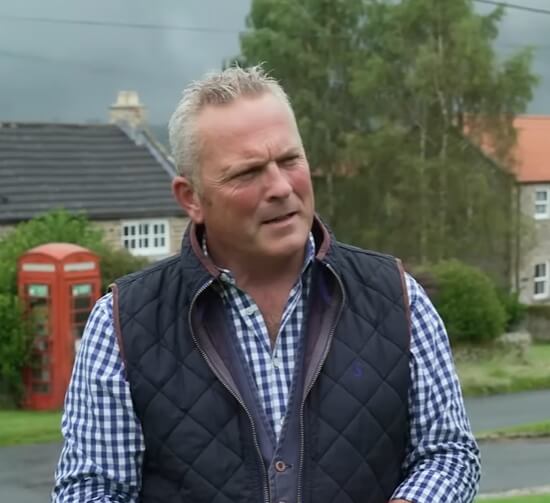
For more than 20 years, Jules Hudson has been a mainstay of British daytime television. He leads couples through windswept farmhouses and converted barns with a certain kind of serene authority that gives you the fleeting impression that rural life might be possible. He is known to the majority of viewers as the trustworthy face of “Escape to the Country” because he is calm, collected, and quietly intelligent. They might be unaware that beneath that calm exterior, Hudson has had to deal with serious and unsettling concerns regarding his own health.
To be clear, Hudson has not turned illness into a defining public narrative. He’s not the kind of presenter who makes a press tour out of a diagnosis. That self-control is telling in its own right. When British TV celebrities do decide to talk about health, which many eventually do, particularly as they approach their forties and fifties, it usually appears in bits and pieces an interview here, an open moment on a podcast there. The image is similar with Hudson. Whatever he has dealt with in private, it seems like he has done so mostly on his own terms.
| Category | Details |
|---|---|
| Full Name | Jules Hudson |
| Date of Birth | 9 September 1970 |
| Nationality | British |
| Profession | Television Presenter, Writer, Naturalist |
| Known For | Escape to the Country (BBC One), wildlife and countryside programming |
| Education | University of Bristol (Zoology) |
| Other Work | Rural affairs contributor, conservation advocate |
What is known to the public revolves around a period of physical difficulty that Hudson has discussed in interviews, characterizing the kind of weariness and disruption that doesn’t fit neatly into a working presenter’s schedule. It is easy to underestimate the physical demands of a job that requires a lot of travel throughout rural Britain, including early starts, cold locations, and long days spent filming in fields and on cliff faces. On screen, the countryside appears serene. Seldom is the production.
Because of his training as a zoologist at the University of Bristol, Hudson has always had a slightly different relationship with nature and the body than the typical television host. He is knowledgeable about biological systems. He has previously discussed the value of living outside and engaging physically with the natural world in a way that goes beyond the typical presenter rhetoric. Therefore, someone with that kind of grounding is likely to react differently when health becomes a personal issue rather than a professional talking point.
Here, a more comprehensive context is worth keeping in mind. In recent years, several male British presenters of Hudson’s generation have experienced serious health issues, some of which have been widely reported and others of which have not. For example, in 2024, Jeremy Clarkson had heart surgery after medical professionals found blocked arteries. His audience was genuinely shaken by this terrifying experience, which also seemed to cause him to reevaluate his relationship with his body. Fans of other presenters often ask similar questions about the people they frequently watch as a result of these moments. It’s possible that the public’s renewed interest in Hudson’s health stems in part from that particular atmosphere of worry.
Fans of “Escape to the Country” frequently comment on how the presenter seems, if anything, more grounded these days. Grounded, not diminished. His interactions with contributors on screen have a stillness that seems earned rather than staged. It’s difficult to tell from the outside whether that’s the inevitable result of experience or if it represents something more intimate that he has resolved. Most likely both.
Based on what Hudson has publicly disclosed, it is still unclear if he is treating a chronic illness or if a particular episode has since ended. He hasn’t provided any thorough confirmation of a formal diagnosis. Although it’s totally his choice, viewers who are genuinely worried find that ambiguity frustrating. Presenters are not required to become case studies just because they frequently appear on television.
What is evident is that Hudson takes his physical health seriously, just as those who spend a lot of time in nature frequently do with a pragmatism that avoids either catastrophizing or denial. It would be consistent with everything he has said in public that he relies on the healing properties of the British countryside when things get tough for him personally. He has spoken warmly about these qualities.
For the time being, he keeps filming, giving presentations, and appearing in a way that gives the impression that the Yorkshire Dales’ stone walls or Devon’s undulating hills are somehow accessible. By itself, that continuity conveys something. It’s difficult to ignore the fact that some of the most interesting characters on British television are those who, despite their personal struggles, continue to appear.
i) https://www.bbc.co.uk/news/articles/c206z9qw533o
ii) https://www.walesonline.co.uk/lifestyle/showbiz/kaleb-coopers-cheeky-jab-jeremy-34122484
iii) https://www.walesonline.co.uk/lifestyle/tv/jeremy-clarkson-issues-apology-clarksons-34071533
iv) https://www.mirror.co.uk/tv/tv-news/jeremy-clarkson-issues-apology-fans-37252124
v) https://www.taxicoventry.com/west-midlands-villages/dilwyn-taxis/taxi-to-car-showrooms