

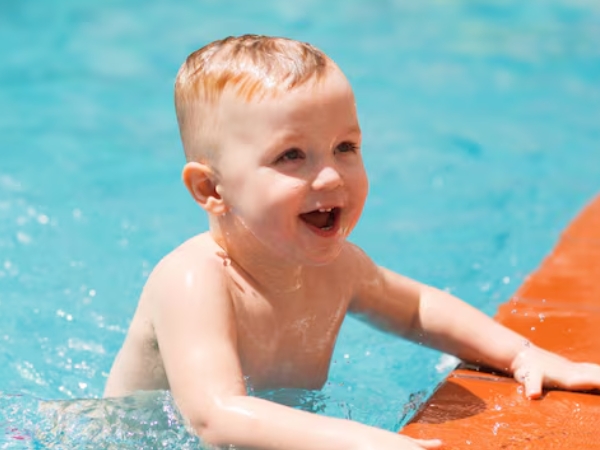
Parents who have given this too much thought worry about a certain type of silence: the silence of a child who has submerged without making a splash. It doesn’t resemble the movies. No one is screaming for assistance or flailing. A toddler can drown in less than a minute by slipping beneath an inch or two of water, frequently within arm’s reach of an adult who just turned away to answer the phone.
More than any statistic, that picture appears to be the catalyst for a subtle but discernible change in the way UK families view water this year. As soon as playtime ends, paddling pools are emptied. Bath seats, which were once thought of as a convenience that freed up a parent’s hands, are becoming more and more suspicious. It’s difficult to ignore how differently parents discuss this now than they did even five years ago; they are less informal, more precise, and practically premeditated in their caution.
| Category | Detail |
|---|---|
| Age group most at risk | Children under 5, with under-fives accounting for a disproportionate share of accidental drownings recorded annually |
| Most common location | Baths, paddling pools and garden ponds — not open water, according to RoSPA’s home safety guidance |
| UK-wide fatalities (2025) | 202 accidental water-related deaths recorded by the National Water Safety Forum |
| Recommended supervision | Arm’s-reach, undistracted, at all times — guidance reinforced by the RNLI’s water safety advice |
| Key survival technique | Float to Live, taught by the RNLI |
| Curriculum change | Water safety education enters secondary RSHE lessons from September 2026, per government policy |
| Local incident mapping | Over 1,500 water incidents since 2020 logged on the London Fire Brigade’s interactive water safety map |
The public’s discussion of drowning still mostly focuses on older kids and open water, such as rivers, reservoirs, and the ocean. Teenagers and adults who are capable of making decisions in the middle of a crisis were the target audience for the RNLI’s Float to Live campaign, which is centered around leaning back, controlling breathing, and waiting out the first shock of cold water. Toddlers are incapable of doing that. A child who has not yet learned to swim a stroke cannot benefit from any floating technique. The entire plan must be implemented before the water, not in it, for children under five.
This is changing the way that organizations like the NHS and RoSPA formulate their guidelines. The real culprit is frequently identified as distraction rather than carelessness: a parent entering the room to get a towel, checking on a sibling, or taking a quick look at a message. If you’ve ever skipped a bath for what seemed like nothing at all, you may find it uncomfortable to hear that drowning experts sometimes refer to it as a problem of seconds rather than minutes.
Because garden ponds are so simple to overlook, they pose a peculiar risk of their own. To an adult, a pond appears decorative, almost drowsy, rather than menacing. It’s just an edge that a toddler learning to walk hasn’t yet learned to appreciate. Rather than rivers or lakes, garden water features are involved in a number of the incidents that are discreetly recorded on local authority safety pages every year. This tells its own tale about where the true danger has been concealed.
Campaigners believe that the public’s awareness of the true threat has lagged. Teenagers jumping into reservoirs are frequently the subject of coverage during heatwaves, and with good reason those deaths are actual and terrible. The toddler cases seldom make the news, maybe because they take place in places that are inherently safe, like homes and gardens. This invisibility may have subtly slowed the reaction.
The language used with very young children themselves appears to be evolving at the moment. A growing number of nurseries and health visitors are incorporating brief discussions about water safety into their daily routines. These are not lectures, but rather brief, repeated cues about staying close, asking before entering water, and realizing that baths and pools aren’t playgrounds without an adult present. Since toddlers forget instructions just as quickly as they learn them, it’s really unclear if this will stick at such a young age. Experts seem to think that over time, repetition even imperfect repetition creates something that resembles instinct.
Although the larger curriculum change water safety will officially be taught in secondary RSHE classes starting in September 2026 is intended for older students, advocates hope that it will also encourage earlier discussions and bring the subject down to nursery and primary schools, where the actual toddler risk lives.
It’s not panic that sticks out when you watch this happen. It’s a sort of recalibration, where parents reluctantly exchange their casual confidence around the water for something more akin to vigilance. On a warm afternoon, nobody wants to linger nervously over a paddling pool. That’s precisely what they’re doing more and more, and few of them appear to be willing to apologize for it.
i) https://www.netmums.com/child/every-parent-should-watch-this-life-saving-water-safety-video-with-their-child-before-going-on-holidays
ii) https://www.hampshirescp.org.uk/water-safety-important-reminder-for-professionals-supporting-families/
iii) https://www.eyalliance.org.uk/news-events/news/new-campaign-launched-to-keep-young-children-safe-around-water/
iv) https://www.london-fire.gov.uk/news/2026-news/june/london-firefighters-warn-parents-and-young-people-about-water-safety-as-part-of-drowning-prevention-week/
v) https://hansard.parliament.uk/commons/2026-06-09/debates/080F7C45-BF19-49B3-9BD4-F4C1DF6C56DA/WaterSafety