

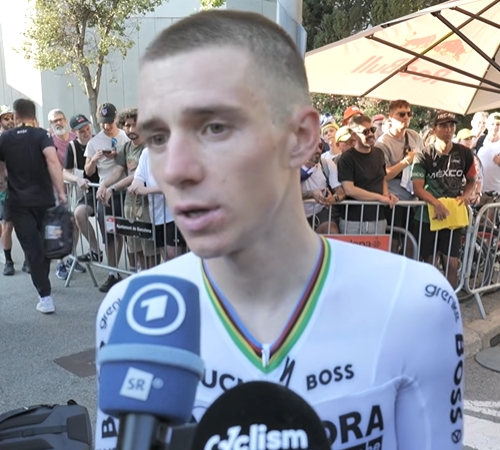
In the days leading up to the Tour de France, cyclists are subjected to a unique kind of attention that includes cameras following your jaw line, reporters calculating your power-to-weight ratio in their heads, and an entire sport silently determining whether or not you look ready.
When Remco Evenepoel showed up to the official race presentation last Thursday, he looked ready. Only a rider who has put in the effort tends to be lean, calm, and confident. The obvious question was posed by someone. How many kilos? “Almost four”, he said, and the room nodded approvingly.
Evenepoel’s Remco Evenepoel weight loss ahead of the 2026 Tour de France has been framed, almost universally, as a performance story. That’s probably right, as far as it goes the Belgian, now riding for Red Bull-Bora-Hansgrohe under a new coaching structure, has spent the months between Liège-Bastogne-Liège and the Tour’s opening stage.
Doing something relatively unusual for him no racing at all, just training. No Critérium du Dauphiné, no national championships, just long focused blocks of work with new coach Tim Heemskerk, previously at Visma-Lease a Bike. The weight decreased Apparently, the watts didn’t.
The final section is important. Evenepoel took care to contextualize the numbers in a separate interview with Belgian media prior to the presentation. “We tackled the weight loss in a smart way”, he stated. “My weight has dropped, but the power has remained”.
It’s the kind of sentence that distinguishes between something more alarming and a deliberate physiological adjustment. Additionally, it appears to be purposefully organized around aerodynamic marginal gains, fueling strategy, and a coaching relationship that he describes with a degree of enthusiasm. Evenepoel described Heemskerk as “a new type of person that I’m working with”. “I try to be as open as possible with him”.
But beneath all of this positive press coverage, there is a stark contrast that is difficult to ignore. Pauline Ferrand-Prevot, one of cycling’s most renowned athletes, won the women’s Tour de France one year ago. She won one of the biggest races in the sport, and her strategy and power weren’t the main topics of discussion.
It had to do with her weight. In private, teammates hoped she wouldn’t prevail. Critical remarks were made in public by other riders. A formal statement regarding the disproportionate scrutiny of women’s bodies in sports was released by the Cyclists Alliance. After a victory that should have required no defense at all, Ferrand-Prevot had to defend herself in press conferences.
All of that doesn’t obscure Evenepoel’s own goals for the race. In addition to winning the stage, he hopes to win the yellow jersey from the first team time trial and place highly in the third-week time trial. “I am someone who aims for the top”, he told reporters, with a directness that’s always been part of his character.
Whether the revised preparation, the new coach, and the leaner racing weight will translate into a general classification result remains genuinely uncertain. Pogačar is Pogačar. Vingegaard has just come off a Giro victory and arrives already race-hardened in a way Evenepoel, deliberately rested, will not be.
What does seem likely is that Evenepoel arrives at this Tour believing, more than at any previous edition, that the physical preparation has been done correctly. He spoke at length about fuelling strategy as the defining performance innovation of the last five years the high carbohydrate intake, the careful management of energy through a stage and there’s a sense that he views the weight loss as part of that same ecosystem.
It’s a physiological variable that he and his team have deliberately changed, not a stand-alone vanity project. Even though the number four kilos sounds exactly the same as a story that happened in a completely different way twelve months ago, that is still a significant distinction.
There has always been a close relationship between performance and injury in the sport of cycling. Regardless of who is in front of the press conference microphone, that discussion should be taken seriously and consistently.