

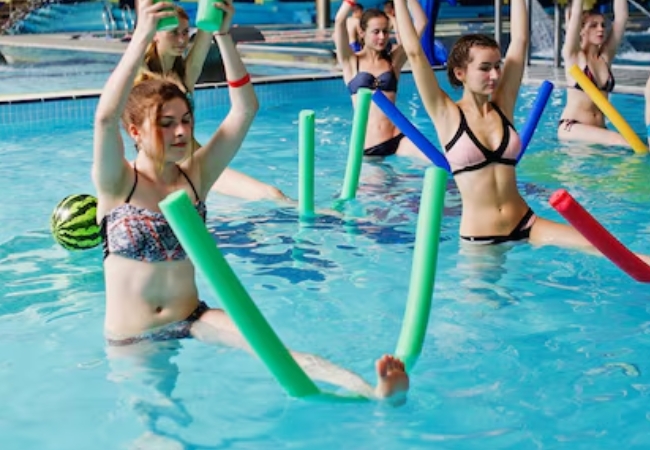
There’s a certain kind of shame that comes with being a fully grown adult trying to propel a rubber duck across a swimming pool using only your forehead. And yet strangely it’s exactly the kind of craziness that makes a summer afternoon feel actually worth remembering. Games in the pool aren’t limited to children playing in the shallow end. In reality, they were never.
At some point, the majority of adults quietly ceased competing in the water. A beer in hand, a lounger in the shade, maybe the occasional float downstream that became the standard. It’s pleasant enough. There’s a somewhat muted quality about it, and it’s difficult to ignore how quickly the vibe changes when someone recommends a real game. People stand up straighter. Alliances are formed. A person who was half asleep two minutes ago is now outlining the objective superiority of their belly flop technique.
Noodle jousting might be the purest manifestation of this dynamic. Armed with foam noodles, two players climb atop pool floaties in the middle of the water and try to knock each other off. It sounds childish. It is immature. When two people who are quite competitive square off, it becomes something completely different very strategic, strangely tense, and sometimes brilliant. Rarely is the stronger player the winner. Usually, it’s whoever discovers equilibrium first.
The reasoning for pool basketball and water volleyball is similar. The games themselves are familiar, but everything is altered by the water: footing vanishes, motions slow down, and seemingly simple shots become difficult. On dry land, teams that don’t talk much are compelled to begin. These games have a social component, which is likely why they have endured for so long in backyards and vacation spots without the need for reinventions.
Almost no equipment is needed for some of the better pool games. The game Whirlpool, in which players circle the pool’s edge to create a current and then attempt to walk against it when the direction reverses, sounds easy enough to be almost too easy. It isn’t. It’s actually hard to battle the physics of flowing water, and it’s always entertaining to watch a bunch of people struggle against a current they made themselves. Who gives up first, who starts laughing, and who is already planning to attempt the opposite direction are the kinds of games that swiftly reveal personality.
Most people think they’ve outgrown Marco Polo because it’s so old. Most likely, they haven’t. The mechanics one blindfolded person screaming out, others yelling back, everyone attempting to avoid being caught remain sufficiently distracting for grownups who would typically be able to ignore such basic games. It’s likely that the reason it continues throughout generations is that being lost in water stimulates something really primordial, and no amount of self-consciousness entirely overrides it.
For parties ready to commit to something more complicated, synchronized swimming contests offer an unexpected amount of fun. Contestants plan acts to music, waterproof props and costumes seemingly welcome, pool lighting adding something almost dramatic to the whole thing. Although in reality, people frequently take it considerably more seriously than they intended, it works best when nobody takes it too seriously. That tension between irony and actual effort is usually where the best summer moments come from anyway.
The one thing all of these activities share is that they force players to stop regulating how they look and just participate. That’s harder for adults than it seems. But a pool makes it easier the water already removes the normal pretensions. Usually, what’s left is more enjoyable than the lounger ever was.
i) https://bigblueswimschool.com/blog/fun-and-safe-pool-games/
ii) https://www.justswim.com.sg/swimming-pool-games-adults/
iii) https://www.scouts.org.uk/news/2023/july/10-exciting-water-activities-for-in-the-swimming-pool/
iv) https://www.universalservicesuk.co.uk/poolside/pool-games
v) https://www.lathampool.com/blog/enjoy/6-fun-swimming-pool-games-for-adults/