

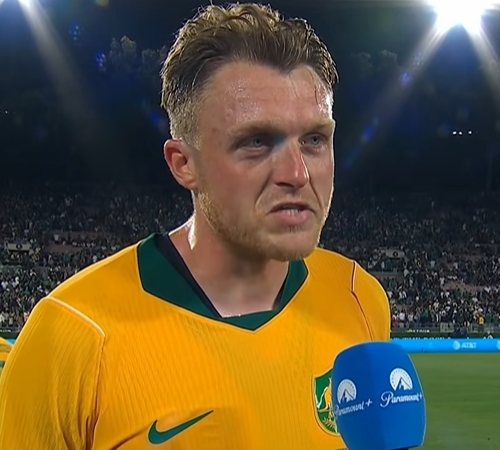
Standing at 1.98 metres 6 feet 6 inches Harry Souttar is the kind of footballer who changes the geometry of a penalty box just by walking into it. There’s something almost disorienting about watching him play, the way opposing strikers seem to do a double take when he steps across to cut off a cross.
It isn’t just the height, though that’s obviously the first thing anyone notices. It’s the way he uses it unhurried, deliberate, like someone who understood very early that the frame he was born into was a gift he’d have to learn to earn.
Souttar was born in Aberdeen, Scotland, on 22 October 1998, and grew up in the small Angus village of Luthermuir. It’s easy to picture a kid that size standing out immediately, even before he understood what football could mean for him.
He came through the youth system at Dundee United, signed his first professional contract at 17, and made his senior debut in the Scottish Premiership.
By the time Stoke City came calling paying a reported £200,000 to bring him south of the border in 2016 it was already clear that whatever was happening with this teenager, physically and technically, was worth paying attention to.
What makes Souttar’s height notable beyond the obvious is its rarity in the specific position he plays. Centre-backs that tall tend to carry a quiet asterisk: you expect aerial dominance, a commanding presence at set pieces, and perhaps some compensating slowness in other departments. Souttar has mostly refused that trade-off.
He reads the game well, distributes with more confidence than his size might suggest, and has developed into something closer to a complete defender than a one-dimensional physical presence.
It’s still unclear whether he’ll ever fully outrun the injury disruptions that have complicated his career a serious ACL injury in November 2021, then a ruptured Achilles during a loan spell at Sheffield United in late 2024 but when fit, the arguments in his favour pile up quickly.
The Wikipedia record is precise: at 2.00 metres in some listed versions of his stats, he is the tallest outfield player in the history of the senior Australian national team. Only goalkeeper Zeljko Kalac, at 2.02 metres, edges him out in the country’s all-time tallest list.
For a player who spent his early career representing Scotland at youth level before switching allegiance to Australia in 2019, that particular distinction carries some symbolic weight.
He didn’t grow up dreaming of the Socceroos his mother’s roots in Western Australia were the eligibility link but by the time of the 2022 FIFA World Cup in Qatar, he had become one of their most praised performers, earning recognition for defensive displays that looked steadier and more assured than most expected.
There’s a sense that 2026 was supposed to be Souttar’s tournament in a way that Qatar never quite got to be. He was named captain. He led the Socceroos into a World Cup on home soil, in North America.
And then came the penalty shootout against Egypt, the ball ballooning over the crossbar, and the quiet devastation of watching a campaign end in the most specific kind of heartbreak that football produces.
It’s hard not to notice how much he was carrying in that moment not just the armband but the weight of being the one who stepped up first, who set the tone and missed. He was 27 years old, and it showed in how he held himself afterwards.
At Leicester City, where he joined on a five-and-a-half-year deal in January 2023 for a reported £15 million, his trajectory has been interrupted more than the club or player would have liked. Injuries have taken genuine bites out of his momentum. Still, the physical reality of what he is has never really been in question.
One post circulating among football fans put it simply: “6ft 6. Australia’s rock at the back who makes grown adults look like children”. That’s probably not wrong. And it’s probably not the whole story either.
Harry Souttar’s height is the most immediately visible thing about him. His career, though, is increasingly about what sits underneath it.